
Sitting through entire workdays left me with shoulders that couldn’t press overhead without compensation, hips that wouldn’t hinge, and a thoracic spine locked in forward flexion — and I was only in my late twenties. That physical wake-up call revealed something crucial: the damage that desk work inflicts accumulates silently, reshaping your posture and movement capacity without you even noticing. What I discovered after addressing my own restrictions and helping countless others work through theirs is this: you don’t need to overhaul your entire training schedule or carve out massive chunks of time to start undoing what prolonged sitting does to your structure. Ten minutes daily of targeted mobility work is sufficient to begin reversing the postural and movement patterns that your chair has been reinforcing — and this guide walks you through the exact sequence.
Why Sitting Is Wrecking Your Body (And What Mobility Actually Does)
The reality is stark: your skeleton didn’t evolve to remain stationary in a seated position for eight to ten hours per rotation. Spending your day in a chair puts your hip flexors — the muscle group bridging your hips and spine — into a persistently contracted state. This chronic shortening gradually tightens them and begins exerting tension on your lumbar spine, which explains why so many office-bound professionals experience lower back discomfort. Simultaneously, your glutes enter a dormant state and lose their capacity to activate properly (the fitness field refers to this condition as gluteal amnesia, and it’s not a metaphor), your thoracic spine — located in your mid-back — surrenders its rotational capacity, and your anterior chest becomes rigid while posterior shoulder musculature weakens.
Mobility training fills this gap. Mobility differs fundamentally from stretching. Stretching involves holding a lengthened position passively, allowing gravity and time to extend the muscle. Mobility requires active engagement — you’re traveling through complete ranges of motion with muscular tension, which teaches your central nervous system to access and control that available range. This active quality is what makes it so potent against the postural deterioration from sitting.
The 10-Minute Daily Mobility Routine for Sitting Damage
Perform this sequence daily — early morning is effective, though immediately following work is genuinely the optimal window since you’re addressing the restrictions you’ve just accumulated. The only equipment required is a mat and enough floor to move around. Progress methodically and deliberately through each movement. Speed is irrelevant here.
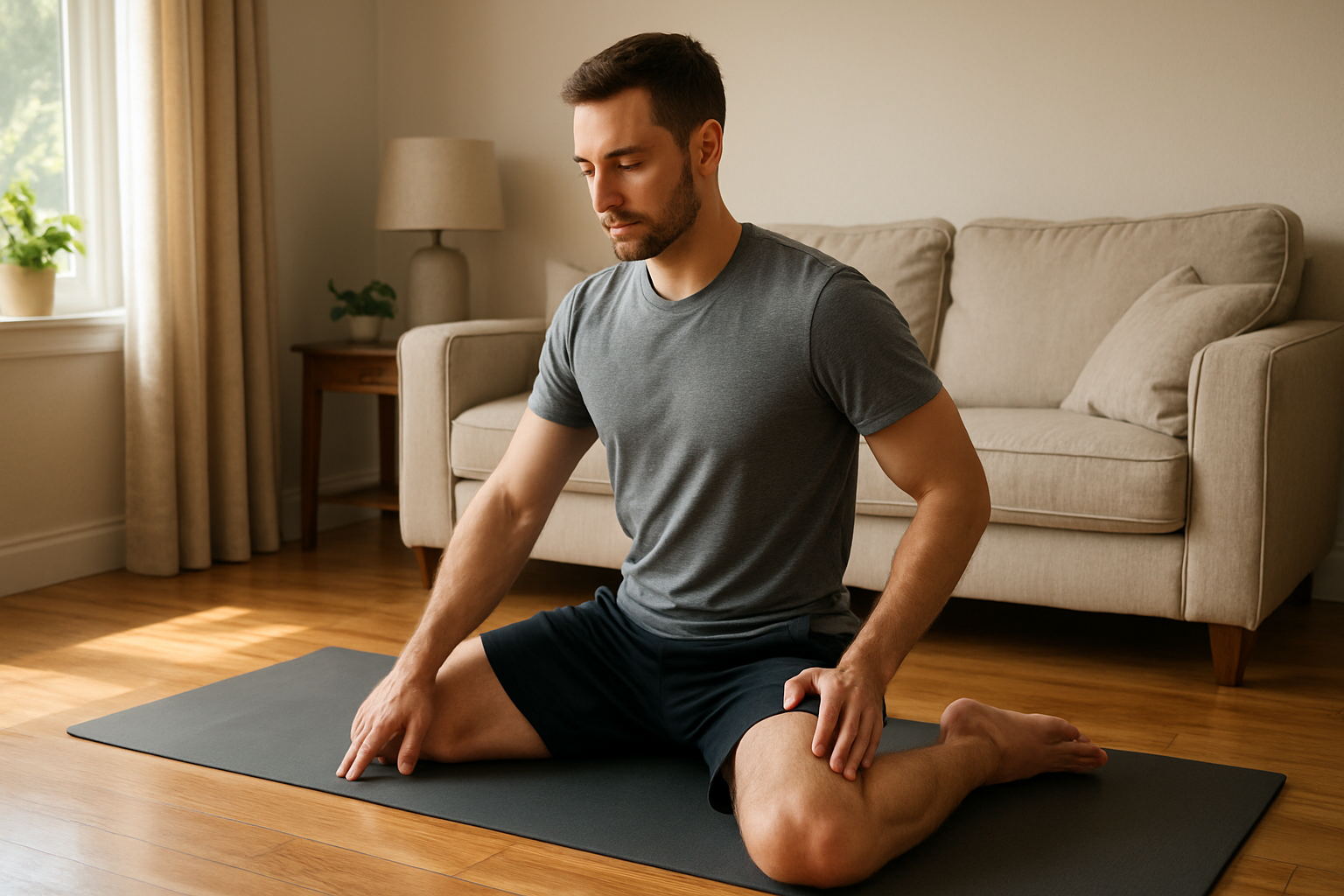
1. 90/90 Hip Stretch — 60 Seconds Per Side
Position yourself on the floor with both legs flexed to ninety degrees — one extended in front of your torso, the other positioned perpendicular. Maintain an upright trunk and fold gently forward over your front leg. Few movements restore hip rotational capacity as effectively, particularly after prolonged sitting has compromised it. Guard against rounding your lumbar spine. Breathe steadily into the sensation.
2. World’s Greatest Stretch — 5 Reps Per Side
Begin in a staggered stance with your right leg forward. Ground your right hand on the floor positioned inside your right foot, then sweep your left arm upward toward your head and open your thoracic cavity. Return to center and repeat the sequence. One movement accomplishes multiple simultaneous objectives — your hip flexors, thoracic mobility, posterior chain, and groin all benefit from this single drill. The name reflects its comprehensiveness.
3. Cat-Cow — 10 Reps
Move into a quadruped position on all fours. On the inhale, allow your midsection to descend toward the floor while your gaze travels upward (cow position). On the exhale, arch your spine upward and draw your chin inward (cat position). Execute each repetition with unhurried, conscious breathing. This sequence reintroduces fluid movement to your vertebral column and rehydrates the intervertebral discs that have been compressed under your seated posture.
4. Thoracic Spine Rotation — 10 Reps Per Side
Recline on your side positioning your knees at a ninety-degree angle. Freeze your lower body in place and rotate your upper arm across your body, allowing your mid-back to follow the movement into the opposite side of the space. Pause momentarily at the terminal position of your range. This exercise isolates the stiffness residing in your middle back that produces that classic forward-slumped desk appearance and holds significant importance for neck and shoulder mechanics.
5. Glute Bridge — 15 Reps
Recline supine with your soles planted on the ground spaced at shoulder distance. Press your heels downward and forcefully contract your glutes as you drive your pelvis upward toward the ceiling. Pause and squeeze maximally for a two-second count at full hip extension. This movement reactivates dormant gluteal muscles and counterbalances the anterior hip positioning (hips tilted forward) that develops from sustained sitting.
6. Deep Squat Hold — 60 Seconds
Stand with your feet positioned shoulder-width apart, toes angled slightly outward. Descend into the lowest squat position your body will permit while maintaining contact between your heels and floor. Grip a wall or door frame for balance if required. This posture unlocks ankle dorsiflexion, liberates restricted hip extensors, and opens your spinal canal at the base of your spine. Most industrialized populations have sacrificed access to this fundamental human position. Reclaim it.
The Foam Roller Set That Transformed How I Actually Maintain Mobility Between Sessions
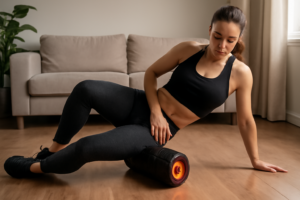
A standard mat addresses only part of the challenge when you’re trying to reverse years of sitting-induced tissue restrictions — you require implements that penetrate the deeper fascial adhesions and muscular knots that desk posture creates. A comprehensive foam roller kit becomes essential equipment for anyone committed to meaningful mobility gains.
What works
- The muscle roller stick reaches into latissimus and shoulder musculature without requiring a partner or contorted positioning — my shoulder pressing mechanics noticeably improve after just a few consecutive applications.
- The massage balls navigate into hip flexor tension zones that larger rollers cannot access, which becomes critical when reversing the anterior pelvic positioning that accumulates from hours at a desk.
- Having all tools contained in one organized kit removes friction from your routine — you remain consistent because everything is already assembled, and consistency is what genuinely transforms your movement patterns, not scattered purchases you ignore.
What doesn’t
- The stretching strap proves too simplistic — within a couple weeks I abandoned it entirely in favor of a basic towel because the strap lacks the angle of mechanical advantage required for substantial work on your posterior chain or upper pec fascia.
- The foam roller itself carries medium firmness, which performs adequately during warm-up phases but lacks sufficient density to address truly entrenched restrictions in your mid-back or lateral thigh band — you’ll rapidly surpass this component if you commit to consistent daily work.
I almost returned it after day four because the roller felt too soft and I thought I’d wasted money, but once I started layering it with the stick and balls in sequence, the whole system clicked into something that actually felt restorative instead of annoying. Grab the Foam Roller Set with Muscle Roller Stick, Massage Balls, and Stretching Strap and treat it as your entry point—you’ll know within two weeks if you need to upgrade pieces.
Frequently Asked Questions
How long does the 10-minute daily mobility routine take?
The routine takes 10 minutes daily and requires only a mat and floor space. It includes six movements: 90/90 hip stretch for 60 seconds per side, world’s greatest stretch for 5 reps per side, cat-cow for 10 reps, thoracic spine rotation for 10 reps per side, glute bridge for 15 reps, and deep squat hold for 60 seconds.
What is the difference between mobility and stretching?
Stretching involves holding a lengthened position passively using gravity and time to extend the muscle. Mobility requires active engagement where you travel through complete ranges of motion with muscular tension, which teaches your central nervous system to access and control that available range.
When is the best time to do this mobility routine?
Early morning is effective, but immediately following work is the optimal window since you’re addressing the restrictions you’ve just accumulated from sitting throughout your workday.
What does prolonged sitting do to your hip flexors?
Spending your day in a chair puts your hip flexors into a persistently contracted state. This chronic shortening gradually tightens them and begins exerting tension on your lumbar spine, which explains why many office-bound professionals experience lower back discomfort.
About This Article

Written by Jordan Ellis. Jordan Ellis isn't a certified personal trainer — just someone who's been genuinely obsessed with training for over eight years and turned it into building smarter home gyms. He focuses on home fitness: effective training spaces, equipment that earns its price, and programs that work in a spare room or basement, not just a commercial gym. More about this site.
Scope and limits. Jordan is not a certified personal trainer, and nothing here is medical advice. Check with a physician before starting a new program, and prioritize form over load on every lift described.
Verify this against a primary source
Specifics change, and your situation may differ from the one described here. These are the authorities worth checking directly:
- Physical Activity Guidelines for Americans (HHS) — the federal physical activity guidelines
- American College of Sports Medicine — exercise prescription and position stands
- NSCA — strength and conditioning research