How Thoracic Spine Mobility Affects Your Overhead Press (And How to Fix It)
By Jordan Ellis
Your overhead press is stuck. Or worse, it hurts.
You’ve done the rotator cuff work. You’ve foam rolled your shoulders. You’ve watched form videos. Nothing changes.
Here’s what most people—and most generic training advice—miss: your shoulder pain or pressing plateau probably isn’t a shoulder problem at all. It’s a thoracic spine problem.
The thoracic spine is the 12 vertebrae in your mid-back, the section that should be naturally curved slightly forward. When this area loses the ability to extend and rotate, your body has to cheat to get your arms overhead. And those compensations create the exact conditions for shoulder pain and weak pressing mechanics.
This post explains why your t-spine matters, how to know if yours is the problem, and the exact drills to fix it.
First: The Self-Assessment (Do This Right Now)
The Wall Test
This takes 60 seconds and tells you everything you need to know.
Stand with your heels, butt, upper back, and the back of your head all touching a wall. Your arms hang at your sides. This is the starting position.
Now slowly raise both arms overhead, as if reaching to touch the wall above your head. Keep your palms facing forward and your arms straight. The goal is to get your hands to touch the wall—or get as close as possible—without moving anything else.
Here’s the key: your lower back must stay flush against the wall. Your ribs must stay down. Don’t arch. Don’t cheat.
What does your result mean?
If your arms reach the wall with everything staying in contact: your thoracic spine extension is fine. Move on to other potential causes of your pressing issues.
If your lower back lifts away from the wall to get your arms up: this is lumbar compensation, and it indicates thoracic restriction. Your t-spine can’t extend, so your lower back is doing the job instead.
If you can’t get your arms all the way up no matter what: severe t-spine restriction, confirmed.
Secondary Assessment: Thoracic Rotation
Sit in a chair with your back tall. Cross your arms over your chest so each hand grabs the opposite shoulder. Now rotate your torso side to side, trying to look over your shoulder as far as possible.
One side will usually feel tighter. Note which side, and note how far you can actually rotate. If rotation is severely limited on both sides, your thoracic spine is stiff in multiple planes.
Why the Thoracic Spine Matters for Overhead Pressing
The Anatomy
The thoracic spine is built for extension and rotation. It’s the most mobile region of the spine in those directions. Your lumbar spine (lower back) is designed for stability and minimal motion. Your cervical spine (neck) is designed for precise, controlled movement.
When the thoracic spine is restricted—when it’s stiff and stuck in a rounded, forward-folded position—the body needs mobility somewhere to press overhead. It can’t just accept “not enough range.” So it cheats.
Compensation Pattern #1: Lower Back Hyperextension
This is the most common pattern. When your t-spine won’t extend, your lower back takes over. You arch excessively at the lumbar spine to achieve overhead arm position. This looks like a dramatic lower back sway, and it creates two immediate problems:
First, you’ve created instability in your pressing base. A strict overhead press requires a stable, rigid core. Hyperextending your lumbar spine puts your disc structures under excessive compressive and shear forces. This is how “I felt something pop in my lower back during overhead pressing” happens.
Second, your bar path becomes inefficient. In a proper overhead press, the bar should travel slightly backward as it moves up, finishing directly over your midfoot. This requires your torso to stay upright and your thoracic spine to extend slightly. If you’re compensating with lower back arch, the bar path becomes a forward lean, you lose stability, and you leak power.
Compensation Pattern #2: Shoulder Impingement
Some people don’t hyperextend the lumbar spine. Instead, their shoulder compensates by going into a compromised position.
Here’s the mechanism: Your shoulder blade (scapula) needs to rotate upward as your arm moves overhead. This upward rotation is essential—it creates space in the shoulder joint and prevents the rotator cuff muscles, especially the supraspinatus, from being compressed between the humeral head and the acromion (the bony roof of the shoulder).
But upward rotation of the scapula requires extension of the thoracic spine. If your t-spine is stuck in kyphosis (excessive rounding), the scapula can’t rotate properly. It stays depressed and internally rotated. The space inside the shoulder joint gets smaller. The supraspinatus gets pinched.
This is why you might feel a sharp, pinching pain right at the top of your shoulder when you press overhead—and why that pain completely resolves when you improve your t-spine mobility. The shoulder wasn’t broken. It just didn’t have the mobility it needed from the segment above it.
The Visual Difference
Stand in front of a mirror. Watch someone with good thoracic mobility press a light weight overhead. Their torso stays upright, their lower back stays neutral, their ribs stay down, their arms move in a straight line overhead.
Now watch someone with restricted t-spine. Their lower back dramatically arches. Their ribs flare forward. They lean backward. Their shoulders might shrug or hitch. That’s compensation. That’s the body fighting for range of motion it doesn’t have.
The Thoracic Spine Mobility Drill Library
These six drills target t-spine extension and rotation, the two planes of motion most critical for overhead pressing. Do them in order before pressing days. Quality over quantity—move slowly and feel the thoracic spine working, not just going through motions.
1. Thoracic Foam Roll Extensions
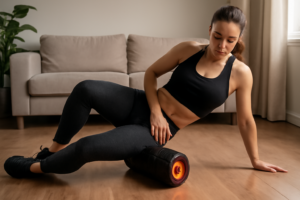
Place a foam roller perpendicular to your spine on the ground. Lie on it so the roller sits across your mid-back, between your shoulder blades. Your knees should be bent with feet on the floor.
You can place your hands behind your head for support, or cross your arms over your chest. Slowly extend your upper back over the roller, letting your head drop back slightly (controlled). Feel the stretch across your chest and the extension through your thoracic spine.
Roll up and down slowly, spending 30-60 seconds on each segment of the t-spine. Work from mid-back to just below the neck. Do 3-5 minutes total.
This is the single most effective tool for t-spine extension mobility. Do it before every pressing session.
2. Thread-the-Needle Rotation
Start on your hands and knees in a quadruped position. Your shoulders are over your wrists, your hips are over your knees.
Take your right arm and thread it under your body, rotating your torso to the right as you slide that arm forward. Go until your right shoulder lightly touches the ground. Your gaze should follow your hand—you’ll be looking to the right.
Pause for a breath, feeling the rotation through your thoracic spine. Come back to center. Repeat for 10 reps, then switch sides and thread the left arm.
Focus on rotating from your mid-back, not your lower back. The movement is slow and controlled.
3. Open Books
Lie on your right side with your hips and knees bent to 90 degrees. Stack your knees. Now place both hands together, palm to palm, directly in front of your chest.
Keeping your lower body completely still and your knees stacked, rotate your torso and open your top (left) arm, bringing it across your body until your left shoulder blade touches the floor. Your chest opens toward the ceiling.
This is a slow, controlled thoracic rotation. Hold for a breath at the end range. Return to the starting position. Do 10 reps, then flip to your left side and repeat with the right arm.
The key is keeping your hips and lower body locked in place. All movement comes from thoracic rotation.
4. Cat-Cow with Thoracic Focus
This is a modified version of the standard yoga pose. Start on your hands and knees, shoulders over wrists, hips over knees.
In the “cow” position, focus on extending your upper back. Think “push your mid-back toward the ceiling” and “drop your chest toward the floor.” This is not a lower back arch—keep your lower back relatively neutral. The extension comes from the thoracic spine.
In the “cat” position, round your mid-back and tuck your chin slightly.
Move slowly between these positions for 10 reps, focusing on articulating each segment of the thoracic spine individually. This drill combines extension and flexion and wakes up mobility through the entire region.
5. Wall Slides
Stand with your back flat against a wall. Your feet are about 6 inches away from the wall. Your entire back should be in contact with the wall—heels, butt, upper back, head.
Raise your arms to 90/90 position: shoulders at 90 degrees of abduction, elbows bent to 90 degrees. Your elbows, wrists, and the back of your hands should all touch the wall.
Now slowly slide your arms up the wall, trying to straighten your elbows as you go. Keep elbows, wrists, and hands in contact with the wall the entire time. Go as high as you comfortably can without your lower back lifting off the wall or your ribs flaring forward.
Lower slowly. Do 2 sets of 10 reps. This is thoracic extension under mild load, which directly transfers to pressing mechanics.
6. Quadruped T-Spine Rotation with Lift
Start on hands and knees. Place your right hand behind your head, elbow pointing out to the right side. Your left hand stays on the ground for support.
Rotate your torso to the right, bringing your right elbow toward the ceiling and opening your chest. You’re rotating from your thoracic spine, not hunching forward or backward. Pause at end range.
Return to center. Do 10 reps on the right, then switch and do 10 reps with your left hand behind your head, rotating left.
This drill combines rotation with a bit of extension and directly mirrors overhead pressing positioning. It’s one of the most specific transfers to actual pressing mechanics.
How to Program These Drills
Timing Matters
Don’t do t-spine mobility as a standalone workout. The mobility improvements from these drills last approximately 30-60 minutes. This window is perfect for taking advantage of improved range during your pressing session.
Do these drills immediately before any session where you’ll be pressing overhead (vertical pressing, push press, bench press, etc.). Spend 5-8 minutes total.
For Mild Restriction
If you have some tightness but passed most of the wall test: spend 5 minutes on thoracic mobility before pressing days. Prioritize the foam roller extensions and wall slides. This will be enough to improve your pressing mechanics immediately and create lasting improvements over 2-3 weeks of consistent work.
For Severe Restriction
If you couldn’t touch the wall, your arms wouldn’t reach, or you have significant pain: commit to daily thoracic work for 4-6 weeks. Spend 5-10 minutes per day. Do the full sequence. This consistent work creates lasting structural change in connective tissue, not just temporary range improvements. After 4-6 weeks, you can transition to pre-training work only.
When It’s NOT the Thoracic Spine
Pass the wall test? Thoracic rotation is good? Mobility work didn’t help your shoulder pain?
Then you likely have a different problem. The most common alternatives:
Rotator Cuff Weakness or Tendinopathy: The rotator cuff muscles (supraspinatus, infraspinatus, teres minor, subscapularis) might be weak or irritated. This requires specific strengthening, not just mobility.
AC Joint Impingement: Pain at the front of the shoulder, especially when arms cross over the midline. This is usually a joint surface issue, not a mobility issue.
Biceps Tendon Involvement: Pain in the front of the shoulder that gets worse with curling motions. Different mechanism, different fix.
If your thoracic spine mobility is good but you still have overhead pain, see a physical therapist who can properly assess which of these is limiting you.
The Bottom Line
Most overhead pressing problems trace back to thoracic spine restriction. Your shoulder isn’t broken—it’s just compensating for limited mobility above it. Fix the t-spine, and the shoulder usually follows.
Do the wall test. Do the drills. Press before training. In 2-4 weeks, you’ll likely notice your overhead press feels stronger, your shoulder feels safer, and your lower back stops complaining.
That’s not coincidence. That’s biomechanics working.
Frequently Asked Questions
How do I know if my thoracic spine is restricting my overhead press?
Stand with your heels, butt, upper back, and head against a wall, then slowly raise both arms overhead keeping your palms forward. If your lower back lifts off the wall to reach, or your arms won’t reach the wall at all, your thoracic spine is restricted and likely affecting your pressing.
When should I do thoracic spine mobility drills before training?
Do these drills immediately before any session where you’ll press overhead. Spend 5-8 minutes total on the full sequence. The mobility improvements last approximately 30-60 minutes, which is the perfect window to take advantage of improved range during your pressing workout.
How long does it take to fix thoracic spine restriction?
For mild restriction, 2-3 weeks of consistent pre-training work usually helps. For severe restriction, commit to daily thoracic work for 4-6 weeks, spending 5-10 minutes per day. After 4-6 weeks, you can transition to pre-training work only.
What should I do if thoracic mobility work doesn’t fix my shoulder pain?
If you pass the wall test and mobility work didn’t help, you likely have a different problem like rotator cuff weakness, AC joint impingement, or biceps tendon involvement. See a physical therapist who can properly assess which issue is limiting you.
About This Article

Written by Jordan Ellis. Jordan Ellis isn't a certified personal trainer — just someone who's been genuinely obsessed with training for over eight years and turned it into building smarter home gyms. He focuses on home fitness: effective training spaces, equipment that earns its price, and programs that work in a spare room or basement, not just a commercial gym. More about this site.
Scope and limits. Jordan is not a certified personal trainer, and nothing here is medical advice. Check with a physician before starting a new program, and prioritize form over load on every lift described.
Verify this against a primary source
Specifics change, and your situation may differ from the one described here. These are the authorities worth checking directly:
- Physical Activity Guidelines for Americans (HHS) — the federal physical activity guidelines
- American College of Sports Medicine — exercise prescription and position stands
- NSCA — strength and conditioning research