
Most people don’t realize they’re conflating two entirely different physical qualities until they’re stuck in one position but mobile in another. During my early twenties, when recreational basketball was my primary training outlet, I discovered this gap the hard way — I could stretch my hamstrings flat on my back, yet I’d still get beaten to the lane because my hips wouldn’t fire explosively out of a low stance. That nagging tightness in my hips persisted week after week, even though I was dedicating ten minutes to pre-game stretching routines. The actual culprit wasn’t inflexibility in the traditional sense; it was a complete absence of mobility. If your body feels chronically locked up despite months of regular stretching work, the distinction between flexibility and mobility — and how they function differently — might be exactly what your training is missing. The terminology often gets used interchangeably, but they represent separate systems, and that difference matters when it comes to how you build capacity, stay injury-free, and move with confidence.
Flexibility vs Mobility Training Difference: Let’s Break It Down
Let’s establish what each term actually means.
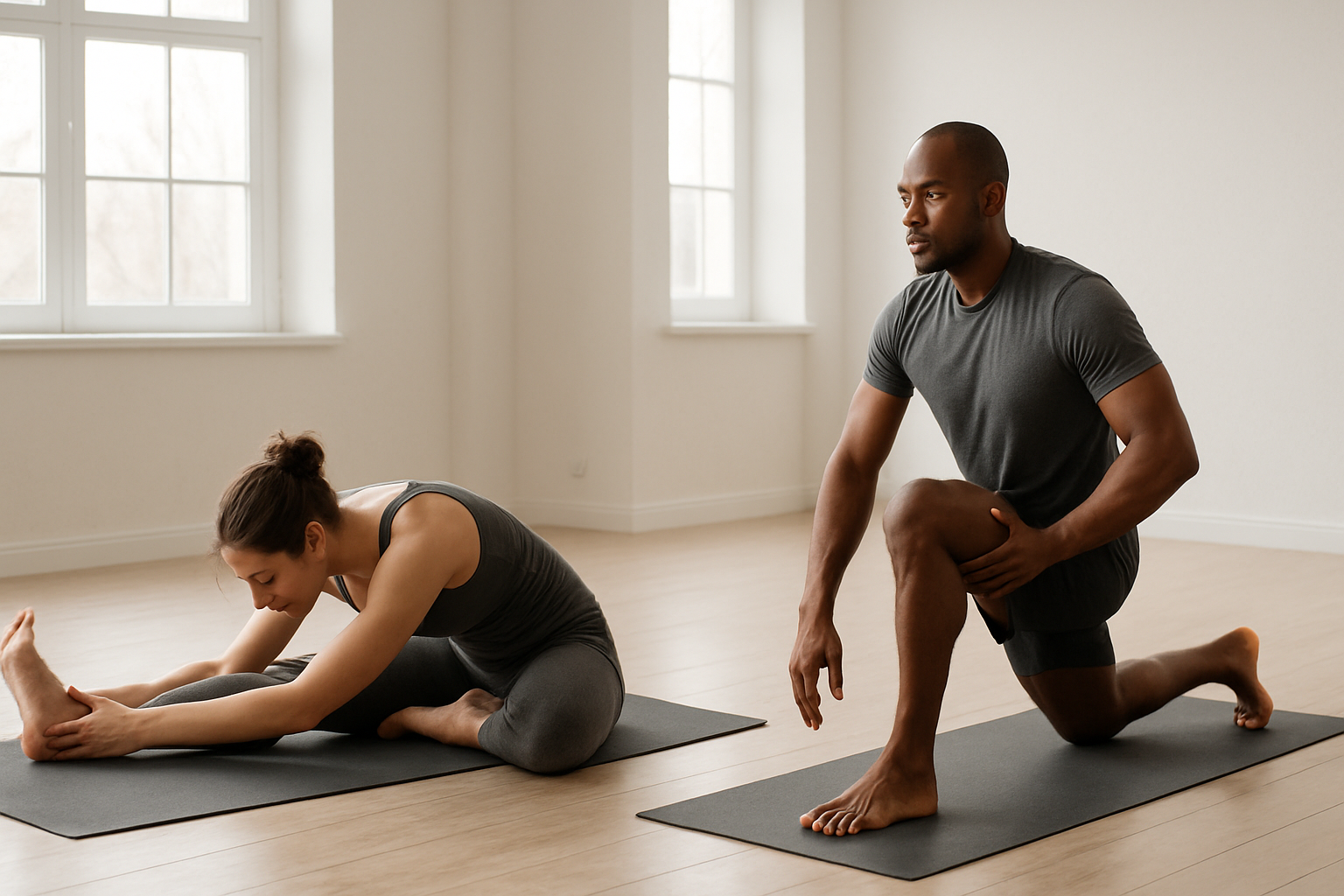
Flexibility is the straightforward capacity of a muscle and its surrounding tissues to elongate without active effort. Picture a muscle being extended by an external load — your body weight, a resistance band, a partner pressing you deeper. When you lie on your back and pull your knee toward your chest, you’re building flexibility. Your tissues are being lengthened, but the work is coming from somewhere outside your muscles.
Mobility describes something different: the ability of your joints to move through their full operational range using your own muscular power and nervous system coordination. It’s not simply whether you can get a joint into a particular position when pushed; it’s whether you can independently move it there, stabilize it, and control it throughout the motion. Mobility shows up in real movement — your deadlift form, your lunge depth, your ability to reach overhead without compensation, bending to pick up a box off the floor.
The critical relationship: flexibility is a prerequisite, but it doesn’t guarantee mobility. A gymnast might demonstrate extreme passive flexibility — someone pushes them into a full split with ease — yet lack the muscular control to perform that split under load during an actual routine, creating injury vulnerability. Flexibility without mobility creates vulnerability; it’s like having expanded reach but no strength to defend it.
Why Most Training Programs Neglect One Entirely (And the Cost)
Conventional fitness programming tends to relegate range-of-motion work to a final checklist item labeled “stretching.” Five or ten minutes of static stretching at the end of your session? Considered sufficient. But treating stretching as a mere appendage means you’re skipping half the equation.
The Journal of Human Kinetics has documented that static stretching alone improves passive flexibility without necessarily creating active joint control. That’s the real explanation for why someone who can fold forward and touch their toes still can’t squat ass-to-grass or execute a proper hip hinge without discomfort. Muscle tissue may be extensible, but your nervous system never learned to command that range independently.
Red flags that your training lacks adequate mobility development include:
- Hip restrictions that prevent reaching full squat depth
- Shoulder limitations in pressing, pulling, or rotational patterns
- Spinal discomfort during lifting or after training sessions
- Good flexibility during isolated stretches but rigidity during actual performance
- Chronic low-grade joint issues that resurface repeatedly
When those patterns emerge, you need to shift how you allocate your movement prep and recovery time.
Building Flexibility and Mobility Into One Coherent Training Framework
The solution doesn’t require doubling your training volume. Strategic sequencing and exercise selection accomplish both goals without adding complexity.
For Flexibility: Static and PNF Approaches
Static stretching — sustaining a lengthened position for 20 to 60 seconds — remains among the most reliable methods for building passive range over time. PNF stretching (Proprioceptive Neuromuscular Facilitation), which involves alternating muscular contraction and relaxation within a stretched position, shows superior results and is standard in rehabilitation contexts. A stretching strap becomes invaluable here because it provides mechanical advantage to access deep ranges on individual muscle groups safely and with progressive overload, eliminating the need for a training partner.
For Mobility: Active Movement Patterns and Controlled Range Work
Mobility development relies on voluntarily moving through ranges of motion under muscular command. Examples include hip circles in different planes, pendulum swings of the legs, rotational work through the upper spine, deep holds in the bottom of a squat with active tension, and controlled articular rotations (CARs). These train your nervous system to own the available range rather than simply achieve it passively. Front-loading these movements into your warm-up — dynamic mobility 5 to 10 minutes before your main workout — preps your body far better than static stretching can accomplish alone.
A typical weekly framework looks like this: dynamic mobility work in every warm-up (5 to 10 minutes), plus dedicated static stretching on off-training days or after sessions (10 to 20 minutes). Progress accumulates through sustained effort across weeks and months — not from occasional longer stretching sessions crammed in after a difficult day.
How a Stretching Strap Bridges the Gap Between Passive and Active Range
For years, I assumed ten minutes of pre-game static stretching would resolve my hip restrictions — spoiler alert, it didn’t. The reality was that reaching genuinely deep positions in my hip flexors and hamstrings was impossible without either sacrificing proper spinal alignment or running out of leverage halfway through the movement. Introducing a stretching strap completely shifted what’s physically possible, delivering the mechanical advantage to hold demanding positions using correct positioning rather than whatever partial form feels tolerable.
What delivers results
- You can work one leg independently without your spine rounding backward or the opposite leg dragging you out of the stretch — the strap absorbs the load so your form stays intact.
- Withstands deep, intense stretching without slipping or rolling; I’ve had to stop because I actually achieved real tension in the target muscle, not due to equipment failure.
- Handles hamstrings, quadriceps, and hip flexor stretches with equal effectiveness, eliminating the need to swap equipment when shifting between muscle groups.
What presents friction
- Demands a learning curve to locate proper hand placement and dial in tension — initial attempts often feel clumsy or fail to target the intended area effectively.
- For individuals with excessive mobility or joint instability, the mechanical advantage creates the ability to exceed safe range boundaries, which requires self-awareness and restraint.
I almost ditched it after the first week because the angle felt wrong on my hamstrings, but I adjusted my foot position and suddenly understood why people say mobility work actually matters. Get the Abiarst Stretching Strap.
Frequently Asked Questions
Can you be flexible but not mobile?
Yes. Flexibility is passive range — your tissues can be lengthened by external force. Mobility is active control through that range using your own muscles and nervous system. You might touch your toes in a stretch but struggle to squat deeply, because your nervous system hasn’t learned to command that range independently during real movement.
How long should I spend on dynamic mobility work daily?
Front-load 5 to 10 minutes of dynamic mobility before your main workout. This includes hip circles, leg swings, rotational work, deep squat holds with tension, and controlled articular rotations. Dynamic work preps your nervous system to own available range far better than static stretching alone.
Is static stretching enough to improve joint mobility?
No. The Journal of Human Kinetics documents that static stretching alone improves passive flexibility without necessarily creating active joint control. You need both: static stretching for tissue length plus active movement patterns so your nervous system learns to command that range independently.
When should I do static stretching in my training week?
Dedicate 10 to 20 minutes on off-training days or after sessions. Progress accumulates through sustained effort across weeks and months, not from occasional longer stretching sessions. Pairing dynamic mobility in warm-ups with static stretching in recovery creates a coherent framework.
About This Article

Written by Jordan Ellis. Jordan Ellis isn't a certified personal trainer — just someone who's been genuinely obsessed with training for over eight years and turned it into building smarter home gyms. He focuses on home fitness: effective training spaces, equipment that earns its price, and programs that work in a spare room or basement, not just a commercial gym. More about this site.
Scope and limits. Jordan is not a certified personal trainer, and nothing here is medical advice. Check with a physician before starting a new program, and prioritize form over load on every lift described.
Verify this against a primary source
Specifics change, and your situation may differ from the one described here. These are the authorities worth checking directly:
- Physical Activity Guidelines for Americans (HHS) — the federal physical activity guidelines
- American College of Sports Medicine — exercise prescription and position stands
- NSCA — strength and conditioning research