My neighbor mentioned over the fence one afternoon that she’d been trying to choose between swimming and walking for her joints, and honestly, it made me sit down and think through my own experience more systematically. A few months back, after three weeks of daily neighborhood walks left my knees sore and my lower back tight, I decided to test what would happen if I spent the next month in a pool instead. The shift was stark — that first time I pushed off underwater and felt the pressure lift from my joints, I realized there was something to this whole buoyancy thing that I hadn’t fully appreciated until I felt it. What started as personal curiosity became a closer look at which movement works better for people in their later years, and the answer turned out to be more nuanced than I’d assumed.
I’m 67. I have mild arthritis in my right knee, a history of lower back stiffness, and the kind of stubborn streak that makes me want to figure things out for myself rather than just take someone’s word for it. So I did two months of intentional exercise tracking: one month walking every single day, one month swimming every single day. I logged sleep quality, energy levels, joint pain, and mood. Here’s what I learned.
| Outcome | Walking | Swimming |
|---|---|---|
| Sleep Quality | Deeper, more restful sleep | Faster onset; quicker to drift off |
| Energy Levels | Sharper early-morning lift | Sharper mental clarity midday |
| Joint Pain | Building strain by week 4 | Dropped almost overnight |
| Mood & Mental Health | Objectively more content | Less favorable than walking |
| Upper Body Engagement | Limited | Works arms, shoulders, core |
| Bone Density Support | Weight-bearing exercise | Does not actively maintain |
| Progress Tracking | 4,000–5,500 steps per session | Difficult; manual lap counting |
What a Month of Daily Walking Actually Did to My Body
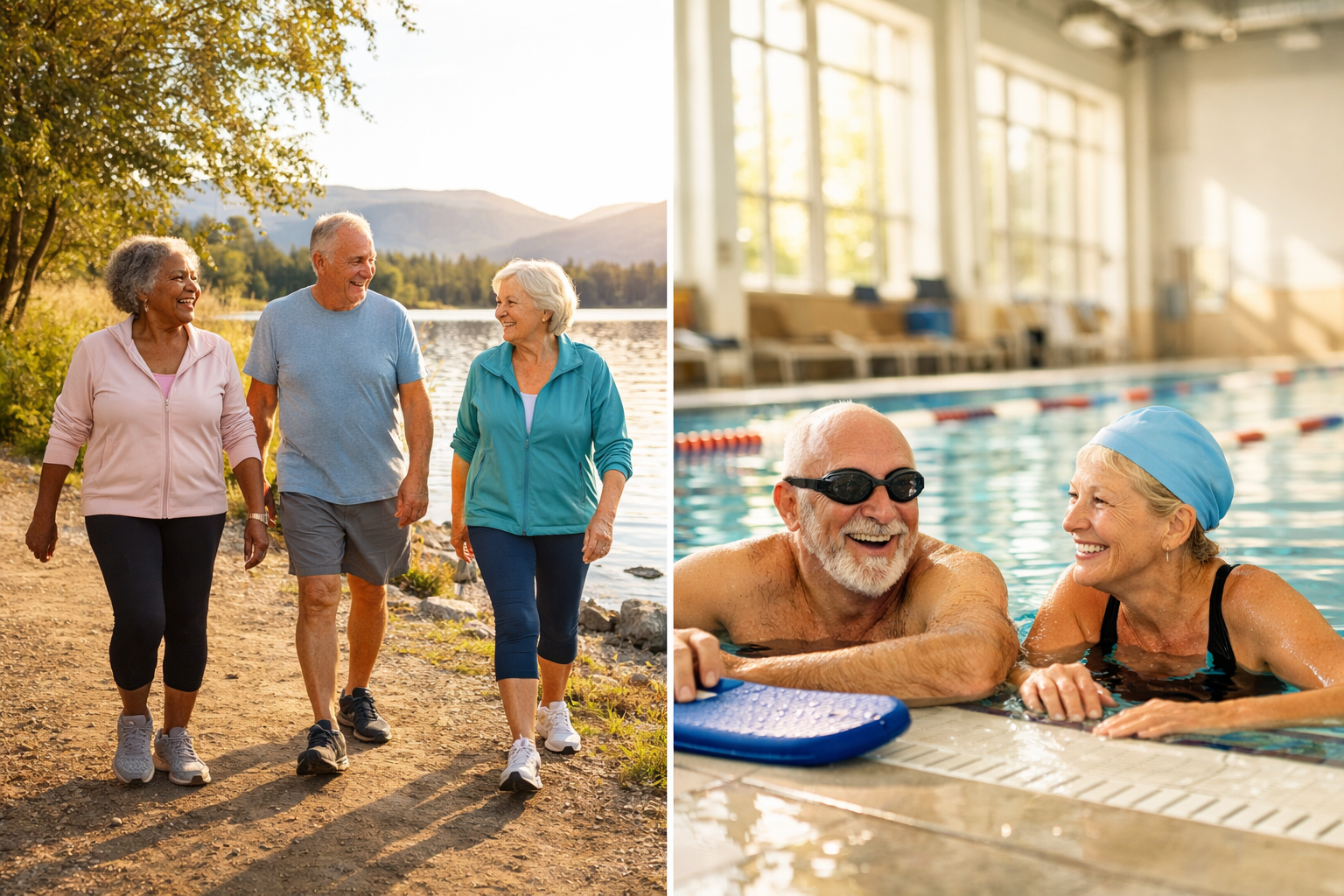
Walking deserves credit — it’s genuinely solid exercise. I’m not going to argue against it here. Every morning for a month I went out for 30 to 45 minutes through the same neighborhood loop, no matter what the weather threw at me, and the positive outcomes showed up right away.
By week two, I was sleeping more soundly. Not longer necessarily, but deeper — I’d wake up feeling like I’d actually rested, which hadn’t been a given for me in years. My mood was noticeably better. There’s something about morning light, fresh air, and moving through the world at a human pace that just works on your brain chemistry. I also started using a Pedometer Watch Senior Friendly No App/Phone Required to track my steps without fussing with a smartphone — it’s waterproof, simple, and showed me I was consistently hitting 4,000 to 5,500 steps on those morning walks. Knowing the numbers motivated me to push a little further each day.
The trouble arrived gradually. Around day 18 or so, my right knee started making its presence known. It wasn’t acute pain, but a persistent low-level complaint. The steady pounding of foot-strike, even on ground that looked smooth enough, compounds over time. My lower back also tightened up noticeably whenever I took routes with rougher pavement. By the end of week four, I’d trimmed my walking paths to stick to the flattest sections I could find and was dedicating the final ten-plus minutes to dedicated stretching work just to keep things functional.
If you’re adding walking to your routine and want to build in some strength support alongside it, I’d suggest pairing it with seated resistance work on your off days. The Relaxgiant 2 Pcs Resistance Band with Handles Chair Exercise Equipment for Seniors is a gentle, accessible way to keep your upper body and legs strong without adding more impact stress. I had a set at home and used them on my rest days.
What a Month of Daily Swimming Revealed
The pivot to water-based training came with its own friction at first — figuring out the pool schedule, managing the changing room, and then the actual question of what to do for 30 to 40 minutes while in the water. I’m no lap swimmer in the graceful sense. My stroke is methodical, unhurried, and probably looks more like determination than athleticism — breaststroke intervals mixed in whenever I needed a break from freestyle.
Then something shifted fast. That knee pain dropped away almost overnight. The water’s support essentially erases roughly 90% of gravitational load pressing down through your joints. For anyone managing arthritis or recovery from joint work, this isn’t just nice — it’s fundamentally different in how it allows your body to function.
Sleep patterns changed too during the swimming phase, though not in the same way as walking had affected them. I’d return home with a comprehensive, whole-body fatigue, and falling asleep came quicker. Walking had deepened my sleep quality; the pool accelerated how fast I could actually drift off. Both deliver real value, just through different mechanisms.
The unexpected downside of swimming? It was harder to track progress in a satisfying way. I eventually picked up the NESKLA 838 3D Pedometer for Walking to keep using on dry land, since you obviously can’t wear most step trackers in the pool. On swim days I tracked laps the old-fashioned way — counting on my fingers and occasionally losing track entirely. Also, pool access isn’t free, and getting there takes time and planning in a way that stepping outside your front door simply doesn’t.

Stacking Them Up: Sleep, Energy, and Joint Pain
Here’s the breakdown of what the two months actually revealed when I looked back at the data.
Sleep Quality
Each month brought sleep improvements over doing nothing structured at all. When joint discomfort was part of the equation, swimming pulled ahead — having less pain radiating through your body at bedtime made it simpler to fall asleep and maintain that sleep through the night.
Energy Levels
Walking delivered a sharper energy lift in the early hours, probably from the mix of outdoor light and the steady rhythm of forward movement. Swimming’s energy payoff showed more in the midday stretch — sharper mental clarity and that absence of the typical afternoon energy crash.
Joint Pain
This was no contest for me — swimming pulled away cleanly. Stiffness and soreness in my knee dropped noticeably during the water-based month. Walking kept discomfort within reasonable bounds but did show a pattern of building strain as each week progressed.
Mood and Mental Health
This outcome caught me off guard — walking took the win. The outdoor landscape constantly changing, the chance interactions with neighbors, the simple fact of being outside under the sky — it all created something that laps in a temperature-controlled facility couldn’t match. I was objectively more content during the walking phase. Not physically stronger or more recovered, but genuinely happier.

Key Factors That Should Shape Your Decision
The reality is that there’s no universal answer — your choice should reflect what’s actually happening with your body and your circumstances. Here’s what I’d recommend thinking through:
- Joint health: If you have significant arthritis, a knee or hip replacement, or chronic joint pain, swimming’s buoyancy makes it the safer starting point.
- Bone density: Walking is a weight-bearing exercise, which means it actively helps maintain bone density in a way that swimming does not. This is a real and meaningful advantage for seniors at risk of osteoporosis.
- Access and consistency: The best exercise is the one you’ll actually do. If a pool requires a 20-minute drive and a membership fee, and walking requires only your front door, consistency often wins out.
- Balance and fall prevention: Walking on varied terrain naturally challenges your balance over time. You can complement either exercise with balance training at home — tools like the Amazon Basics Wood Wobble Balance Trainer Board or the Balance Board Wooden Wobble Board for Adults are excellent for building stability without risk of falls, since you can hold a counter or wall nearby when you start out.
- Upper body engagement: Swimming works your arms, shoulders, and core in ways walking simply doesn’t touch. If upper body strength and cardiovascular conditioning are priorities, swimming pulls ahead.
- Strength supplementing: Whichever exercise you choose, adding some resistance band work helps fill the gaps. The Healthy Seniors Chair Exercise Program with Two Resistance Bands and Printed Exercise Guide is a wonderful all-in-one kit that even includes illustrated instructions — no guesswork required. There’s also the 3 Pcs Resistance Band with Handles Chair Exercise Equipment for Seniors if you want a bit more variety in resistance levels.
For balance training specifically, the Yes4All Professional Rocker Balance Board for Physical at 15.75 inches is another solid option that’s been popular for years — sturdy, affordable, and effective for building ankle stability and core engagement during short daily sessions.

Tracking Walking Volume: Why a Pedometer Watch Fills the Gap
Once you’re splitting time between two different activities, one of them — swimming — leaves no digital footprint. That missing data is exactly where people lose sight of their walking consistency and stop noticing momentum. A pedometer watch bridges that gap, keeping your daily step volume visible without forcing you to carry or charge a phone constantly.
What works
- Display is sized so you can read your step tally on the move without pulling anything out of your pocket or straining your eyes.
- It runs standalone, no applications to manage or notifications clogging up your screen — just straightforward functionality, which is what most people actually prefer instead of juggling another digital tool.
- Wearing it constantly creates accountability for casual movement on non-swimming days, turning everyday activity into trackable data that shows weekly patterns and progress.
What doesn’t
- The power cell needs swapping regularly — roughly every half year if you wear it constantly, which means ongoing costs that add up fast.
- Accuracy takes a hit in certain situations, particularly very leisurely-paced walking or movement with a mobility aid, since the motion algorithm doesn’t interpret shorter, slower strides the same as typical walking rhythm.
I almost ditched this watch after a week when it refused to register the first ten minutes of a slow, warm-up walk—until I realized I needed to let it calibrate a few sessions in. Pedometer Watch Senior Friendly No App/Phone Required
Frequently Asked Questions
Does swimming really reduce joint pain compared to walking?
Swimming pulled ahead cleanly for joint pain in my month-long comparison. The water supports roughly 90% of gravitational load pressing through your joints, so stiffness and soreness in my knee dropped noticeably during the swimming month. Walking kept discomfort within reasonable bounds but showed a pattern of building strain as each week progressed.
How many steps did you average on daily neighborhood walks?
I consistently hit 4,000 to 5,500 steps on morning walks through the same neighborhood loop. Those walks lasted 30 to 45 minutes, and tracking the numbers with a pedometer watch motivated me to push a little further each day.
Which exercise improved your mood more walking or swimming?
Walking took the win for mood and mental health. The outdoor landscape constantly changing, chance interactions with neighbors, and simply being outside under the sky created something that laps in a temperature-controlled facility couldn’t match. I was objectively more content during the walking phase.
What’s the main advantage of swimming for seniors with arthritis?
Swimming is the safer starting point if you have significant arthritis, knee or hip replacement, or chronic joint pain. The water’s buoyancy essentially erases roughly 90% of gravitational load, allowing your body to function fundamentally differently than it does on land.
About This Article

Written by Jordan Ellis. Jordan Ellis isn't a certified personal trainer — just someone who's been genuinely obsessed with training for over eight years and turned it into building smarter home gyms. He focuses on home fitness: effective training spaces, equipment that earns its price, and programs that work in a spare room or basement, not just a commercial gym. More about this site.
Scope and limits. Jordan is not a certified personal trainer, and nothing here is medical advice. Check with a physician before starting a new program, and prioritize form over load on every lift described.
Verify this against a primary source
Specifics change, and your situation may differ from the one described here. These are the authorities worth checking directly:
- Physical Activity Guidelines for Americans (HHS) — the federal physical activity guidelines
- American College of Sports Medicine — exercise prescription and position stands
- NSCA — strength and conditioning research