Chair Yoga Isn’t Your Only Option After 60: Real Strength Training for Seniors
By Jordan Ellis | Home Gym Builder | Published [DATE]
Every article about exercise after 60 reads like it was written for someone in a hospital bed.
Walk. Do chair yoga. Push against a wall. Congratulations, you’re staying active.
If you’re reading this and you’re over 60, you already know how patronizing this sounds. And if you’re a trainer or healthcare provider recommending only these activities to older adults, we need to talk about what the research actually says you’re capable of—and what you’re leaving on the table.
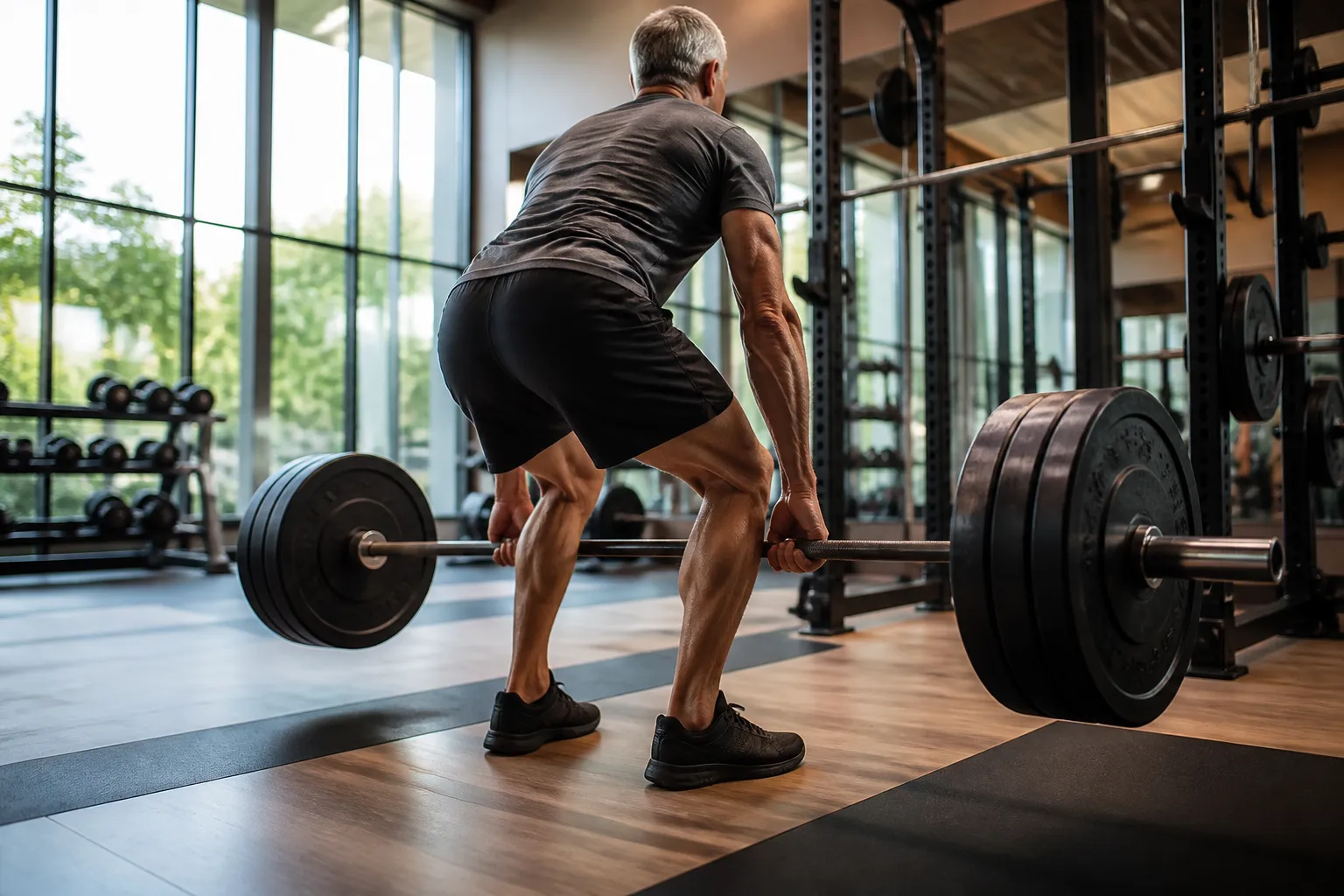
I’m Jordan Ellis, and I’ve spent the last eight years training alongside people over 60. Some of the strongest people I train with are in their 70s and 80s. They squat with barbells. They deadlift. They press overhead. And they’re not exceptional—they’re just willing to do real work instead of settling for the default script.
The gap between what Google’s AI recommends for seniors and what the research supports is enormous. And it’s costing people their independence, bone density, metabolic health, and quality of life.
The Research Google Isn’t Highlighting
Let me start with something that should be mainstream knowledge but apparently isn’t: progressive resistance training for adults over 60 produces better outcomes than low-impact exercise alone.
The most compelling evidence comes from the LIFTMOR trial (Watson et al., 2018), a randomized controlled trial that followed postmenopausal women doing structured resistance training. The women performed compound lifts—deadlifts, squats, overhead presses—over 8 months.
The result? Resistance training increased bone mineral density in the spine and hip more effectively than standard low-impact exercise programs. This is critical, because osteoporosis and bone fragility are among the biggest threats to independence and quality of life after 60. A fall that breaks a hip at 70 is fundamentally different from one at 35.
But LIFTMOR isn’t the only voice here. The 2019 NSCA Position Statement on Resistance Training for Older Adults (Fragala et al.) reviewed decades of research and made this clear: resistance training—properly designed and progressed—is safe and effective for improving:
- Bone mineral density (especially important for women post-menopause)
- Muscle mass and strength (which decline ~3-8% per decade after 30 without training)
- Fall risk and balance (through improved proprioception and lower-body strength)
- Metabolic health (insulin sensitivity, glucose control)
- Cognitive function (resistance training correlates with better executive function and memory)
- Independence (the ability to get up from a chair, carry groceries, play with grandchildren without assistance)
The NSCA’s 2019 position statement on resistance training for older adults explicitly states that older adults can progress from roughly 20-30% of their one-rep max up to 80% of their one-rep max when properly programmed and supervised. That’s not gentle. That’s not chair yoga. That’s real training.
So why do most seniors only hear about walking and wall push-ups?
Liability concerns. Risk aversion. The assumption that older = fragile. Outdated guidelines written before this research was synthesized. A system optimized for the lowest common denominator rather than the actual capabilities of healthy, motivated adults over 60.
What I Tell Training Partners Over 60 on Day One
“Your body doesn’t know your age. It knows stress and adaptation. Right now, most people your age stopped stressing their bodies years ago. That’s why they’re weak. That’s why they fall. That’s why they lose independence.
“We’re going to change that. Not because you’re 60-something and we want to keep you ‘active.’ But because you’re a human being with 20-30+ years ahead of you, and you deserve to spend them strong, capable, and independent.”
Then I explain the real benefits. Not abstract health metrics, but concrete outcomes:
- You’ll be harder to knock down—literally. Fall risk drops dramatically as lower-body strength increases.
- You won’t need help moving—carrying groceries, getting up from low chairs, picking things up off the floor, playing on the floor with grandchildren.
- Your bones get stronger—especially critical if you’re at any risk for osteoporosis.
- Your metabolism improves—muscle burns calories at rest. You’ll have an easier time maintaining a healthy weight.
- Your brain gets sharper—resistance training is one of the strongest correlates with preserved cognitive function in aging.
- You’ll feel like yourself—strength training is a psychological intervention. It builds confidence, capability, and dignity.
Most people over 60 have never been told they could do these things. The response is usually: “Really? You think I can do that?”
Yes. Yes, I do.
The 12-Week Progression Pathway: From Bodyweight to Barbell
The progression matters more than where you start. Most people over 60 haven’t done serious strength training in years (or ever). We don’t throw barbells at them immediately. We build a foundation, reinforce movement patterns, develop confidence, and progress systematically.
Here’s the framework I use:
Phase 1: Bodyweight + Resistance Bands (Weeks 1-4)
Goals: Establish movement patterns, build confidence, assess baseline strength and limitations, reinforce proper breathing and tension.
Frequency: 3 days per week, non-consecutive (e.g., Monday, Wednesday, Friday)
Structure: Warm-up (5 minutes mobility), 2-3 sets of 8-12 reps per exercise, 60-90 seconds rest between sets
| Exercise | Progression | Target |
|---|---|---|
| Lower Body Push | Chair squat → Chair squat + band resistance | 2-3 x 10 reps |
| Upper Body Push | Wall push-up → Incline push-up (hands on elevated surface) | 2-3 x 8-10 reps |
| Lower Body Pull (Hip Hinge) | Hip hinge with dowel (learning the pattern) → Band pull-through | 2-3 x 10 reps |
| Upper Body Pull | Assisted pull-up machine or band-assisted lat pulldown | 2-3 x 8-10 reps |
| Core | Pallof press with band (anti-rotation) or dead bug | 2 x 8-10 per side |
Key Focus: Quality over intensity. If a friend can’t do 8 clean reps, that’s the right resistance. We’re teaching the nervous system the movement, not chasing fatigue.
When to Progress to Phase 2: When exercises become easy (can complete all reps with good form and still have capacity). Usually 3-4 weeks, sometimes longer—and that’s fine.
Phase 2: Dumbbells + Goblet Loading (Weeks 5-8)
Goals: Increase external load, develop strength in more sport-specific positions, continue building confidence, introduce slightly heavier resistance while maintaining form.
Frequency: 3 days per week
Structure: Same as Phase 1, but weight/resistance increases
| Exercise | Progression | Target |
|---|---|---|
| Lower Body Push | Chair squat → Goblet squat (dumbbell held at chest) → Goblet squat heavier dumbbell | 3 x 8-10 reps |
| Upper Body Push | Incline dumbbell press → Floor dumbbell press → Regular push-up (or assisted) | 3 x 8-10 reps |
| Lower Body Pull | Band pull-through → Single-leg Romanian deadlift with light dumbbell | 3 x 8 reps per leg |
| Upper Body Pull | Single-arm dumbbell row → Double-arm dumbbell row | 3 x 8-10 reps |
| Loaded Carry | Dumbbell farmer carry → Waiter walk (one dumbbell overhead) | 2 x 30-40 meters |
Key Focus: We’re introducing load that feels real but manageable. The goblet squat is particularly useful here—holding weight in front of the chest reinforces upright posture and engages core muscles actively. A 65-year-old doing goblet squats with a 25-30 lb dumbbell for 10 reps is doing legitimate strength work.
When to Progress to Phase 3: When people are comfortable with moderate dumbbell weights and form is locked in. Typically weeks 7-8.
Phase 3: Barbell Introduction (Weeks 9-12)
Goals: Introduce barbell movements, higher loads, progressive overload with barbell exercises, build long-term sustainable strength routine.
Frequency: 3 days per week (can expand to 4 if desired)
Structure: 3-4 sets of 6-8 reps for main lifts, 2-3 sets of 8-10 for assistance
| Exercise | Progression | Target |
|---|---|---|
| Lower Body Push | Goblet squat → Barbell back squat (empty bar first) → Loaded squat | 3 x 6-8 reps |
| Upper Body Push | Dumbbell press → Barbell bench press or standing overhead press | 3 x 6-8 reps |
| Lower Body Pull | Single-leg RDL → Trap bar deadlift → Conventional deadlift | 3 x 5-6 reps |
| Upper Body Pull | Dumbbell rows → Barbell rows | 3 x 6-8 reps |
| Accessory | Weighted dips, weighted pull-ups, sled push/pull, or farmer carries | 3 x 6-10 reps |
Key Focus: Barbell movements are tools, not tests. We introduce them because they scale beautifully and allow for precise loading and progression. A 68-year-old woman squatting 95 lbs for 6 reps is doing real work. It won’t look like a 28-year-old’s workout, and that’s irrelevant.
Form is non-negotiable. If a friend’s squat form breaks down with a certain weight, we reduce the load. This is the opposite of ego-driven training. Our goal is sustainable strength, not Instagram videos.
Exercise Progressions: The Specific Paths
The Squat Pattern: Chair Squat → Goblet Squat → Barbell Squat
Chair Squat (Weeks 1-2): Stand in front of a sturdy chair, feet shoulder-width apart. They lower their hips back and down as if sitting, briefly touch the chair, and stand back up. The chair is a safety net—they learn the movement without worrying about depth or falling.
Progression indicator: When they can do 10 reps with control without needing to actually sit, move to goblet squats.
Goblet Squat (Weeks 3-8): Hold a dumbbell at chest height, elbows pointing down. Squat to comfortable depth (usually parallel or slightly above), focusing on keeping the torso upright and core engaged. The weight in front creates an automatic counterbalance that promotes upright posture.
Common issue: Knees caving inward. Fix: Cue “knees out” or use a mini-band around the knees during warm-ups.
Progression indicator: When they’re comfortable with 25-35 lb dumbbells for 3 x 8-10 with perfect form, introduce the barbell.
Barbell Back Squat (Weeks 9+): Start with an empty 45-lb bar. Focus on setup and movement pattern. Gradually add 5-10 lb per session as form allows. A 65-year-old squatting 115 lbs (empty bar + 35 lbs) for 6-8 reps is making excellent progress.
Alternative: If back squats feel uncomfortable, front squats or safety bar squats often work better.
The Push Pattern: Wall Push-up → Incline → Floor → Full Push-up
Wall Push-up (Weeks 1-2): Standing arm’s length from a wall, hands on wall at shoulder height. Lower chest toward wall, push back. This teaches the movement with minimal load.
Progression indicator: When 10 reps feel easy, move to elevated surface.
Incline Push-up (Weeks 2-4): Hands on a bench, step, or sturdy elevated surface. Higher elevation = easier. Gradually lower the surface as strength increases.
Progression indicator: When they can do 10 reps from knee height with good form, try floor push-ups.
Floor Push-up (Weeks 5-8): Regular push-up from knees or toes. For some, starting from knees indefinitely is perfectly fine. The strength still transfers.
Barbell or Dumbbell Bench Press (Weeks 9+): Lying on a bench with external load. A 70-year-old pressing 65 lbs for 6-8 reps is strong relative to their bodyweight.
Frequently Asked Questions
Can seniors really do barbell squats and deadlifts safely?
Yes. The LIFTMOR trial and 2019 NSCA Position Statement show resistance training is safe and effective for older adults when properly programmed. Older adults can progress from roughly 20-30% of their one-rep max up to 80% when properly supervised. The key is building a foundation through phases one and two before introducing barbells in week nine.
What does the LIFTMOR trial say about bone density?
The LIFTMOR trial followed postmenopausal women doing structured resistance training with compound lifts over 8 months. Resistance training increased bone mineral density in the spine and hip more effectively than standard low-impact exercise programs, which is critical for preventing osteoporosis and maintaining independence after 60.
How many weeks does the progression from bodyweight to barbell take?
The full 12-week progression pathway includes phase one (bodyweight and bands, weeks 1-4), phase two (dumbbells, weeks 5-8), and phase three (barbell introduction, weeks 9-12). Progression timing depends on individual readiness—phases may take longer if needed, which is fine.
What weight should a senior start with for goblet squats?
Start with a weight that allows quality form for all reps without excessive fatigue. When comfortable and ready to progress to barbells, you should be managing 25-35 lb dumbbells for 3 x 8-10 reps with perfect form before introducing the barbell.
About This Article

Written by Jordan Ellis. Jordan Ellis isn't a certified personal trainer — just someone who's been genuinely obsessed with training for over eight years and turned it into building smarter home gyms. He focuses on home fitness: effective training spaces, equipment that earns its price, and programs that work in a spare room or basement, not just a commercial gym. More about this site.
Scope and limits. Jordan is not a certified personal trainer, and nothing here is medical advice. Check with a physician before starting a new program, and prioritize form over load on every lift described.
Verify this against a primary source
Specifics change, and your situation may differ from the one described here. These are the authorities worth checking directly:
- Physical Activity Guidelines for Americans (HHS) — the federal physical activity guidelines
- American College of Sports Medicine — exercise prescription and position stands
- NSCA — strength and conditioning research