Tag: low-impact exercise

  • Walking vs Swimming for Seniors: Which Low-Impact Exercise Is Better for You?

    Walking vs Swimming for Seniors: Which Low-Impact Exercise Is Better for You?

    This post contains affiliate links. As an Amazon Associate I earn from qualifying purchases at no extra cost to you.

    Back in college, I was the guy eating peanut butter straight from the jar to hit my protein macros because I had zero budget and even less time — fitness was always something I approached with whatever tools I had available, not the ideal ones. Fast forward a few decades, and that same scrappy mindset is what pushed me, on a quiet Tuesday morning in early spring, to lower myself into a pool for the first time in probably fifteen years, after a month of daily walks had left my knees loudly protesting every step. The moment I pushed off the wall and felt that joint pain go almost completely silent, I remember floating there thinking, “Oh. Oh, that’s different.” That single moment launched what became my unofficial deep-dive into walking vs. swimming for seniors — and honestly, what I found surprised me more than I expected.

    I’m 67. I have mild arthritis in my right knee, a history of lower back stiffness, and the kind of stubborn streak that makes me want to figure things out for myself rather than just take someone’s word for it. So I did two months of intentional exercise tracking: one month walking every single day, one month swimming every single day. I logged sleep quality, energy levels, joint pain, and mood. Here’s what I learned.

    Walking vs Swimming for Seniors: Which Low-Impact Exercise Is Better for You? — image 1

    What a Month of Daily Walking Actually Did to My Body

    I want to be clear: walking is fantastic. Please don’t take anything I say here as knocking it. I walked 30 to 45 minutes every morning through my neighborhood, rain or shine, and there were real benefits that showed up surprisingly fast.

    By week two, I was sleeping more soundly. Not longer necessarily, but deeper — I’d wake up feeling like I’d actually rested, which hadn’t been a given for me in years. My mood was noticeably better. There’s something about morning light, fresh air, and moving through the world at a human pace that just works on your brain chemistry. I also started using a Pedometer Watch Senior Friendly No App/Phone Required to track my steps without fussing with a smartphone — it’s waterproof, simple, and showed me I was consistently hitting 4,000 to 5,500 steps on those morning walks. Knowing the numbers motivated me to push a little further each day.

    On the downside: by week three, my right knee started talking to me. Not screaming, but definitely grumbling. The repetitive impact, even on sidewalks I thought were reasonably smooth, added up. I also noticed my lower back stiffened noticeably on days when I walked on uneven terrain. By week four, I was modifying my route to stay on flatter ground and finishing each walk with a good ten minutes of stretching.

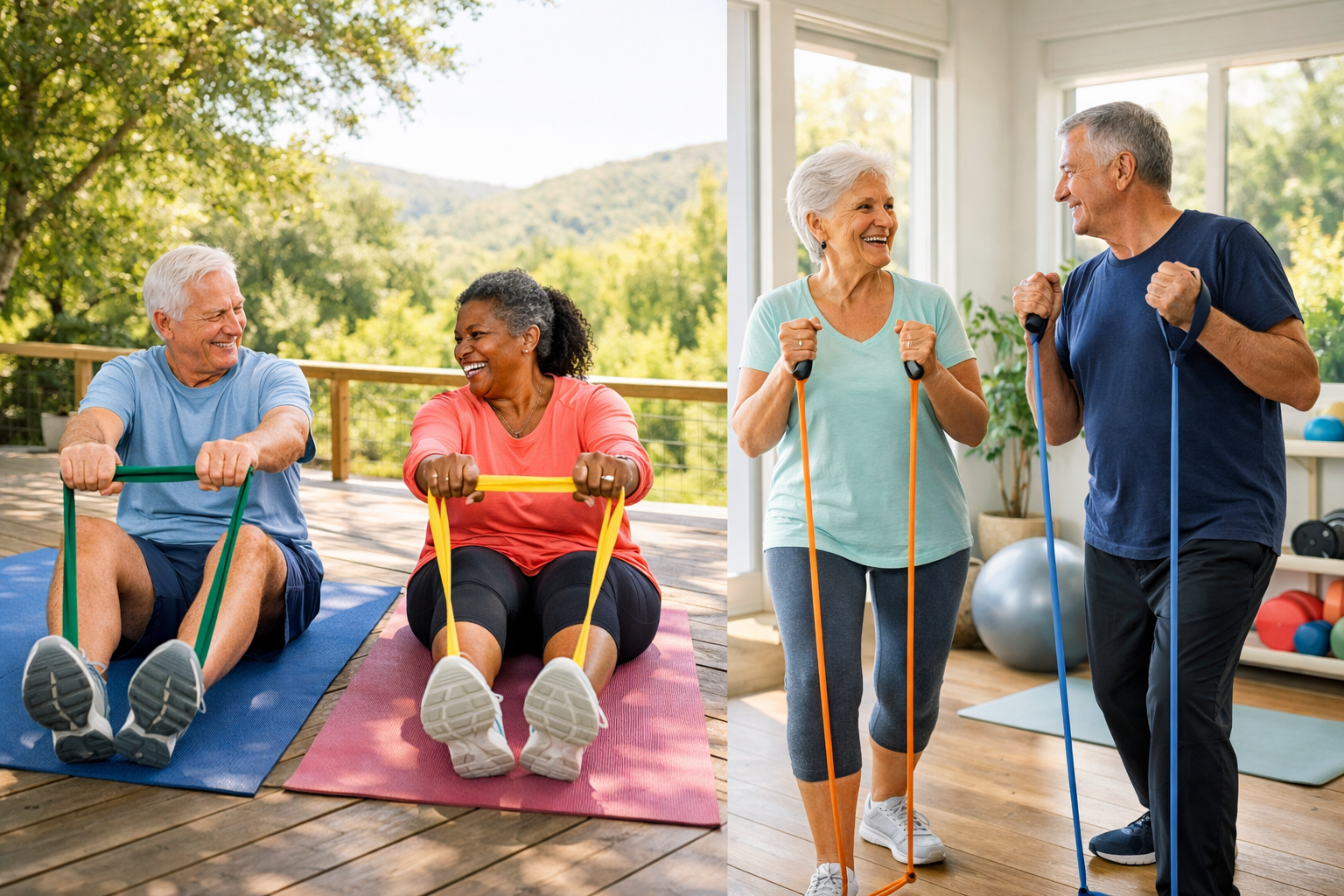
    If you’re adding walking to your routine and want to build in some strength support alongside it, I’d suggest pairing it with seated resistance work on your off days. The Relaxgiant 2 Pcs Resistance Band with Handles Chair Exercise Equipment for Seniors is a gentle, accessible way to keep your upper body and legs strong without adding more impact stress. I had a set at home and used them on my rest days.

    What a Month of Daily Swimming Revealed

    Here’s where things got interesting. Swimming month started with some logistical awkwardness — I had to drive to the community center pool, deal with the locker room situation, and figure out what to actually do in the water for 30 to 40 minutes. I am not a graceful swimmer. I do a very dignified, very slow freestyle with a breaststroke rest lap thrown in every few lengths. I look like a golden retriever who got into the pool by accident.

    But here’s what happened: my knee stopped hurting. Not gradually — almost immediately. The buoyancy of the water takes roughly 90% of your body weight off your joints. For someone with arthritis or joint replacements, that’s not a small thing. That’s life-changing relief.

    My sleep during swimming month was also good, but different. I’d come home from the pool pleasantly tired in a full-body way, and I’d fall asleep faster. Walking had improved my sleep depth; swimming improved my sleep onset. Both useful, just different flavors of benefit.

    The unexpected downside of swimming? It was harder to track progress in a satisfying way. I eventually picked up the 3D Pedometer for Walking Running Sports with Large LCD Display to keep using on dry land, since you obviously can’t wear most step trackers in the pool. On swim days I tracked laps the old-fashioned way — counting on my fingers and occasionally losing track entirely. Also, pool access isn’t free, and getting there takes time and planning in a way that stepping outside your front door simply doesn’t.

    Walking vs Swimming for Seniors: Which Low-Impact Exercise Is Better for You? — image 2

    The Head-to-Head Comparison: Sleep, Energy, and Joint Pain

    Let me break down what my informal tracking actually showed across both months.

    Sleep Quality

    Both exercises improved my sleep compared to my baseline of doing nothing structured. Swimming edged out walking slightly on nights when my joints had been bothering me during the day — less pain meant easier time falling asleep and staying asleep.

    Energy Levels

    Walking gave me a clearer morning energy boost, probably from the sunlight exposure and the rhythm of moving through space. Swimming’s energy benefit hit me more in the afternoons — I had better sustained focus and less of that 2 p.m. slump.

    Joint Pain

    Swimming won this category decisively for me. My knee was measurably less stiff and sore during swimming month. Walking managed my pain acceptably but did cause some accumulation of discomfort by the end of the week.

    Mood and Mental Health

    This one surprised me — walking won. The outdoor element, the changing scenery, the neighbors waving from their porches — all of it contributed to a sense of connection with the world that laps in an indoor pool simply didn’t replicate. I felt happier during walking month. Not healthier, but happier.

    Walking vs Swimming for Seniors: Which Low-Impact Exercise Is Better for You? — image 3

    What Seniors Should Consider When Choosing Between the Two

    The honest answer is that the right choice depends heavily on what’s going on in your body and your life. Here are the key factors I’d encourage you to think through:

    • Joint health: If you have significant arthritis, a knee or hip replacement, or chronic joint pain, swimming’s buoyancy makes it the safer starting point.
    • Bone density: Walking is a weight-bearing exercise, which means it actively helps maintain bone density in a way that swimming does not. This is a real and meaningful advantage for seniors at risk of osteoporosis.
    • Access and consistency: The best exercise is the one you’ll actually do. If a pool requires a 20-minute drive and a membership fee, and walking requires only your front door, consistency often wins out.
    • Balance and fall prevention: Walking on varied terrain naturally challenges your balance over time. You can complement either exercise with balance training at home — tools like the Amazon Basics Wood Wobble Balance Trainer Board or the Balance Board Wooden Wobble Board for Adults are excellent for building stability without risk of falls, since you can hold a counter or wall nearby when you start out.
    • Upper body engagement: Swimming works your arms, shoulders, and core in ways walking simply doesn’t touch. If upper body strength and cardiovascular conditioning are priorities, swimming pulls ahead.
    • Strength supplementing: Whichever exercise you choose, adding some resistance band work helps fill the gaps. The Healthy Seniors Chair Exercise Program with Two Resistance Bands and Printed Exercise Guide is a wonderful all-in-one kit that even includes illustrated instructions — no guesswork required. There’s also the 3 Pcs Resistance Band with Handles Chair Exercise Equipment for Seniors if you want a bit more variety in resistance levels.

    For balance training specifically, the Yes4All Wooden Wobble Balance Board at 15.75 inches is another solid option that’s been popular for years — sturdy, affordable, and effective for building ankle stability and core engagement during short daily sessions.

    Walking vs Swimming for Seniors: Which Low-Impact Exercise Is Better for You? — image 4

    My Recommendation After Two Months of Walking vs Swimming for Seniors

    If I had to pick just one for the rest of my life, I’d choose walking — but only because of the bone density benefits, the mental health lift from being outdoors, and the sheer ease of access. However, I’d pair it with pool sessions two or three times per week whenever my knee starts complaining. The two exercises genuinely complement each other in a way that neither does alone.

    If you’re dealing with significant joint pain and every step feels like a negotiation with your body, start with swimming. Build your cardiovascular fitness, let your joints recover, and consider adding walking back in gradually once things calm down. There is no shame in starting in the water — plenty of elite athletes train there to protect their joints.

    What I didn’t expect to learn from this experiment was how much my body still had to tell me, if I was quiet enough to listen. Two months of intentional movement gave me more useful information about my own health than years of occasional, half-hearted exercise ever did. You might be surprised what a month of honest tracking reveals for you.

    Start this week. Pick one. Lace up your shoes or find your nearest pool schedule. Grab a simple step counter like the Pedometer Watch Senior Friendly No App/Phone Required to track your progress without any tech headaches, and just begin. Your joints — and your future self — will thank you.

  • Best Resistance Bands for Seniors: Low-Impact Strength Training That Actually Works

    Best Resistance Bands for Seniors: Low-Impact Strength Training That Actually Works

    This post contains affiliate links. As an Amazon Associate I earn from qualifying purchases at no extra cost to you.

    I used to stay up until 2am watching YouTube fitness videos, taking notes in a beat-up spiral notebook like I was cramming for an exam — which, honestly, I kind of was. After my mother-in-law Dorothy, 74, had her third fall in six months, her doctor made it clear she needed to build real strength and improve her balance, and I was determined to find something she’d actually do — because stepping inside a gym was, in her words, absolutely not happening. Those late nights sent me deep into the research on resistance bands for seniors, and what I found genuinely surprised me.

    Best Resistance Bands for Seniors: Low-Impact Strength Training That Actually Works — image 1

    Why Resistance Bands Are Genuinely Perfect for Older Adults

    Before I get into the specific products we tested, let me make the case for resistance bands, because I was skeptical at first too. I kept thinking — can a stretchy rubber tube really do anything meaningful for someone who needs real, functional strength? The short answer is yes, and the research backs it up.

    Resistance bands provide what’s called accommodating resistance, meaning the tension increases as you stretch the band further. That might sound like a minor technical detail, but in practice it means joints aren’t slammed with sudden heavy loads the way they can be with free weights. For seniors dealing with arthritis, osteoporosis, or post-surgical recovery, that matters enormously. The movement is smooth, controllable, and forgiving.

    They’re also ridiculously practical. Dorothy does her exercises in her living room, sitting in her favorite armchair. No commute, no locker room, no intimidating equipment. She’s been consistent for eight months now, which is more than I can say for my own gym attendance, and I’m thirty years younger. (Embarrassing but true.)

    Here’s what resistance band training specifically offers seniors:

    • Low joint stress compared to free weights or machines
    • Seated exercises are fully effective, which is a game changer for those with balance concerns
    • Resistance is easy to adjust — simply change bands or your grip position
    • Portable enough to use at home, on vacation, or at a family member’s house
    • Inexpensive compared to virtually any other form of strength training equipment

    The Bands We Actually Tested (And What Dorothy Thought of Each)

    I ordered several different options and we spent about six weeks working through them with Dorothy, paying attention to handle comfort, resistance levels, ease of use, and whether she’d actually pick them up on her own. Here’s what we found.

    Our Top Pick: Relaxgiant Resistance Bands with Handles

    The clear winner for Dorothy was the Relaxgiant 2 Pcs Resistance Band with Handles Chair Exercise Equipment for Seniors. This set comes in yellow (lighter resistance) and green (moderate resistance), which gave her a natural progression path. The handles were the first thing she commented on — soft, cushioned, and easy to grip even on days when her hands felt stiff. She doesn’t have to strain her fingers just to hold on, which had been a real issue with cheaper bands we’d tried previously.

    These are specifically designed for chair-based exercise, and that design intention shows. The length is right for seated rows, chest presses, leg extensions, and bicep curls all performed from a chair. Dorothy does her entire 20-minute routine with just these two bands. She also told me — unprompted — that the yellow and green color coding makes it easy to remember which one is which. Small detail, genuinely useful.

    Best for Structure: Healthy Seniors Chair Exercise Program

    If the person you’re buying for needs more guidance than just the bands themselves, the Healthy Seniors Chair Exercise Program is worth serious consideration. What sets this apart is the printed exercise guide that comes with it. Dorothy’s neighbor Jean, who started exercising alongside her a few months ago, found this one invaluable because she didn’t have anyone to show her the movements. The guide takes away that “but what do I actually do with this thing?” paralysis.

    The kit includes two bands with handles and the resistance levels are labeled clearly. It’s also positioned as a thoughtful gift, which it genuinely is — the packaging is presentable enough to give directly without reboxing. If you’re buying for a parent or grandparent who lives alone or would benefit from structured guidance, this set gives them a complete starting point.

    Best Resistance Bands for Seniors: Low-Impact Strength Training That Actually Works — image 2

    Best Set for Progression: 3 Pcs Resistance Band Set

    For seniors who are a bit more active or who want room to grow, the 3 Pcs Resistance Band with Handles Chair Exercise Equipment for Seniors adds a third resistance level to the mix. More bands means more flexibility as strength improves over time, and it means you can match the resistance more precisely to different muscle groups. Dorothy uses her lighter band for shoulder work and a heavier one for leg exercises, for example. Having three options makes that kind of tailoring easier without buying multiple separate products.

    Don’t Overlook Balance Training — It Works Alongside Resistance Bands

    Here’s something I didn’t expect to include in a post about resistance bands: balance boards. But after about three months of band work, Dorothy’s physical therapist suggested adding some light balance training to complement the strength she was building. And since we were already testing equipment, I figured we’d look into it.

    Balance boards challenge the stabilizer muscles in the ankles, knees, and hips — exactly the muscles that help prevent falls. Used carefully, they can be a meaningful addition to a senior fitness routine. We looked at a few options:

    The Amazon Basics Wood Wobble Balance Trainer Board is a solid, no-frills entry point. It’s slip-resistant, handles up to 265 lbs, and doesn’t feel flimsy underfoot. For a first balance board, it’s a reasonable choice.

    If ankle support is a priority, the Balance Board Wooden Wobble Board for Adults with Ankle Support is worth looking at specifically because of that added stability feature — reassuring for seniors just getting started with balance training.

    We also tested the Yes4All Wooden Wobble Balance Board, which has been around long enough to accumulate a serious track record. It’s well-built, at 15.75 inches it’s a comfortable size, and the blue finish is nicer-looking than you’d expect for the price. Dorothy’s therapist actually approved of this one specifically for use during supervised sessions.

    Important note: balance boards should be introduced carefully, ideally with a wall or sturdy chair nearby for support. They are not step-one equipment for someone just starting out. But as a complement to resistance band strength training a few months in? They’re excellent.

    Best Resistance Bands for Seniors: Low-Impact Strength Training That Actually Works — image 3

    Track Progress — It Matters More Than You Think

    One thing I’ve learned watching Dorothy stick with this routine is that seeing progress is fuel. When she could do twelve reps with the green band instead of eight, that mattered to her. And tracking daily activity — even just step counts — has kept her motivated on days when she’d otherwise skip.

    We looked at two pedometer options specifically suited for seniors. The Pedometer Watch Senior Friendly — No App or Phone Required is exactly what Dorothy wanted. No syncing, no app, no Bluetooth headaches. It tracks steps, calories, and sleep, and it’s waterproof. She wears it every day. The interface is straightforward enough that she figured it out herself, which genuinely impressed me.

    If a watch-style tracker feels like too much, the 3D Pedometer for Walking with Clip and Lanyard is an even simpler option. Clip it to a waistband, glance at the large LCD display, done. No wrist band, no buttons to navigate. For seniors who find wearables fussy, this is genuinely easier.

    Tracking doesn’t have to be complicated to be effective. Even a simple step count gives people a number to beat, and that small competitive instinct — even if it’s just competing with yesterday’s self — turns out to be remarkably motivating.

    Best Resistance Bands for Seniors: Low-Impact Strength Training That Actually Works — image 4

    My Final Recommendation and What to Do Next

    After eight months of watching Dorothy go from reluctant to genuinely enthusiastic about her home fitness routine, I feel confident saying this: the best resistance bands for seniors don’t need to be complicated, expensive, or intimidating. They need to be comfortable, appropriately challenging, and easy enough to pick up consistently.

    If you’re buying for yourself or a loved one and want one clear recommendation: start with the Relaxgiant Resistance Bands with Handles. They’re designed with seniors in mind, the dual resistance levels give immediate progression options, and the handle comfort is genuinely superior to cheaper alternatives. If the person needs a structured program to follow, pair it with the Healthy Seniors Chair Exercise Program for the printed guide.

    Add a basic pedometer — either the watch-style or the clip-on — and you’ve given someone a complete, self-contained fitness setup that requires no gym, no heavy equipment, and no tech expertise. That’s a genuinely meaningful gift. For Dorothy, it was life-changing. I don’t use that phrase lightly.

    If you found this helpful, share it with someone who might need it — and drop a comment below if you have questions about specific exercises or how to get started. I’m happy to help.