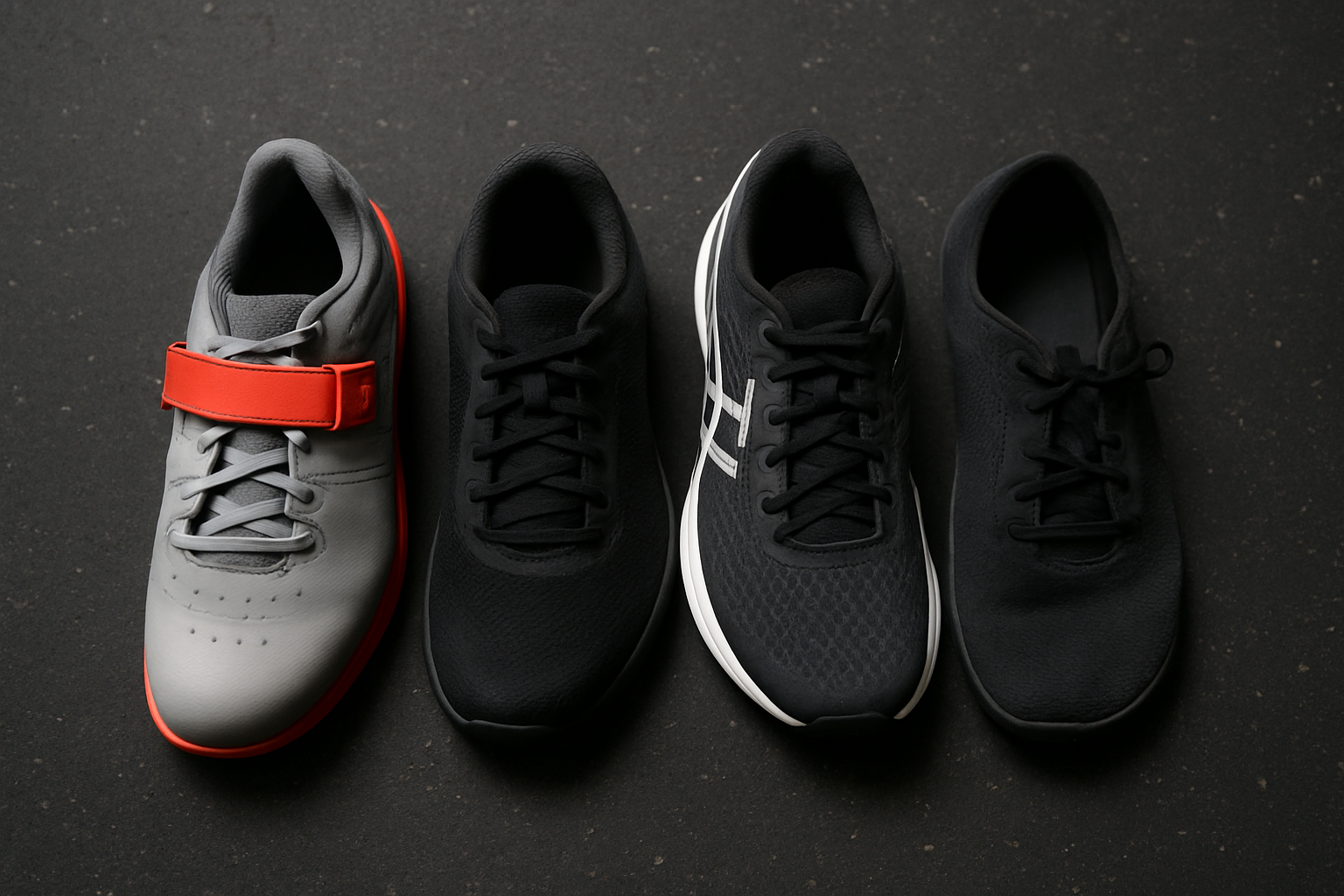

Most fitness writing focuses on program design and nutrition without addressing a foundational problem: your footwear can sabotage even solid training. During an early running phase, I pushed too hard on day one wearing sneakers that had lost their structural integrity, strained my calf, and spent the next two weeks sidelined — all preventable. What took me time to understand was that my worn-out shoes were actively undermining my body’s ability to handle the work I was asking it to do. That realization shifted how I think about training gear entirely: what you wear on your feet directly determines how safely and effectively your body can perform. I watch this play out regularly — someone loading up a squat in cushioned running shoes, then fighting heel lift and losing their base of support — and the root cause is always footwear mismatch. Let’s dig into how to select the right shoes for each training style, because nailing this detail genuinely separates sessions where you’re moving well from ones where you’re fighting your own setup.
| Training Style | Shoe Type | Key Features | Why It Matters |
|---|---|---|---|
| Heavy squats & Olympic lifting | Dedicated lifting shoe | Raised heel (0.6–1 inch), rigid sole, secure lacing | Expands ankle range, deepens squat, maintains upright torso |
| Mixed-modality & general strength | Low-profile flat training shoe | Solid side-to-side support, resists compression | Handles multi-directional movement without instability |
| Running & road work | Running shoe | Thick shock-absorbing midsole | Dampens impact during forward locomotion |
| Heavy squat in running shoe | Cushioned running shoe | Thick, compressible midsole | Compresses unevenly, shifts weight forward, disrupts power transfer |
Why Your Shoe Choice Actually Changes Your Performance
Your shoes function as your contact point with the ground. Everything you do — whether it’s a single explosive movement or a sustained hold — originates from this interface. Wearing the wrong shoe doesn’t just feel off; it actively interferes with how force travels through your body. The mechanics tell the story: various training modalities create distinct physical stresses on your feet and lower leg. A running shoe features a thick, shock-absorbing midsole engineered to handle the pounding rhythm of forward locomotion. That works perfectly for running. But placed under a heavy squat, that same cushioned layer becomes an unstable medium between you and the floor — it gives unevenly, shifts your weight distribution forward, and disrupts your ability to transfer power cleanly. You end up loading a weight through a substance that compresses rather than a solid base.
Contrast this with a purpose-built Olympic lifting shoe: its rigid construction with a lifted heel works biomechanically to expand your ankle’s available range of motion, allowing you to descend deeper into a squat while maintaining an upright torso angle. Research in the Journal of Strength and Conditioning Research documents that raising the heel measurably deepens squat position and improves spinal alignment — both critical for injury prevention and efficient load handling.
The implication is straightforward: a single shoe cannot address the varying demands across different training modalities. Below is a framework for matching footwear to your primary training focus.
Choosing the Right Shoe for Your Training Style
For Strength Sports, Heavy Squats, and Olympic Lifting Movements
Serious Olympic lifting and heavy lower-body work demands a dedicated lifting shoe with three essential features: an unyielding, incompressible sole, a raised heel (in the 0.6–1 inch range), and a secure lacing or strap system to keep your foot locked down. Any flex or give in your sole during maximal loading drains stability — you want your foot to feel anchored to the platform.
For Mixed-Modality Sessions, General Strength, and Cross-Training
When your training rotates across different modalities — some loaded strength work, some bodyweight movement, some circuit-style intervals — reach for a low-profile, flat training shoe with solid side-to-side support. You won’t benefit from an elevated heel in this context, but you absolutely need something that resists compression under load and doesn’t slip or roll during multi-directional movement.
For Running and Road-Based Work
Running shoes serve one specific purpose: propelling your body forward repeatedly while dampening ground impact. They excel at this. They belong on running routes, not in racks used for loaded movements.
Shoes Worth Your Attention
The selections below represent products I trust based on durability, performance credibility, and demonstrable results in real training. Here’s what I’d recommend depending on where your training emphasis lands.
Lifting Shoe That Transformed My Squat Mechanics
When your focus is heavy barbell work and Olympic movements, footwear becomes the determining factor in whether your ankle’s available range works for you or becomes a limiting factor. I spent considerable time working toward greater squat depth and more controlled drive before recognizing that my flat, cushioned trainers were the actual constraint—not my mobility or movement pattern.
Advantages
- The heightened heel (roughly 0.75 inches) instantly expands your ankle’s capacity to flex, making it possible to achieve deeper squat positioning while keeping your spine more vertical and preventing valgus knee movement.
- The non-compressible platform stays firm under serious weight—when you’re handling heavy loads, you’re pushing against a genuinely stable surface, not sacrificing force through a cushioned interface.
- The structured side support maintains your foot’s position throughout the ascent; ankle stability holds throughout the set, preventing the micro-instabilities that accumulate during heavy reps.
Drawbacks
- There’s a learning curve—typically 2–3 training sessions—if you’ve trained exclusively in conventional running shoes; the heel angle requires accommodation and some lifters don’t end up preferring it.
- They represent tool specialization; wearing them for cardio work or general conditioning is unnecessary since they’re optimized narrowly for loaded lower-body movement.
I’ll admit the first time I squatted in them, the rigid sole felt almost too firm, and I questioned whether the heel was too aggressive—until I hit a triple at a weight that had felt shaky in my old shoes. Nordic Lifting MEGIN Powerlifting Shoes
Frequently Asked Questions
Do lifting shoes really improve squat depth?
Yes. Research in the Journal of Strength and Conditioning Research shows that raising the heel measurably deepens squat position and improves spinal alignment. A lifted heel expands your ankle’s available range of motion, allowing you to descend deeper while maintaining an upright torso angle, which is critical for injury prevention and efficient load handling.
Why shouldn’t I squat in cushioned running shoes?
Cushioned running shoes compress unevenly under heavy weight, shifting your weight distribution forward and disrupting power transfer. That thick, shock-absorbing midsole becomes an unstable medium between you and the floor instead of a solid base. You need an incompressible sole to transfer force cleanly during maximal loading.
What heel height should a lifting shoe have?
A proper lifting shoe should have a raised heel in the 0.6–1 inch range. The Nordic Lifting MEGIN, for example, features a heightened heel of roughly 0.75 inches, which expands your ankle’s capacity to flex and allows deeper squat positioning while keeping your spine more vertical.
How long does it take to adjust to lifting shoes?
There’s typically a learning curve of 2–3 training sessions if you’ve trained exclusively in conventional running shoes. The heel angle requires accommodation since it differs from flat trainers, though some lifters prefer the adjustment once they experience the improved stability and depth it provides.
About This Article

Written by Jordan Ellis. Jordan Ellis isn't a certified personal trainer — just someone who's been genuinely obsessed with training for over eight years and turned it into building smarter home gyms. He focuses on home fitness: effective training spaces, equipment that earns its price, and programs that work in a spare room or basement, not just a commercial gym. More about this site.
Scope and limits. Jordan is not a certified personal trainer, and nothing here is medical advice. Check with a physician before starting a new program, and prioritize form over load on every lift described.
Verify this against a primary source
Specifics change, and your situation may differ from the one described here. These are the authorities worth checking directly:
- Physical Activity Guidelines for Americans (HHS) — the federal physical activity guidelines
- American College of Sports Medicine — exercise prescription and position stands
- NSCA — strength and conditioning research