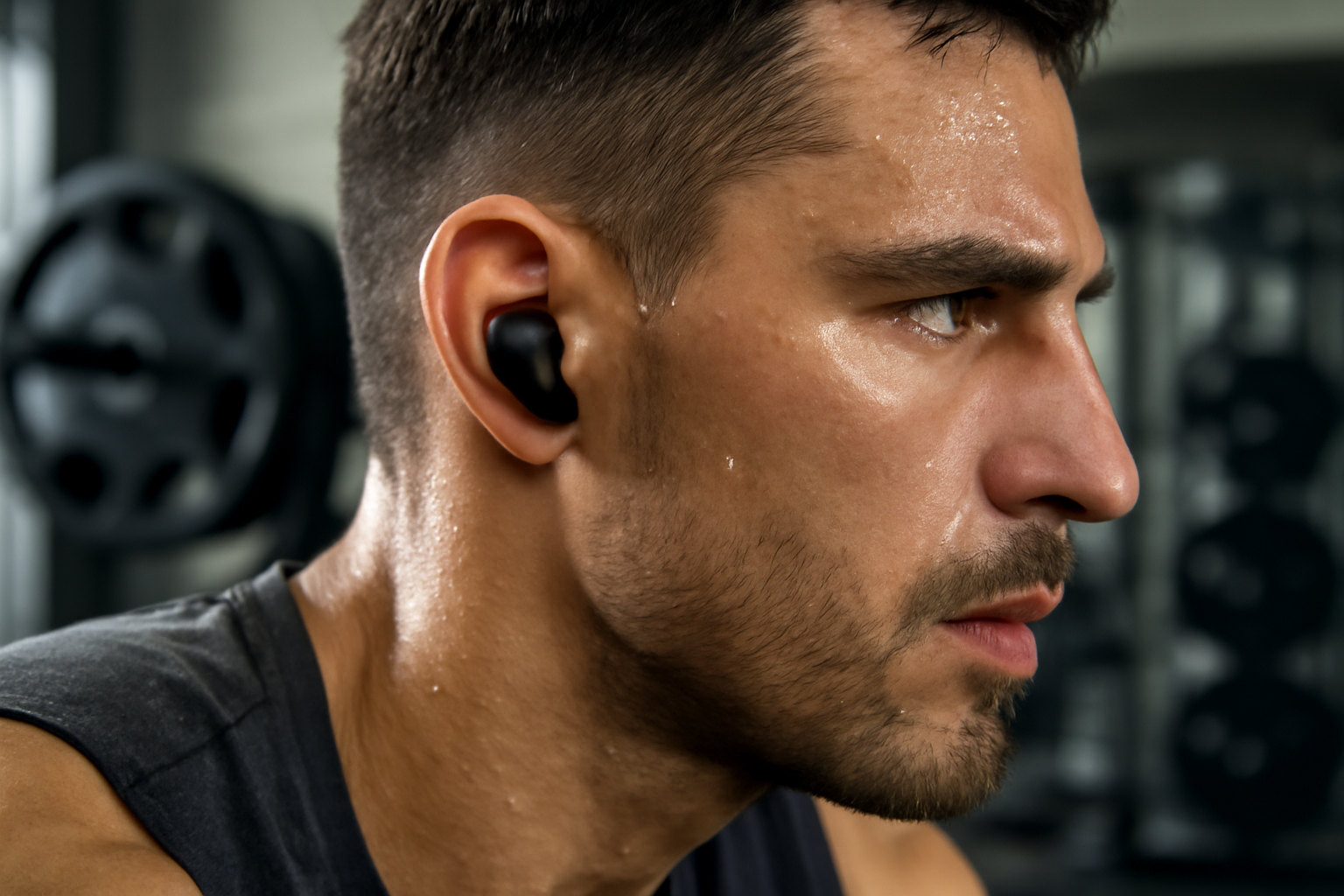
If someone asked me right now what finally fixed the earbud-dropout problem during heavy training, I’d tell them: get the ones with mechanical earhooks instead of relying on fit alone. I’ve spent over eight years working on strength and conditioning, and the single most common complaint during intense sessions isn’t about sound — it’s that wireless earbuds simply won’t stay in your ears. Not occasionally. Repeatedly. During compound movements, sprints, heavy pulling work. The issue became impossible to ignore.
It came to a head one Tuesday morning when a 41-year-old person walked in visibly annoyed. He’d burned through three pairs of wireless earbuds in half a year because they kept ejecting during his initial warm-up lifts. That conversation pushed me to hunt for an actual solution — something engineered to handle the demands of real gym environments.
The stakes weren’t about pristine audio fidelity or how long the battery lasted. Those are nice-to-haves. What mattered was whether earbuds could endure the rigors of grinding through multiple sets of demanding lifts at serious weight. That’s the true measure. And frankly, most mainstream options simply don’t pass.
The Problem with Standard Wireless Earbuds in the Gym
To understand why this frustration is so widespread, you need to look at how standard true wireless earbuds maintain their position. They depend on a precise fit inside the ear canal to remain stable. That approach functions adequately during casual audio consumption or a leisurely pace run. However, introduce heavy strength training, Olympic movement patterns, or metabolic conditioning into the equation, and the underlying mechanics work against you.
Physical exertion — especially movements involving rapid acceleration, pulling, or vertical force — causes subtle shifts in ear anatomy and muscular engagement in the head and neck region. Perspiration further complicates matters by reducing the contact friction between the earbud surface and skin, fundamentally destabilizing the fit. I’ve witnessed countless training sessions derailed because people were forced to pause and locate earbuds that had fallen during heavy pulls or jumping sequences. Beyond the aggravation factor, there’s a real financial cost when equipment requires replacement every two or three months due to avoidable failure.
My friend’s repeated frustration mirrored my own — equipment that gives up during intense compound movements defeats its purpose. I needed a solution that delivered genuine mechanical retention, not simply a fit that worked until perspiration entered the picture.
Earhooks as the Answer to Retention Failure
The solution turned out to be surprisingly simple: earhooks. Not a new concept, but modern implementations have come a long way. The Wireless Earbuds, Bluetooth 5.4 Headphones Sport, Over Ear Buds With ENC Noise Cancelling Mic, 48H, Wireless Earphone With Earhooks, Stereo Deep Bass, IP7 Waterproof ear bud for Workout Running, Black uses a rigid over-ear design that wraps around the top and back of your ear. This isn’t a flimsy addition — it’s engineered to handle the biomechanics of athletic movement.
I put these to the test across my own training and alongside several people, including the firefighter mentioned earlier. My approach was methodical: minimum two weeks of consistent use across varying workout styles before drawing conclusions. Heavy barbell work, conditioning circuits, outdoor training sessions, stretching and mobility routines — I deliberately sought out the scenarios where they might come up short.
Where They Deliver
- The mechanical hook structure wraps securely through dynamic movements — I cycled through heavy rows, jumping variations, and high-speed interval sprints without any need to readjust or reposition.
- IP7-rated water resistance tolerates intensive sweat output and incidental water exposure; performance remained consistent after repeated post-session rinsing.
- Running duration stretches to 48 hours between charges, eliminating the hassle of mid-week charging or power concerns when training multiple consecutive days.
- Built-in environmental noise cancellation on the mic allows for hands-free communication during rest intervals without removing the earbuds — a surprisingly practical advantage.
- The audio profile emphasizes rich bass response, which pairs well with high-intensity sessions where rhythm and low-end punch support mental intensity.
Where They Fall Short
- The protruding hook structure occupies additional space around the outer ear — this becomes problematic when wearing fitted winter headgear during outdoor cold-weather sessions, and familiarity with the design takes a few training days.
- Pairing between multiple devices occasionally produces brief audio dropouts, particularly when transitioning between smartphone and wearable fitness watch mid-session.
- Individuals with proportionally smaller ear structures may encounter fit inconsistencies or reduced security — trying them on before purchase is advisable if retail availability allows.
How They Performed Under Demanding Conditions
There was one particular moment during an extended loaded carry circuit where I wondered whether sustained tension and elevated grip pressure might compromise the mechanical integrity — they absolutely held firm. The design succeeds because it doesn’t depend solely on canal compression; instead, the earhook distributes stabilizing force across a larger structural footprint of the ear itself, a fundamentally stronger engineering approach.
That same person has maintained his pair for five months now with zero instances of loss or dropout. He’s rotated them through grappling-focused wrestling sessions, metabolic conditioning in a CrossFit setting, and traditional barbell strength programming. This represents a dramatic improvement compared to his prior experience of needing replacements every eight weeks.
Bottom Line
When your primary frustration is equipment that bails on you mid-set, when you’re exhausted by the cycle of replacing earbuds that fall out during training, mechanical earhooks represent the actual fix. These aren’t flawless — minor connectivity hiccups occur, and there’s an adjustment window for physical comfort. That said, if your priority is durability and stability during high-output strength or explosive training, the structural retention provided by earhook designs changes the equation.
Frequently Asked Questions
Why do standard wireless earbuds fall out during heavy lifting?
Standard wireless earbuds rely on a precise fit inside the ear canal, which fails under heavy strength training. Physical exertion causes subtle shifts in ear anatomy, and perspiration reduces contact friction between the earbud and skin, destabilizing the fit during compound movements and pulling work.
How long do earhook earbuds last between charges?
These earhook earbuds run for 48 hours between charges, eliminating the hassle of mid-week charging or power concerns when training multiple consecutive days.
Are these earbuds waterproof for sweat during workouts?
Yes, they have an IP7 waterproof rating that tolerates intensive sweat output and incidental water exposure. Performance remains consistent after repeated post-session rinsing.
Do earhook earbuds work with winter headgear outdoors?
The protruding hook structure occupies additional space around the outer ear, which becomes problematic when wearing fitted winter headgear during outdoor cold-weather sessions. Familiarity with the design takes a few training days.
About This Article

Written by Jordan Ellis. Jordan Ellis isn't a certified personal trainer — just someone who's been genuinely obsessed with training for over eight years and turned it into building smarter home gyms. He focuses on home fitness: effective training spaces, equipment that earns its price, and programs that work in a spare room or basement, not just a commercial gym. More about this site.
Scope and limits. Jordan is not a certified personal trainer, and nothing here is medical advice. Check with a physician before starting a new program, and prioritize form over load on every lift described.
Verify this against a primary source
Specifics change, and your situation may differ from the one described here. These are the authorities worth checking directly:
- Physical Activity Guidelines for Americans (HHS) — the federal physical activity guidelines
- American College of Sports Medicine — exercise prescription and position stands
- NSCA — strength and conditioning research