
A training partner once complained mid-set that her shoulders felt locked up during pressing movements, and when I handed her a resistance band to try instead, something clicked. She finished strong, no pain, full range of motion — and that moment stuck with me as a perfect example of how the right tool changes everything. Bands aren’t a backup plan or a last resort; they’re a completely legitimate training method that most people use wrong because nobody teaches them properly. This guide covers what different bands actually do, how to read their resistance levels, and which exercises will actually move the needle for your training — whether you’re building a home setup, coming back from an injury, or just tired of being bored by the same barbell movements.
| Band Type | Primary Use | Resistance Range | Key Feature |
|---|---|---|---|
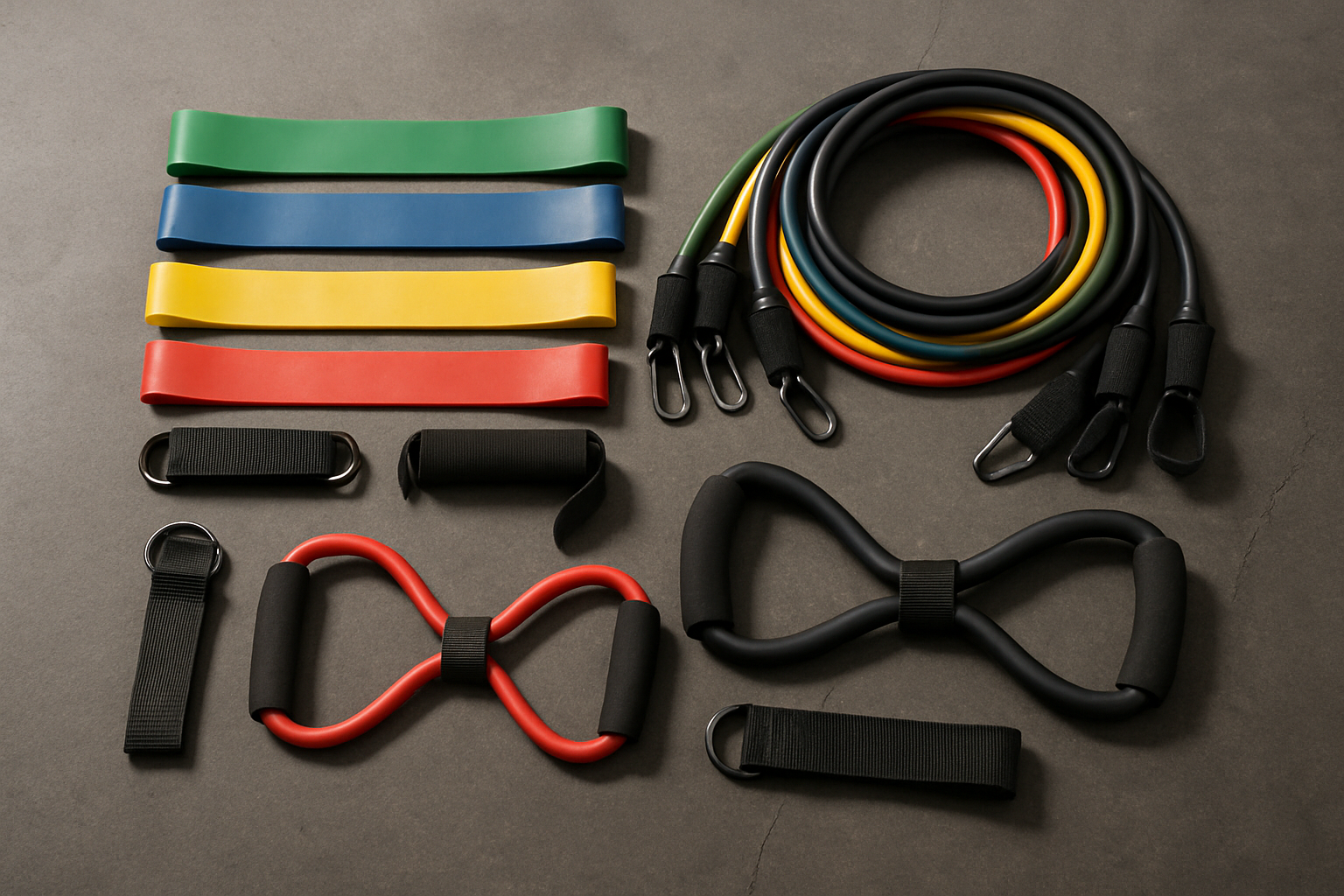
| Tube Bands with Handles | Upper body pressing and pulling | 10–50+ lbs per band | Stackable; includes door anchor |
| Loop Bands (Flat) | Strength work; assisted pull-ups; glute movements | Light to 100+ lbs when stacked | Variable resistance; color-coded |
| Mini Bands (Hip Circles) | Glute activation; lateral stepping; clamshells | Light resistance | Sits around hips or feet |
| Figure-8 and Therapy Bands | Stabilization; recovery work | Extremely light | Stabilizes wrists or ankles |
The Resistance Bands Guide to Types and Tensions You Actually Need
The mistake I see constantly is treating all resistance bands as interchangeable — they’re not. Grabbing the wrong band type for a given exercise tanks your results and sometimes creates injury risk. Here’s what distinguishes each category and when to actually use it.
Tube Bands with Handles
These cylindrical rubber or latex bands with plastic or foam handles are what most people recognize instantly. They excel at upper body pressing and pulling work — curls, presses, shoulder raises, horizontal rows, and more. Standard sets include several resistance options, usually spanning from roughly 10 lbs through 50+ lbs per band, and you can combine multiple bands to increase total load. Door anchors (normally included in a set) open up cable-style exercises that replicate what you’d do on a cable stack.
Loop Bands (Flat Loop Resistance Bands)
Thick, flat continuous loops built from stacked latex sheets are the backbone of serious strength work. Walk into any powerlifting gym and you’ll see lifters wrapping them around barbells to add variable resistance to squats and deadlifts, but they’re equally powerful for assisted pull-ups, glute-focused movements, and mobility drills. Color-coded tension designations make selection easy — lighter options handle stretching and mobility duties well, while heavier weights (green, black) deliver substantial resistance for heavy compound lifts.
Mini Bands (Hip Circles)
Smaller, thinner circular loops designed to sit around hips or feet are the specialist tool for glute activation, lateral stepping, clamshells, and hip spreading patterns. Physical therapists routinely prescribe them, as do strength coaches working with athletes on movement prep. Struggling to feel your glutes fire during a squat? A mini band usually fixes it within a session.
Figure-8 and Therapy Bands
Figure-8 designs feature a crossover structure that stabilizes wrists or ankles in place during movement. Therapy or flat bands modeled after TheraBand products show up everywhere in physical therapy clinics and rehab rooms. Both are extremely light and built for stabilization work and recovery-focused programming.
Understanding Resistance Band Tensions
This is where most people get confused, so I’ll keep the explanation straightforward. Bands create escalating tension — the further you stretch them, the greater the resistance. This is actually a huge mechanical advantage over traditional weights because you achieve peak resistance at the point where your muscles can produce maximum force (full range of motion). That property is what strength and conditioning coaches call accommodating resistance, and it’s exactly why you’ll see serious lifters pairing bands with barbells in programs.
When shopping for bands, hunt for sets with transparent resistance labeling. Most tube band offerings use this color scheme:
- Yellow/Light: 10–15 lbs — perfect for entry-level trainees, post-injury work, and isolated shoulder movements
- Red/Medium: 20–30 lbs — suitable for standard upper body pressing and pulling patterns
- Green/Heavy: 30–40 lbs — well-suited for back exercises, pressing strength, and assisting pull-ups
- Blue/Extra Heavy: 40–60 lbs — built for lower body patterns, useful for stacking multiple bands together
- Black/Max: 50–80+ lbs — designed for experienced lifters, full-body strength work, and strength sport training
Loop bands designed for strength sport work or pull-up assistance frequently exceed 100 lbs of tension. When you’re starting out, choose a band lighter than your instinct suggests — bands have a reputation for surprising people when form deteriorates under load.
Best Resistance Band Exercises (By Muscle Group)
Upper Body
- Bicep Curl: Position yourself on the band, grab both handles, curl upward to shoulder level. Keep your elbows locked against your torso throughout.
- Chest Press: Secure the band at chest height behind your body, press forward with both arms as if performing a standing bench press movement.
- Lat Pulldown: Fix the band overhead, pull it toward your chest while maintaining a slight forward lean. Targets back width effectively.
- Seated Row: Wrap the band around a stable object or under your feet, pull toward your midsection, drive your shoulder blades together at the top.
Lower Body
- Banded Squat: Step onto the band, thread handles over your shoulders, descend into a squat. The band automatically penalizes shallow depth.
- Glute Kickback: Secure the band at a low point, loop it around one ankle, thrust backward and contract your glute maximally at the endpoint.
- Lateral Band Walk: Slip a mini band around your thighs, bend your knees slightly, shuffle sideways. Deceptively tough on hip stability.
- Romanian Deadlift: Stand on the band, hinge from the hips, feel the hamstring lengthen — lower the movement with deliberate control.
Core
- Pallof Press: Affix the band at sternum height perpendicular to your body, push straight ahead and hold tension. One of the best rotational stability builders available.
- Woodchop: Anchor the band overhead, pull it across your torso toward the opposite side hip. Crushes oblique strength and power.
Gear I Recommend
These are the bands I’d put in someone’s hands without hesitation or stock in a personal gym. Each one delivers real value and suits different training contexts and spending limits.
If you want a complete setup right out of the box, the WHATAFIT Resistance Bands Set (100 lbs, with handles) gives you five stackable tubes, handles, ankle straps, and a door anchor in one bag.
Frequently Asked Questions
Can you stack multiple resistance bands together for more weight?
Yes. Tube bands typically span from roughly 10 lbs through 50+ lbs per band, and you can combine multiple bands to increase total load. Loop bands designed for strength sport work frequently exceed 100 lbs of tension when stacked together.
What resistance band color means heavy weight?
Green and black bands deliver heavy resistance. Green bands are 30–40 lbs and well-suited for back exercises and pull-up assistance. Black bands are 50–80+ lbs and designed for experienced lifters and strength sport training.
Why do strength coaches use bands with barbells?
Bands create escalating tension as you stretch them, delivering peak resistance at full range of motion where your muscles produce maximum force. This property, called accommodating resistance, is why serious lifters pair bands with barbells in programs.
What band should a beginner lifter choose?
Choose a band lighter than your instinct suggests. Bands have a reputation for surprising people when form deteriorates under load, so starting conservatively helps you maintain proper technique while building confidence.
About This Article

Written by Jordan Ellis. Jordan Ellis isn't a certified personal trainer — just someone who's been genuinely obsessed with training for over eight years and turned it into building smarter home gyms. He focuses on home fitness: effective training spaces, equipment that earns its price, and programs that work in a spare room or basement, not just a commercial gym. More about this site.
Scope and limits. Jordan is not a certified personal trainer, and nothing here is medical advice. Check with a physician before starting a new program, and prioritize form over load on every lift described.
Verify this against a primary source
Specifics change, and your situation may differ from the one described here. These are the authorities worth checking directly:
- Physical Activity Guidelines for Americans (HHS) — the federal physical activity guidelines
- American College of Sports Medicine — exercise prescription and position stands
- NSCA — strength and conditioning research