Tag: leg exercises

  • How to Squat Properly: The Definitive Barbell Squat Guide

    How to Squat Properly: The Definitive Barbell Squat Guide

    This post contains affiliate links. As an Amazon Associate, I earn from qualifying purchases at no extra cost to you.

    If I had to pick one exercise that every lifter — beginner or advanced — needs to master, it’s the squat. It builds more total muscle mass, demands more full-body coordination, and transfers to more real-world movement patterns than almost anything else you can do under a barbell. But here’s the catch: the squat is also the most technique-dependent lift in the gym. Done well, it’s transformative. Done poorly, it’s a fast track to knee pain, lower back strain, and wasted training. That’s why learning how to squat correctly from the start isn’t optional — it’s the whole game. In this guide, I’m going to walk you through every element of squat form so you can train heavier, move better, and stay injury-free for the long haul.

    Squat Setup: Bar Position, Stance, and Grip

    Before you touch the bar, you need a plan. The decisions you make during setup determine everything that happens on the way down and back up.

    High Bar vs. Low Bar

    High bar positioning places the barbell across the upper traps, just below the base of the neck. It produces a more upright torso and is the go-to for Olympic lifters, athletes, and most general fitness trainees. Low bar positioning sits the bar two to three inches lower, across the rear deltoids, which shifts the torso forward and allows more weight to be moved — making it the preferred setup for most powerlifters. Neither is universally superior. If you’re training for athletic performance or body composition, start with high bar. If your primary goal is maximal strength and competition, low bar is worth learning.

    Stance Width and Foot Angle

    Stance width is not one-size-fits-all — it’s anatomy-dependent. A shoulder-width stance works well for most people, but lifters with wider hips or deeper hip sockets often squat better with a slightly wider stance. Experiment within a range of shoulder-width to just outside shoulder-width. As for foot angle, point your toes out somewhere between 15 and 30 degrees. This toe-out position matches the natural angle of your femurs and allows your knees to track directly over your toes throughout the movement. Forcing your feet straight forward is a common mistake that restricts depth and puts unnecessary stress on the knee joint.

    Grip and Wrist Position

    Your grip width should be just wide enough to allow your elbows to drive down and back without shoulder discomfort. A thumbless or “suicide” grip is common among experienced lifters, but a full grip works perfectly fine. The critical point is wrist position: do not let your wrists bend back under the bar. Keep them neutral and straight. Bent wrists under load lead to forearm and elbow pain over time. If achieving this position is difficult, widen your grip slightly and work on shoulder and thoracic mobility.

    How to Squat: Step-by-Step Execution

    The Walkout

    Unrack the bar by taking it out in no more than two to three steps. Step back with one foot, bring the other foot to your squat stance, and make one final micro-adjustment if needed. That’s it. Every extra step you take is wasted energy and an opportunity to lose your setup. Once you’re in position, don’t drift forward or shuffle around — own your stance before you descend.

    Bracing

    Before every single rep, take a deep diaphragmatic breath — breathe into your belly, not your chest — and brace your entire core as hard as you can, as if you’re about to take a punch to the stomach. This intra-abdominal pressure creates a rigid column of support for your spine. Don’t just breathe in; brace outward in all directions. This is the Valsalva maneuver, and it is non-negotiable for safe, strong squatting under load.

    The Descent

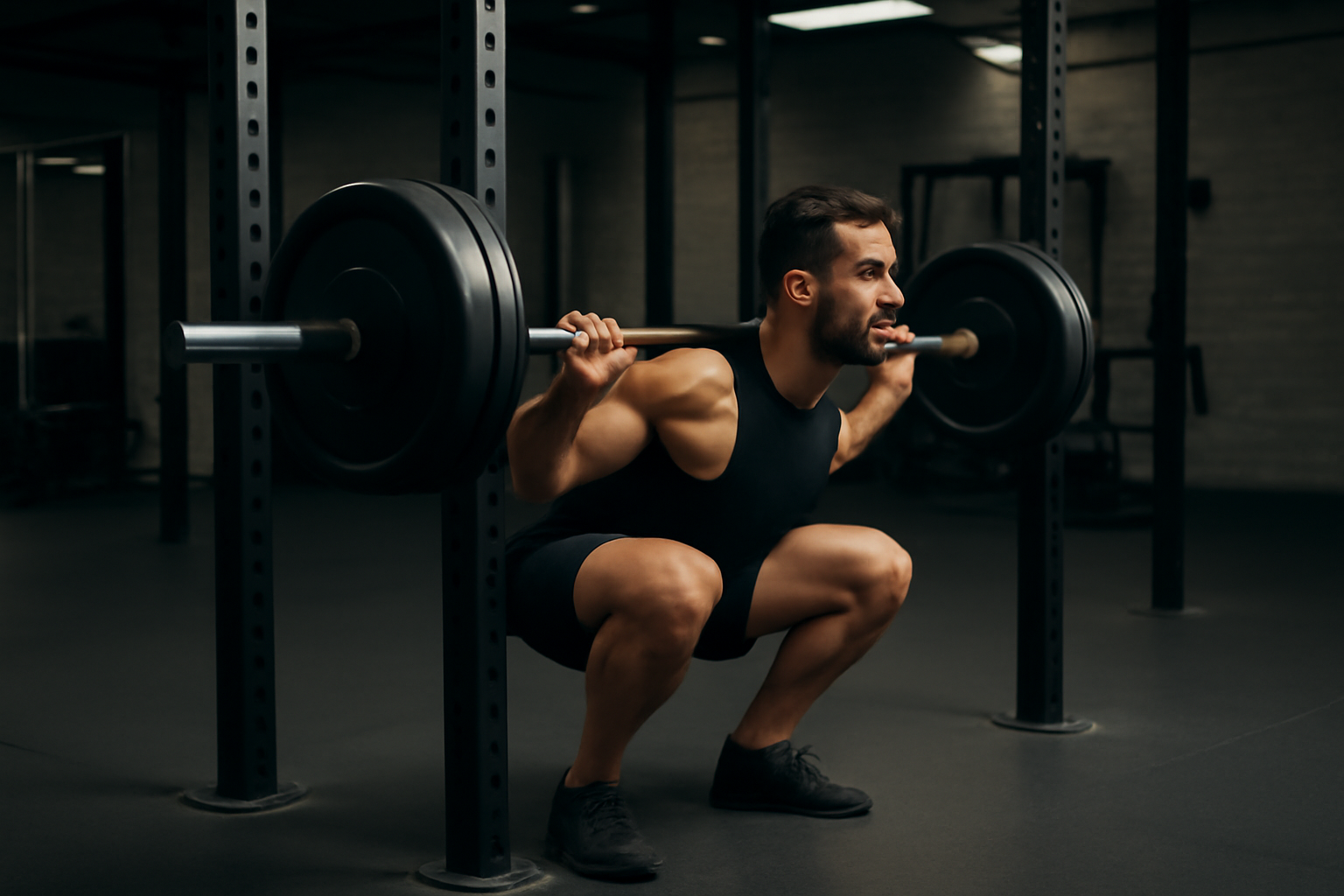
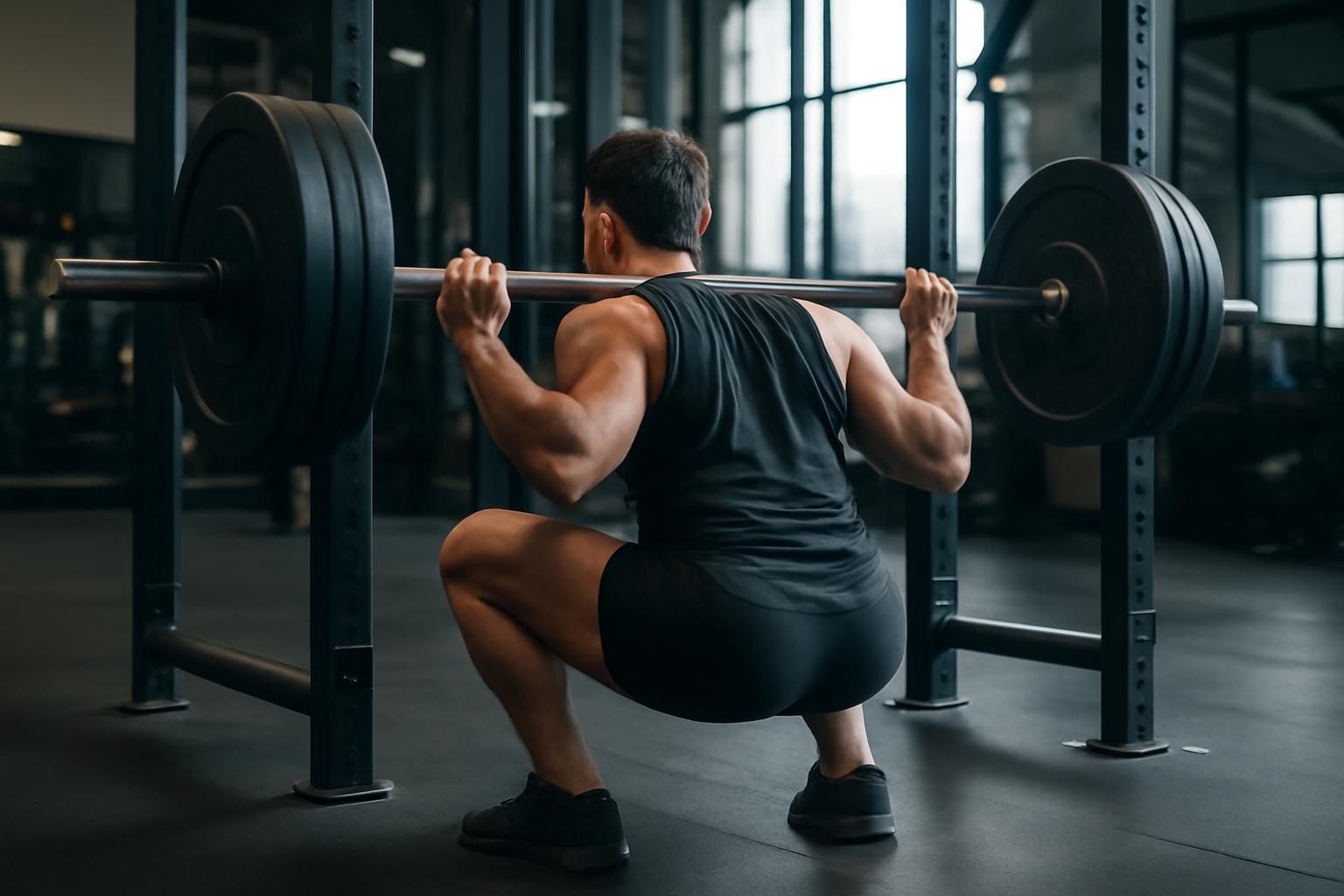
    Initiate the squat by breaking at the hips and knees simultaneously — not by pushing the knees forward first, and not by hinging at the hips like a deadlift. Both joints move at the same time. As you descend, keep your chest up, your knees tracking over your toes (not collapsing inward), and your weight distributed across your entire foot — heel, ball, and toes all in contact with the floor. Think about “spreading the floor” with your feet as you go down. This cue activates your glutes and keeps your knees in proper alignment.

    Depth

    Proper squat form requires reaching at least parallel — meaning the hip crease drops to the level of the top of your knee or below. This is the range of motion at which the glutes and hamstrings are maximally recruited. Quarter squats are not squats. If mobility is limiting your depth, I’ll cover that in detail below. But the goal is always hip crease at or below parallel.

    The Drive Up

    Out of the hole, think “chest up and knees out” simultaneously. Drive your feet through the floor, push your hips forward, and maintain that braced torso all the way to lockout. Your hips and shoulders should rise at the same rate — if your hips shoot up first, your chest falls forward and you’ve turned your squat into a good morning. Exhale at the top once you’ve locked out, reset your brace, and go again.

    Footwear plays a bigger role in squat execution than most people realize. I recommend the MANUEKLEAR Deadlift Shoe – Weight Lifting Shoes for Men Women as a versatile flat-soled option for lifters who want a stable, zero-drop platform under the bar. The barefoot-style sole keeps your foot in full contact with the floor, which improves proprioception and prevents the energy loss you get from training in soft-soled running shoes. I’ve had several clients switch to these and immediately notice better stability and a more grounded feel during their drive phase. They’re also cross-trainer friendly, so they pull double duty on days when you’re moving between squat racks and conditioning work.

    The Most Common Squat Mistakes

    Butt Wink

    Butt wink refers to posterior pelvic tilt at the bottom of the squat — the pelvis tucks under and the lower back rounds. A small amount is normal and not dangerous at light loads, but excessive rounding under heavy weight significantly increases lumbar disc stress. The most common cause is limited ankle or hip mobility preventing a full, neutral-spine descent. Don’t just squat shallower to avoid it — address the mobility restriction directly.

    Valgus Collapse (Knees Caving In)

    Knee cave — where the knees track inward on the descent or drive — is one of the most dangerous and most common errors in how to squat. It places massive rotational stress on the knee joint and is a leading cause of ACL and meniscus injuries over time. The fix is twofold: cue “knees out” aggressively on every rep, and strengthen your hip abductors and glute medius with accessory work like banded squats, clamshells, and lateral band walks.

    The Good Morning Squat

    This happens when your hips rise faster than your shoulders out of the hole, causing your torso to fall forward and the lift to convert into a hip hinge. It’s usually a sign of quad weakness relative to the posterior chain. The fix is paused squats, tempo squats, and front squats to force a more upright position and build quad-dominant strength patterns.

    Not Hitting Depth

    Partial range of motion squats reduce glute activation, limit muscle development, and teach your nervous system to stop short. If you’re not hitting at least parallel, you’re leaving the best results on the table. Record yourself from the side — most lifters who think they’re hitting depth are not.

    Excessive Forward Lean

    Some forward lean is natural and unavoidable, especially with a low bar setup. But if your torso is nearly horizontal, it’s typically caused by ankle mobility restrictions, weak upper back, or incorrect bar placement. Improving ankle dorsiflexion and reinforcing “chest up” as a setup cue will correct this in most cases.

    If knee discomfort is part of your squat story, compression sleeves can make a real difference in how your joints feel under load. Most of my intermediate and advanced clients train in the Gymreapers Knee Sleeves (1 Pair) with Gym Bag, and I keep a pair in my own gym bag. These are 7mm neoprene IPF-approved sleeves that provide genuine compression and warmth to the knee joint — not just a psychological crutch. The added proprioceptive feedback they provide helps many lifters maintain better tracking and knee alignment, particularly during heavy working sets. The included gym bag is a nice touch that keeps them from stinking up your kit.

    Can’t Squat Deep? Here’s Why

    Ankle Mobility Limitations

    Limited ankle dorsiflexion is the number one reason lifters can’t hit depth without their heels rising or their torso pitching forward. Test it by trying a deep squat barefoot — if your heels come up, your ankles are the problem. Fix it with daily ankle stretching (banded ankle mobilizations, wall ankle stretches), calf foam rolling, and in the short term, elevate your heels slightly with plates while you build mobility. Consistency over weeks is what moves the needle here, not one session of stretching.

    Hip Mobility

    Tight hip flexors and limited hip internal rotation can both restrict your ability to descend into a deep squat without butt wink or groin discomfort. The goblet squat hold at the bottom is one of my favorite corrective tools — use a light dumbbell or kettlebell, sink into a deep squat, use your elbows to push your knees out, and hold for 30–60 seconds. Add 90/90 hip stretches and pigeon pose into your daily warm-up routine to address capsular and soft tissue restrictions over time.

    When to Use Squat Shoes

    Weightlifting shoes with an elevated heel are one of the most effective tools for improving squat depth immediately. The raised heel effectively compensates for limited ankle dorsiflexion, allowing you to stay more upright and hit greater depth without any lower back rounding. They’re particularly valuable for high bar squats, Olympic lifting, and anyone with naturally limited ankle range of motion. I recommend the Adidas Unisex-Adult Powerlift 5 Weightlifting Shoe as a best-in-class option for most lifters. The Powerlift 5 features Adidas’s signature raised heel platform and a wide, flat sole that creates exceptional stability at the bottom of the squat. They’re what I personally lace up on squat days, and they’ve been a game-changer for clients who previously struggled to hit depth consistently.

    For lifters dealing with chronic knee discomfort or who want extra joint support during maximal efforts, knee wraps offer another layer of protection beyond sleeves. The DMoose Fitness Knee Sleeves for Weightlifting — which also come in a wrap configuration — are USPA and IPL approved and designed specifically for the compressive demands of squatting and powerlifting. What sets them apart is the 78-inch length that allows you to customize tightness and support based on your load and comfort level. I typically recommend these to lifters who are pushing near-maximal weights or coming back from a knee injury and need both stability and confidence under the bar.

    Final Thoughts on Squat Form

    Learning how to squat well is a process, not a one-time event. Even experienced lifters benefit from filming their sets, working with a coach, and regularly revisiting the fundamentals. Proper squat form is what separates lifters who make steady progress year over year from those who plateau and get hurt. Get your setup right, brace hard, hit depth, and address your mobility restrictions before piling more weight on the bar. The squat rewards patience and precision — put in the work on technique now, and the strength gains will follow.

  • Leg Day Workout: The Complete Lower Body Training Guide

    Leg Day Workout: The Complete Lower Body Training Guide

    This post contains affiliate links. As an Amazon Associate, I earn from qualifying purchases at no extra cost to you.

    Let’s be honest — leg day gets skipped more than any other training session. People dread it, they find excuses, and they quietly convince themselves that upper body work is “enough.” I’ve heard every justification in the book. But here’s what the research actually shows: skipping your leg workout is one of the most counterproductive things you can do for your overall fitness. Heavy compound leg exercises trigger a significant hormonal response, elevating testosterone and growth hormone levels that benefit your entire body — not just your lower half. Studies have consistently shown that lower body training contributes to greater systemic anabolic output than upper body training alone. Beyond hormones, training your legs improves athletic performance across virtually every sport and physical activity, and it’s one of the most powerful things you can do for long-term knee, hip, and lower back health. If you’re not prioritizing a structured leg workout at least once or twice a week, you’re leaving gains on the table and increasing your injury risk. Let’s fix that.

    The Best Leg Exercises

    Not all leg exercises are created equal. The ones I program for myself and my clients are chosen based on their ability to load the target muscle group effectively, their transferability to real-world movement, and the evidence behind them. Here’s a breakdown by muscle group.

    Quads

    • Back Squat: The king of quad development. Loads the entire lower body under heavy tension through a full range of motion.
    • Front Squat: Shifts more demand onto the quads and upper back. Excellent for developing quad thickness and improving squat mechanics.
    • Leg Press: A machine-based option that allows high volume loading with less spinal compression — great as a secondary quad movement.
    • Leg Extensions: An isolation exercise that trains the quads through terminal knee extension. Research supports its use for VMO development and knee health when programmed correctly.
    • Lunges: A unilateral movement that corrects side-to-side imbalances and challenges stability alongside raw strength.

    If you’re squatting heavy — and you should be — knee support matters. I personally recommend the Gymreapers Knee Sleeves (1 Pair) with Gym Bag – IPF Approved for anyone pushing serious weight on squats. These 7MM neoprene sleeves provide genuine compressive support that keeps the knee joint warm and tracking properly under load. The fact that they’re IPF approved tells you they’re built to a standard that competitive powerlifters actually trust. I keep a pair in my bag on every leg day, and most of my clients who squat over 225 lbs have switched to these and haven’t looked back.

    Hamstrings

    • Romanian Deadlifts (RDLs): The most effective hamstring exercise for developing length and strength simultaneously. Trains the hamstrings in a lengthened position, which research links to greater hypertrophy.
    • Lying Leg Curls: A direct hamstring isolation movement. Pairs well with RDLs to cover both hip-dominant and knee-flexion-based hamstring function.
    • Nordic Curls: One of the most challenging and effective hamstring exercises available. Strong evidence supports their use for hamstring injury prevention in athletes.

    Glutes

    • Hip Thrusts: Unmatched for glute activation. EMG research consistently shows higher glute activation during hip thrusts than during squats.
    • Bulgarian Split Squats: A brutal unilateral movement that hammers the glutes and quads simultaneously while improving hip mobility and single-leg stability.

    Calves

    • Standing Calf Raises: Targets the gastrocnemius, the larger, more visible calf muscle. Best performed through a full range of motion with a controlled tempo.
    • Seated Calf Raises: Specifically targets the soleus, which sits beneath the gastrocnemius. Often neglected, but essential for complete calf development.

    Footwear is often overlooked in leg training, but it makes a real difference — especially for squats and deadlifts. I’ve been recommending the Osterland Weightlifting Shoes to clients who struggle with heel lift or forward lean during squats. The elevated heel position built into these shoes improves squat depth and keeps your torso more upright, which means better quad activation and safer mechanics under heavy load. These are purpose-built for exactly the kind of leg exercises we’re talking about here, and the quality you get for the price is genuinely impressive.

    The Complete Leg Day Workout

    This is the leg day workout I come back to again and again when I want a session that hits everything — quads, hamstrings, glutes, and calves — with the right balance of intensity and volume. It’s built around compound movements first, with accessory work to fill in the gaps. Rest 2-3 minutes between sets on the heavier compound lifts, and 60-90 seconds on the accessory exercises.

    • Back Squats: 4 sets × 6-8 reps
    • Romanian Deadlifts: 3 sets × 8-10 reps
    • Leg Press: 3 sets × 10-12 reps
    • Walking Lunges: 3 sets × 12 reps each leg
    • Lying Leg Curls: 3 sets × 12 reps
    • Standing Calf Raises: 4 sets × 12-15 reps

    The structure here is intentional. You’re squatting first when your central nervous system is freshest and your energy reserves are highest. RDLs follow because they’re technically demanding but don’t compete with the squat pattern. The leg press gives your quads additional volume without adding more spinal loading. Walking lunges address any imbalances while also building functional unilateral strength. Leg curls close out the hamstring work, and calf raises finish everything off. This is a complete, evidence-based leg workout that delivers results when you execute it with genuine effort.

    For deadlift-heavy sessions like this one, having the right shoe matters just as much as it does for squatting. The MANUEKLEAR Strong Anti-Slip Deadlift Lifting Squat Shoes are a solid choice if you want one pair of shoes that handles both movements well. The rubber non-slip sole keeps you rooted to the floor during heavy pulls, which is exactly what you need when you’re grinding through Romanian deadlifts at the end of a tough session. I’ve had clients who were slipping in regular running shoes switch to these and immediately report better stability and more confidence under load. That’s not a small thing when the bar is heavy.

    Quad-Dominant vs Hamstring-Dominant Leg Days

    If you’re training lower body twice per week — which I strongly recommend for most intermediate and advanced lifters — the smartest approach is to split your sessions by emphasis rather than trying to max out everything twice. This allows for better recovery, higher quality volume, and more targeted development.

    Quad-dominant leg day should anchor around back squats or front squats, followed by leg press, leg extensions, and walking lunges. This session will be harder on your knees and anterior chain, so it’s worth having your knee sleeves on hand. Keep rep ranges moderate to heavy (6-12 reps) and prioritize depth and control.

    Hamstring-dominant leg day should lead with Romanian deadlifts or a deadlift variation, followed by lying leg curls, Nordic curls, hip thrusts, and Bulgarian split squats. This session hammers the posterior chain and glutes. Rep ranges here can go slightly higher (8-15 reps) since the posterior chain often responds well to additional volume.

    Both sessions should include some calf work at the end — calves are easy to under-train when you’re focused on the bigger muscle groups. Alternating between standing and seated calf raises across your two weekly leg workouts ensures you’re hitting both the gastrocnemius and soleus consistently.

    On your heavier quad-focused days especially, knee compression support becomes important for session longevity. The Jupiter Knee Sleeves (1 Pair), 7mm Compression Knee Braces are another option I recommend to lifters who want reliable joint support without spending a fortune. The 7mm compression is the same thickness used by competitive powerlifters, and these sleeves hold up well across repeated heavy sessions. If you’re squatting twice a week with serious intent, having a quality pair of knee sleeves isn’t optional — it’s part of training smart.

    Leg Workout at Home Without Equipment

    No gym? No problem. A bodyweight leg workout done with intensity and progressive overload principles can still drive significant adaptation — especially for beginners and intermediate trainees. The key is choosing movements that are genuinely challenging and progressing them over time.

    • Pistol Squat Progressions: Start with assisted pistol squats using a doorframe or TRX strap, then progress to box pistols (sitting back to a low surface), and eventually full pistol squats. This movement demands single-leg strength, balance, and mobility simultaneously.
    • Jump Squats: A power-based variation that trains the fast-twitch muscle fibers in your quads and glutes. Perform 3-4 sets of 10-15 explosive reps with a soft landing and immediate re-engagement at the bottom.
    • Single-Leg Deadlifts: Trains the hamstrings and glutes unilaterally while building balance and hip stability. Hold a water jug or backpack for added resistance as you get stronger.
    • Wall Sits: An isometric quad exercise that’s deceptively difficult when held for 45-90 seconds. Add a tempo component or pulse at the bottom to increase difficulty without equipment.

    Structure your home leg workout the same way you would a gym session — hardest movements first, then accessory work. A sample home leg workout might look like: pistol squat progressions (4 sets), jump squats (3 sets), single-leg deadlifts (3 sets each side), and wall sits (3 rounds). That’s a complete, challenging leg workout that requires zero equipment and zero excuses.

    Final Thoughts

    A well-designed leg workout isn’t just about aesthetics — it’s about building a body that performs, stays healthy, and continues to make progress year over year. Whether you’re following the complete leg day workout outlined above, splitting into quad and hamstring sessions, or training at home with bodyweight progressions, the most important thing is consistency and progressive overload. Show up, track your numbers, add weight or reps over time, and respect the recovery process. Your legs are the foundation of your athleticism. Train them like it.