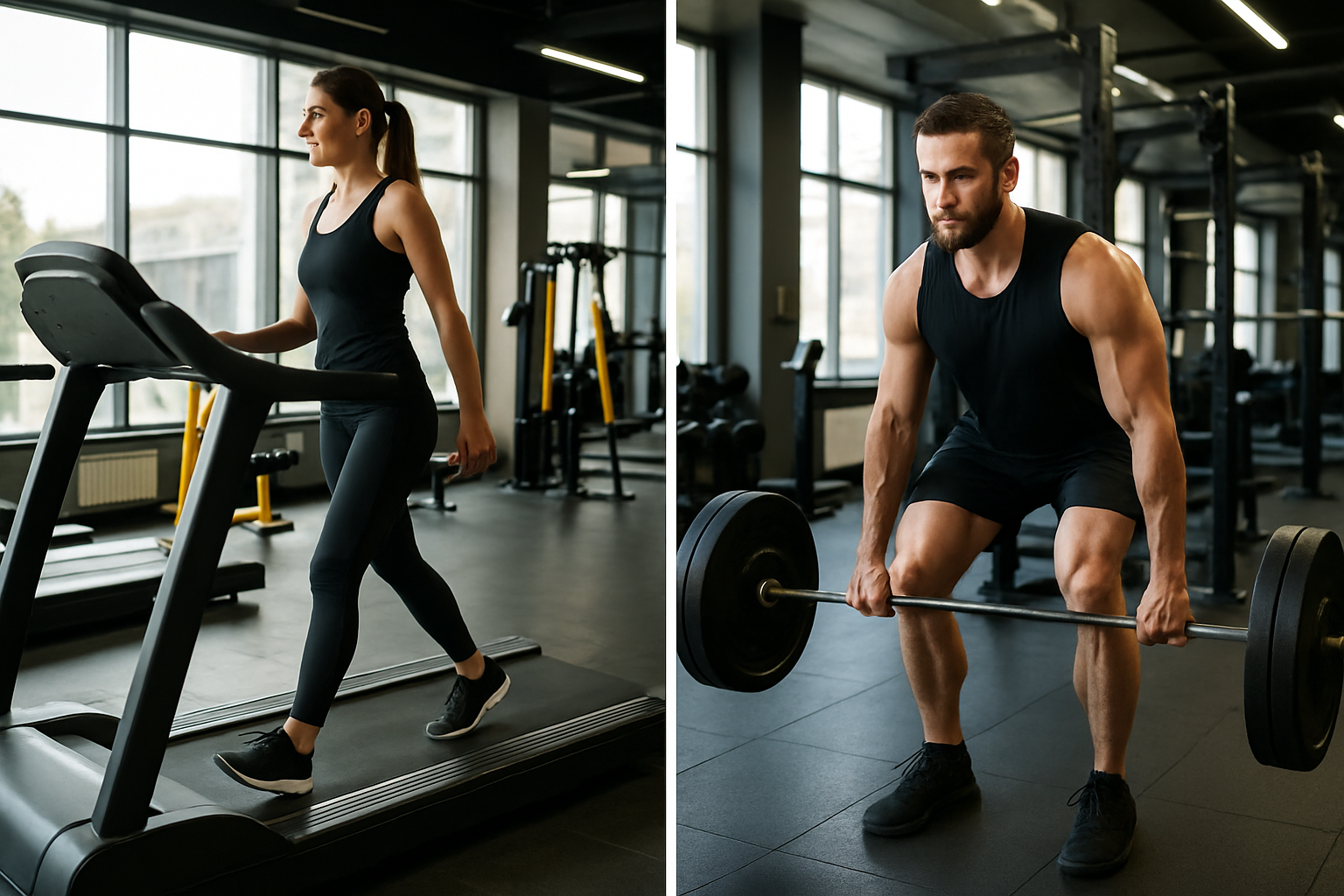

There was a stretch where I’d find myself deep in fitness rabbit holes at night, pen in hand, frantically documenting everything I could find about fat loss and training. The conventional wisdom seemed straightforward: more running equals faster fat loss. I’d observe lean endurance athletes and the logic felt airtight. That certainty evaporated once I started working with other people and began digging into what the peer-reviewed literature actually demonstrated. The debate around cardio versus weights for fat loss remains one of fitness’s most contentious subjects, yet the actual scientific evidence reveals something far more layered — and far more encouraging — than the simplistic either-or framework most people operate within.
| Training Modality | Immediate Calorie Expenditure | Body Composition Over Time | Metabolic Advantage |
|---|---|---|---|
| Aerobic Conditioning (Cardio) | 400–600 calories in 45 minutes | Moderate shifts | No enduring elevation |
| Resistance Training (Weights) | Lower per-session expenditure | Markedly superior shifts | Muscle tissue elevates baseline metabolic rate |
| Combined Protocol (Cardio + Weights) | High total expenditure | Superior fat loss and physique composition | Sustained elevation from muscle tissue |
The Cardio vs Weights for Fat Loss Debate: What Science Actually Says
Let’s get straight to the point. When researchers pit cardio-focused regimens against resistance-focused regimens in head-to-head fat loss comparisons, the findings prove surprising. A seminal study in the Journal of Applied Physiology demonstrated that while aerobic conditioning (cardio) excels at immediate calorie expenditure during exercise, weight training (resistance work) generates markedly superior shifts in body composition when tracked over weeks and months. The mechanism? Metabolic rate elevation.
Resistance exercise triggers muscle tissue development and maintenance. Muscle functions as metabolically demanding tissue — it consumes energy continuously, even during periods of rest like watching television. Scientific evidence indicates that each pound of muscle tissue requires approximately 6–10 calories daily just to sustain itself. Accumulate 5–10 additional pounds of muscle tissue over several months and you’ve effectively raised your baseline caloric expenditure in a durable, lasting way. Steady-state aerobic work doesn’t produce this same enduring metabolic advantage.
That said, dismiss cardio at your own peril. Aerobic conditioning delivers substantial gains for heart health, emotional wellbeing, and undeniably — calorie destruction during individual sessions. Forty-five minutes of running can incinerate anywhere from 400–600 calories depending on bodyweight and intensity. That volume of energy use is measurable and significant.
The Actual Solution: Why Picking One Isn’t the Right Move
Here’s what most sensationalized fitness content conveniently ignores — fat loss doesn’t require choosing between cardio and weights. The evidence points toward strategic pairing of both modalities. Research conducted at Duke University in 2012 tracked three separate cohorts: an aerobic-only group, a resistance-only group, and a group combining both. The combined protocol group achieved superior fat loss and the most favorable changes in overall physique composition. It’s intuitive when you think through it systematically, yet having research validate it carries weight.
For someone focused on fat loss, here’s how I’d structure things:
- Incorporate resistance training 3–4 times weekly. Emphasize multi-joint movements — squats, deadlifts, bench press, rowing variations. These engage numerous muscle groups simultaneously and demand more total energy expenditure relative to single-joint isolation work.
- Include 2–3 aerobic sessions each week. Intensity doesn’t need to be maximal. A moderately-paced walk, stationary bike work, or an easy-paced run all generate meaningful calorie loss without overtaxing recovery capacity.
- Make walking a cornerstone. This often catches people off guard. Walking requires minimal impact stress, remains indefinitely sustainable, and torches body fat while keeping cortisol (your body’s primary stress hormone, which can paradoxically impede fat loss) in check.
- Get your food intake dialed in. Training is only half the equation; diet choices ultimately determine the outcome. A calorie deficit — consuming less energy than you expend — is the non-negotiable foundation for any fat loss goal.
Understanding EPOC — The Post-Workout Calorie Burn
You’ve likely encountered trainers reference EPOC, shorthand for Excess Post-Exercise Oxygen Consumption. Stripped of jargon, it describes the surplus calories your body burns during the recovery window following exercise while it restabilizes. Intense resistance sessions and HIIT workouts (High-Intensity Interval Training) generate considerably higher EPOC responses compared to moderate-intensity steady-state aerobic activity. Your metabolism remains elevated even after weights are returned to the rack. That residual energy expenditure represents a metabolic advantage unique to resistance-based training that easy-paced steady running simply doesn’t replicate.
Equipment and Tools That Support Fat Loss Success
Strategic equipment choices amplify adherence — and adherence determines whether fat loss actually happens. Here are options I stand behind:
Treadmills and Walking Platforms
Given walking’s prominence in my fat-loss framework, let me share some practical options for accumulating steps indoors. These tools excel for people with limited time availability, those operating from home offices, or anyone who prefers avoiding commercial gym atmospheres.
- Walking Pad Treadmill for Home (Folding with Handle Bar) — This compact, foldable option is perfect for small spaces and slides right under a bed when you’re done. Quiet motor, easy to use, and it gets the job done. Great for morning walks while you answer emails.
- CURSOR FITNESS Walking Pad with 15% Incline — If you want to level up, this one goes up to a 15% incline and speeds of 6.2 MPH. Incline walking is one of the most underrated fat-burning tools out there — it dramatically increases calorie burn without the joint stress of running. Supports up to 300 lbs and comes with a remote control.
- WELLFIT Home Treadmills 400+LBS Capacity — A heavy-duty option with a powerful 3.0 HP motor, handrails for stability, and a generous 400-pound weight capacity. The three LED displays keep your speed, time, and distance front and center so you stay motivated.
Supplement Options With Research Support
I need to be transparent: supplements cannot substitute for whole food nutrition, dedicated training consistency, and maintaining a calorie deficit. However, certain research-validated compounds can meaningfully accelerate progress when layered onto a comprehensive program. Two standouts merit genuine consideration:
- Cellucor SuperHD Thermogenic Fat Burner — This is a well-known thermogenic supplement containing Capsimax (a concentrated capsaicin extract), green tea extract, and 160mg of caffeine. Thermogenics work by slightly raising your body temperature and metabolic rate. The ingredients in SuperHD have actual research behind them. If you tolerate caffeine well and want an energy boost alongside appetite control,
The Metabolic Accelerator for Extended Aerobic Training
During extended moderate-intensity cardio work toward fat loss, performance drops noticeably between the 20–30 minute mark—particularly when consuming below maintenance calories. A quality metabolic booster maintains work output and restrains hunger signals between training bouts without triggering the energy crash that derails program consistency.
Strengths
- The 160mg caffeine dose delivers sustained energy across a complete 45-minute cardio block—no performance cliff mid-session.
- Capsimax combined with green tea extract genuinely reduce hunger between workouts, which proves critical during caloric restriction.
- Energy elevation happens without tremor or elevated heart rate—the metabolism climbs steadily without the wired sensation some experience with stimulants.
Limitations
- Individuals with caffeine sensitivity may find 160mg excessive—the brand doesn’t manufacture a reduced-dose variant.
- This product functions as an aid, not an engine; I’ve witnessed people believe supplementation alone moves the needle, and it simply doesn’t without the deficit in place.
I stopped taking it for two weeks thinking I’d gotten “used to it,” and my afternoon energy on long cardio days tanked immediately—that’s when I realized how much it was actually working. If you’re serious about sustained fat-loss cardio, pick up the Cellucor SuperHD Thermogenic Fat Burner.
Frequently Asked Questions
How many calories does one pound of muscle burn daily?
Each pound of muscle tissue requires approximately 6–10 calories daily just to sustain itself. If you accumulate 5–10 additional pounds of muscle over several months, you’ve effectively raised your baseline caloric expenditure in a lasting way.
How many times per week should I do resistance training for fat loss?
Incorporate resistance training 3–4 times weekly, emphasizing multi-joint movements like squats, deadlifts, bench press, and rowing variations. These engage numerous muscle groups simultaneously and demand more total energy expenditure than single-joint isolation work.
How many aerobic sessions per week does research recommend?
Include 2–3 aerobic sessions each week. Intensity doesn’t need to be maximal—a moderately-paced walk, stationary bike work, or an easy-paced run all generate meaningful calorie loss without overtaxing recovery capacity.
Does running burn more calories than weight training?
Aerobic conditioning excels at immediate calorie expenditure during exercise—forty-five minutes of running can incinerate 400–600 calories depending on bodyweight and intensity. However, weight training generates markedly superior shifts in body composition over weeks and months through metabolic rate elevation.
About This Article
Written by Jordan Ellis. Jordan Ellis isn't a certified personal trainer — just someone who's been genuinely obsessed with training for over eight years and turned it into building smarter home gyms. He focuses on home fitness: effective training spaces, equipment that earns its price, and programs that work in a spare room or basement, not just a commercial gym. More about this site.
Scope and limits. Jordan is not a certified personal trainer, and nothing here is medical advice. Check with a physician before starting a new program, and prioritize form over load on every lift described.
Verify this against a primary source
Specifics change, and your situation may differ from the one described here. These are the authorities worth checking directly:
- Physical Activity Guidelines for Americans (HHS) — the federal physical activity guidelines
- American College of Sports Medicine — exercise prescription and position stands
- NSCA — strength and conditioning research