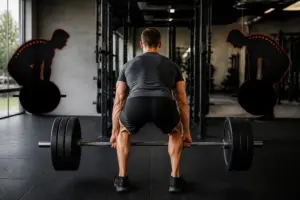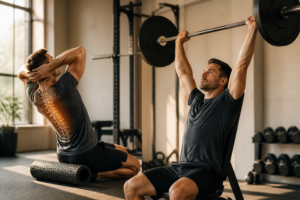

Overhead pressing stalls for plenty of lifters, and the culprit isn’t always what you’d think. Strip away the cues, the form drills, and the programming adjustments—often what you’re left with is a thoracic spine locked down by months or years of poor posture and sedentary work, refusing to extend or rotate the way the movement demands. I’ve watched this dysfunction appear across dozens of trainees in different contexts, and tracing it backward almost always points to the same issue: restricted thoracic mobility. If you want the full anatomy breakdown, how to test it yourself, and a comprehensive set of drills to address it, I’ve detailed all of that here. What follows is about a single piece of equipment that shifted things for a friend when verbal coaching and bodyweight work hit a wall.
The One Thoracic Tool That Broke Through a Plateau
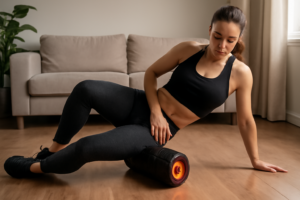
Cueing and movement drills can only take you so far when the tissue itself won’t cooperate. My person needed actual mechanical change in that thoracic region—extension and rotation capacity that no amount of verbal feedback was generating. The Chirp Wheel became the intervention that made his overhead position functionally press-like instead of visibly compromised.
What works
- Its curved profile targets the thoracic spine far more effectively than any standard roller—you notice the specificity the instant you load into extension on it.
- Movement and rotation happen while your body is supported by the tool, which means you’re training mobility through ranges that directly transfer to pressing positions rather than simply holding passive stretches.
- The footprint is compact enough that home use stays practical—people will actually deploy it regularly, and that sustained routine is what drives real mobility improvements.
What doesn’t
- The firmness requires an adaptation period—early users often interpreted the initial sensation as excessive intensity, when what was actually happening was their body learning to relax under unfamiliar pressure.
- It carries a premium relative to basic foam rolling tools, and it’s tempting to deprioritize the purchase if mobility isn’t already a structured part of your training.
I was skeptical the first week—wondered if I was just throwing another gadget at the problem—but after two weeks of consistent use, my friend’s thoracic extension came back enough that he could finally press overhead without compensation.
Frequently Asked Questions
Can a Chirp Wheel fix my stalled overhead press?
A Chirp Wheel can help if restricted thoracic mobility is the bottleneck. Poor posture and sedentary work often lock down thoracic extension and rotation, which overhead pressing demands. The curved profile targets the thoracic spine more effectively than standard rollers, restoring extension capacity. One person saw functional improvement after two weeks of consistent use.
Is the Chirp Wheel uncomfortable at first?
Yes, the firmness requires an adaptation period. Early users often interpret the initial sensation as excessive intensity, when their body is actually learning to relax under unfamiliar pressure. Pushing through that adjustment period—rather than avoiding the tool—is what drives real mobility improvements.
How does Chirp Wheel compare to a standard foam roller?
The Chirp Wheel’s curved profile targets the thoracic spine far more effectively than flat rollers. You notice the specificity immediately when you load into extension. It also supports movement and rotation through pressing-relevant ranges rather than just holding passive stretches, and the compact footprint makes consistent home use practical.
How long does it take to see results from a Chirp Wheel?
Results depend on consistency. After two weeks of regular use, one lifter regained enough thoracic extension to press overhead without compensation. Sustained routine is what drives real mobility improvements, so sporadic use won’t generate the same benefit.
About This Article

Written by Jordan Ellis. Jordan Ellis isn't a certified personal trainer — just someone who's been genuinely obsessed with training for over eight years and turned it into building smarter home gyms. He focuses on home fitness: effective training spaces, equipment that earns its price, and programs that work in a spare room or basement, not just a commercial gym. More about this site.
Scope and limits. Jordan is not a certified personal trainer, and nothing here is medical advice. Check with a physician before starting a new program, and prioritize form over load on every lift described.
Verify this against a primary source
Specifics change, and your situation may differ from the one described here. These are the authorities worth checking directly:
- Physical Activity Guidelines for Americans (HHS) — the federal physical activity guidelines
- American College of Sports Medicine — exercise prescription and position stands
- NSCA — strength and conditioning research