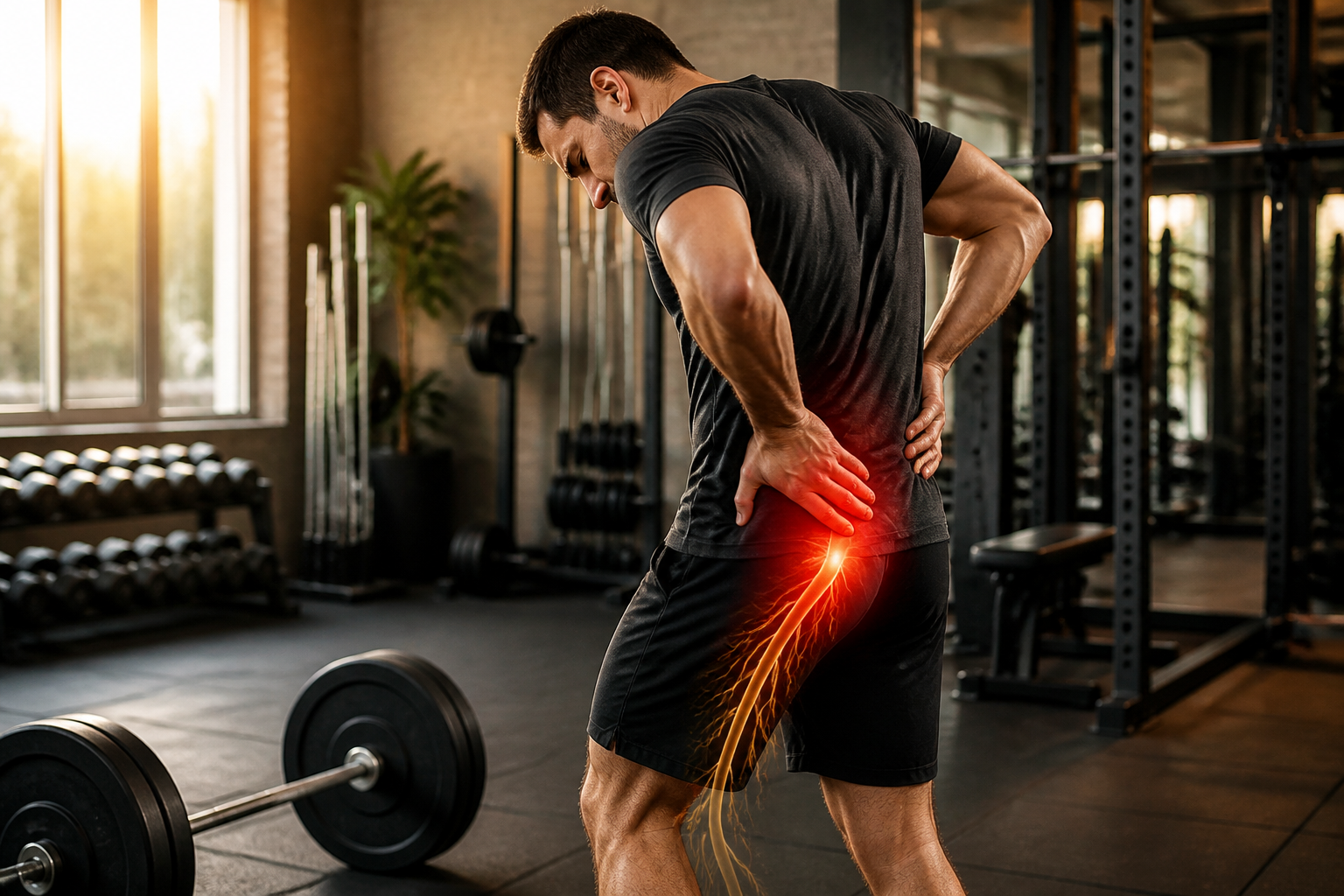
Sciatica From Lifting: A Lifter’s Guide to Fixing It Without Quitting the Gym
By Jordan Ellis, Strength & Conditioning Coach
You felt a twinge during your last deadlift session. Now, a week later, you’ve got sharp pain radiating down your leg, tingling in your foot, and your search history looks like “can I squat with sciatica” and “will I ever lift again.”
Google tells you to rest, stretch, and call your doctor. Your YouTube rabbit hole suggests it’s piriformis syndrome and you need to foam roll your glutes into oblivion. Reddit lifters are telling you their stories of six-month layoffs and MRI machines.
Here’s what they’re all missing: Most sciatica in lifters is disc-related, and you don’t need to quit training—you need to train smart.
After years of coaching lifters through this exact problem, I’ve learned that complete rest makes things worse, random stretching can aggravate the nerve, and the right approach lets you stay in the gym while healing. The McKenzie method combined with intelligent exercise modification works better than shutdown protocols, and the timeline is much shorter than you think.
This guide is specifically for lifters. It’s not what your search engine or generic PT will tell you.
What Sciatica Actually Is (And Why It Matters for Your Training)
Sciatica isn’t a diagnosis—it’s a symptom. It means the sciatic nerve, the longest nerve in your body, is irritated.
The nerve exits your lower spine and travels down through your glutes, hamstrings, and all the way to your foot. When something presses on it—usually a disc herniation or bulge—you get pain, tingling, numbness, or weakness radiating down your leg. It’s often one-sided.
In lifters, the culprit is almost always a lumbar disc issue, not the piriformis muscle that YouTube loves to blame. Your disc has shifted slightly, pressing on a nerve root. The good news: discs heal. They reabsorb. Most people recover completely.
The reason this distinction matters: your training approach depends on what’s causing the nerve irritation. And that’s where most advice fails.
Disc-Related vs. Piriformis: How to Tell the Difference
Before you do anything, figure out what you’re dealing with. The distinction changes everything about your recovery plan.
Disc-Related Sciatica (The Most Common in Lifters)
Movement pattern: Pain gets worse with forward bending, sitting for long periods, deadlifting from the floor, or any spinal flexion under load. Your pain might ease when you stand up and arch backward slightly.
The SLUMP test: Sit in a chair. Round your lower back, then straighten one leg. If this significantly aggravates your leg pain, you likely have a disc issue. The test is positive because it stretches the dura (the sheath around your nerve) and increases pressure on a herniated disc.
Piriformis Syndrome (Less Common in Lifters, Overhyped on the Internet)
Movement pattern: Pain worsens with prolonged sitting on hard surfaces, deep hip external rotation (like a pigeon pose), or walking uphill. Pain usually improves with standing and movement.
The FAIR test (Flexion, Adduction, Internal Rotation): Lie on your back. Cross one leg over your opposite knee. Pull that knee toward your opposite shoulder. If this aggravates your pain, piriformis syndrome is a candidate.
Most lifters reading this? You’ve got a disc issue. And the McKenzie approach is your best tool.
When to Stop and See a Doctor Immediately
Before we talk about training around sciatica, you need to know the red flags. These mean you stop training and go to an emergency room or urgent care:
- Loss of bladder or bowel control: This is cauda equina syndrome. Your entire nerve bundle is compressed. This is a surgical emergency and extremely rare, but it exists.
- Progressive weakness in your foot or inability to lift your toes: Foot drop suggests a nerve root is dying. You need imaging and specialist evaluation.
- Bilateral symptoms (pain on both sides): This also suggests cauda equina involvement.
- Pain that doesn’t change with ANY position: Mechanical pain usually has a directional preference. If nothing helps and pain is constant and severe, see a professional before self-managing.
If you have none of these, you likely have a manageable disc irritation. Keep reading.
The McKenzie Method: Your Secret Weapon for Disc-Related Sciatica
Robin McKenzie, a New Zealand physiotherapist, developed a system based on a simple principle: most disc problems respond to repeated extension movements, not flexion.
This runs counter to what your body wants to do (curl up and protect itself), but it works.
The Core Exercise: Prone Press-Ups
Here’s the protocol during acute flare-ups:
Setup: Lie face down on a comfortable surface. Place your hands under your shoulders, like you’re about to do a push-up. Your hips and legs stay relaxed on the ground.
Movement: Push your upper body up with your arms, extending your spine. Go only as far as is comfortable—you’re not trying to do a full cobra or achieve full extension immediately. You’ll feel mild pressure in your lower back; that’s normal. You should NOT feel sharp pain.
Dosage: 10 repetitions. Rest for a minute. Repeat.
Frequency: Every 2 hours during the acute phase (first few days to a week). As pain decreases, you can reduce frequency to every 4-6 hours, then 1-2 times daily for maintenance.
Centralization: The Magic Sign
Here’s what to watch for: Does your leg pain move closer to your spine?
If you start with pain in your calf and, after a few sets of press-ups, the pain moves to your thigh, and then to your glute—that’s centralization. This is a positive prognostic sign. Your nerve is decompressing. The pain is moving from the periphery back toward the source, which means the disc is rebounding.
If your leg pain gets worse, the press-ups aren’t working for you. You might have a different presentation, and you need professional assessment.
What You Can Keep Doing (The Good News)
This is the part that separates smart training from shutdown protocols: you don’t have to stop training entirely.
Keep These Movements
Upper body pressing and pulling (pain-free): Bench press, incline press, rows, pull-ups, lat pulldowns—all fine as long as they don’t cause leg pain. Your sciatica isn’t aggravated by horizontal pressing. Use this opportunity to build upper body work.
Walking: This is the best medicine. 20-30 minute walks, multiple times daily if possible. Walking doesn’t load the spine heavily, keeps your nervous system engaged, and promotes disc reabsorption. Do this.
Leg press (modified): If your leg press machine is tolerable with short range of motion (not going into deep flexion), you can continue it. Use partial reps, lighter weight, and monitor symptoms. Many lifters find this works fine during recovery.
Pain-free core work: Not traditional sit-ups. We’re talking about the McGill Big 3, which I’ll detail below.
What You Need to Modify (Temporarily)
Back squats: Heavy spinal loading + flexion under load = irritation. Switch to goblet squats (light dumbbell held at chest) or belt squats (loading through the hips, not the spine). You’ll maintain leg strength without aggravating the disc.
Conventional deadlifts: The worst culprit. Switch to trap bar deadlifts with elevated handles (reduces spinal flexion angle) or rack pulls above the knee (shortens range of motion, removes the flexion component). These maintain deadlift strength without the problematic loading pattern.
Heavy barbell rows: The spinal loading and potential flexion under fatigue is risky. Switch to dumbbell rows (less symmetrical loading, more stable), seal rows (supported back), or machines.
Avoid completely for 2+ weeks: Sit-ups, crunches, good mornings, heavy back squats, and any heavy barbell work that loads the spine in flexion.
The rule: if an exercise requires you to bend forward under load, drop it for now.
The McGill Big 3: Core Stability for Spine Patients
Dr. Stuart McGill, a spine biomechanist, studied what core work actually helps disc patients. His conclusion: traditional sit-ups make disc problems worse. They compress the disc and flex the spine repeatedly—exactly what you don’t want.
Instead, his research supports three isometric exercises:
1. Bird Dog
Setup: Hands and knees position. Tighten your core.
Movement: Extend one arm forward and the opposite leg backward simultaneously. Hold for 10 seconds. Return. Alternate sides.
Dosage: 8 reps per side, once daily. This teaches core stability without spinal motion.
2. Side Plank
Setup: Lie on your side, propped on your forearm. Your body should form a straight line.
Movement: Hold. Don’t sag. Don’t pike your hips up. Neutral spine.
Dosage: 20-30 seconds per side. Build to 60 seconds over weeks. This trains lateral stability.
3. Curl-Up (Not a Sit-Up)
Setup: Lie on your back, knees bent, feet flat. Place one hand under your lower back.
Movement: Raise your shoulders slightly off the ground—just your head and upper back. Think “nod” rather than “crunch.” Your lower back should stay pressed against your supporting hand. Hold for 2 seconds. Lower.
Dosage: 8-10 reps, once daily. This is minimal flexion, maximum control.
Do this Big 3 once daily. That’s your core work. It’s boring, but McGill’s research showed it’s more effective than traditional ab training for people with disc issues.
Nerve Flossing: Gentle Decompression
Nerve flossing (also called nerve gliding) helps the sciatic nerve move through the surrounding tissue without inflammation. Think of it as “massage for the nerve” rather than aggressive stretching.
Supine Sciatic Nerve Glide
Setup: Lie on your back near the edge of a bed or couch. One leg hangs off the edge, knee bent at 90 degrees. Use your hands to hold the other thigh.
Movement: Straighten the supported leg (knee extension) while pulling your toes toward your shin (dorsiflexion). You’ll feel a gentle stretch down the back of your leg. Hold 1 second, then reverse: bend your knee and point your toes away (plantarflexion). This is one gentle oscillation.
Dosage: 2 sets of 15 gentle oscillations, once or twice daily.
Critical rule: Never force this into sharp pain. This should feel like a mild sensation, not aggressive stretching. You’re teaching the nerve to move, not attacking it.
The Timeline: When Will This Resolve?
Most disc-related sciatica resolves in 6-12 weeks with conservative management. Research shows 90% of people with disc herniations do not need surgery. The disc naturally reabsorbs; your body heals itself.
Here’s what you can expect:
Weeks 1-2: Acute phase. Frequent McKenzie press-ups (every 2 hours). Minimal training. Walking and modified upper body work only. Pain often worsens before improving (this is normal during the first few days).
Weeks 3-6: Pain begins centralizing. You can increase training volume. Introduce modified squats and deadlifts. Start reintroducing barbell work with lighter loads.
Weeks 6-12: Return to normal training. Most lifters report 80-90% pain reduction by week 8. Full clearance to heavy spinal loading usually by week 12.
This assumes you’re actually doing the protocol. Lifters who ignore it and keep heavy deadlifting? Their timeline stretches to months.
Prevention: Never Deal With This Again
Once you’ve experienced sciatica, you’ll do anything to avoid it again.
Hip Hinge Mechanics
Most disc herniations happen during deadlifts and squats when you’re fatigued and your form breaks down. Your low back starts doing the work instead of your hips and glutes. Train the hip hinge: bending from your hips, not your spine. This is technical, but it matters.
Bracing Technique
Before heavy lifts, take a deep breath into your belly and brace your core. This increases intra-abdominal pressure and stabilizes your spine. Many lifters skip this on lighter work, then lose it on heavy sets when they’re tired.
Avoid Flexion Under Load When Fatigued
Never deadlift from the floor, squat deep, or do heavy rows when you’re running on empty. This is when form breaks down and discs get irritated. Use good judgment about exercise selection based on fatigue level.
Don’t Skip Deloads
Regular deload weeks reduce cumulative spinal stress. Your discs need recovery just like your muscles do.
The Bottom Line: You Can Train Through This
Sciatica sucks. The pain is real and it’s distracting. But it’s not permanent, and it doesn’t mean your lifting career is over.
The McKenzie approach works. Intelligent exercise modification works. Understanding the difference between disc and piriformis issues works. And the data is clear: most people recover completely with conservative management.
You don’t need to quit the gym. You need to be smarter about how you train for the next 6-12 weeks. Your future self—the one pain-free and back to heavy deadlifts—will thank you for taking this seriously now.
Stay strong. Stay smart. You’ll get through this.
Managing Seated Pressure While You Train Through It
During the active loading phase of this protocol, you’re spending time at a desk or in a car between sessions—and prolonged sitting with poor lumbar support can undo your progress. I have people use a quality memory foam seat cushion during these in-between hours to manage pressure on the nerve and maintain neutral spine positioning while they’re doing the real work in the gym.
Disc-related sciatica worsens with forward bending, sitting, or deadlifting—and improves when you arch backward. Try the SLUMP test: sit, round your lower back, then straighten one leg. If this aggravates leg pain, it’s likely disc-related. Piriformis pain worsens with prolonged hard-surface sitting and deep hip external rotation, and improves with standing. Most lifters have disc issues. You don’t need to quit the gym. Keep pain-free upper body pressing and pulling, walking 20–30 minutes multiple times daily, and modified leg press with short range of motion. Temporarily avoid back squats, conventional deadlifts, heavy barbell rows, sit-ups, crunches, and good mornings. Train smart, not shutdown. During the acute phase (first few days to a week), do 10 repetitions every 2 hours. Rest one minute between sets. As pain decreases, reduce frequency to every 4–6 hours, then 1–2 times daily for maintenance. Watch for centralization—pain moving from your calf toward your spine—which signals the disc is rebounding. Do the McGill Big 3 once daily: bird dog (8 reps per side, 10-second holds), side plank (20–30 seconds per side, building to 60 seconds), and curl-ups (8–10 reps, minimal flexion). Skip traditional sit-ups and crunches—they compress the disc and worsen disc problems.Exercise Status During Recovery Reason Upper body pressing and pulling (bench, rows, pull-ups) Keep doing Pain-free; sciatica not aggravated by horizontal pressing Walking Keep doing Best medicine; 20-30 minutes multiple times daily Leg press (modified, short range of motion) Keep doing Tolerable with partial reps and lighter weight Pain-free core work (McGill Big 3) Keep doing Bird dog, side plank, curl-ups safe; no disc compression Back squats Modify to goblet or belt squats Heavy spinal loading + flexion aggravates disc Conventional deadlifts Modify to trap bar or rack pulls Worst culprit; spinal flexion under load irritates disc Heavy barbell rows Modify to dumbbell or machine rows Spinal loading and flexion under fatigue risky Sit-ups, crunches, good mornings Avoid 2+ weeks Load spine in flexion; compress disc Frequently Asked Questions
How do I know if my sciatica is from a disc or piriformis?
Can I keep training with sciatica or must I rest completely?
How often should I do McKenzie prone press-ups during acute sciatica?
What core exercises are safe for someone with disc-related sciatica?
About This Article

Written by Jordan Ellis. Jordan Ellis isn't a certified personal trainer — just someone who's been genuinely obsessed with training for over eight years and turned it into building smarter home gyms. He focuses on home fitness: effective training spaces, equipment that earns its price, and programs that work in a spare room or basement, not just a commercial gym. More about this site.
Scope and limits. Jordan is not a certified personal trainer, and nothing here is medical advice. Check with a physician before starting a new program, and prioritize form over load on every lift described.
Verify this against a primary source
Specifics change, and your situation may differ from the one described here. These are the authorities worth checking directly:
- Physical Activity Guidelines for Americans (HHS) — the federal physical activity guidelines
- American College of Sports Medicine — exercise prescription and position stands
- NSCA — strength and conditioning research