Should You Work Out With a Pulled Muscle? A Practical Decision Framework
You felt it the moment it happened. A sharp twinge. A sudden tightness. Maybe you heard a small pop. Now you’re sitting on the gym floor wondering: do I stop training entirely, or can I keep going?
The generic internet answer is always the same: “Rest for 1-2 weeks.” Google’s AI doesn’t know the difference between a mild muscle twinge and a complete tear. It can’t tell you whether your hamstring pull should sideline you for three days or three months. And it definitely won’t tell you that complete inactivity might actually slow your recovery.
After eight years of training seriously, I’ve learned that the decision to train around an injury isn’t binary. It’s a spectrum. And the right answer depends entirely on what you actually injured.
This framework will show you exactly how to assess your strain, decide what training is safe, and actually accelerate your recovery instead of sabotaging it.
First: Understand the Grading System
Before you can decide whether to train, you need to know what you’re dealing with. Muscle strains are classified into three grades. Most people have never heard of this, which is why they treat a mild twinge the same way they’d treat a complete tear.
Grade 1 (Mild Strain)
This is the “ouch” injury. You feel discomfort, but the muscle still works. During activity, there’s mild pain—maybe a 3/10 on the pain scale. Swelling is minimal or absent. You can still use the muscle, just not at full capacity. This is the “twinge” in your hamstring during a hard sprint, or the slight pull in your shoulder during an aggressive bench press.
Grade 1 strains happen to every serious lifter. They’re annoying, not catastrophic.
Grade 2 (Moderate Strain)
Now we’re talking about actual injury. Significant pain—probably 5-7/10. Visible swelling and possibly bruising. Noticeably reduced strength. You can’t fully use the muscle. A Grade 2 is what happens when you deadlift with poor form and feel sharp pain through your lower back, or when you walk down stairs and your quad seizes up. Movement is still possible, but it’s clearly compromised.
This requires structured modification and active monitoring.
Grade 3 (Severe/Complete Tear)
Extreme pain at the moment of injury—8-10/10. Significant swelling and bruising develop within hours. Complete loss of function in that muscle. Sometimes you can actually feel a gap in the muscle belly or see it bunching abnormally. This is rare in the gym for most people, but it happens: a pec tendon rupture on a heavy bench press, a complete bicep tear on a loaded curl.
Grade 3 strains require medical attention and imaging. This is not a “train around it” situation.
The Decision Framework: What to Do Right Now
Here’s the practical framework I use with the people I train with. Follow your grade down through the decision tree.
Grade 1: Train Around It
Timeline: 3-5 days before returning to direct work on that muscle
This is where most people make their mistake. They feel that twinge and stop everything. They rest for a week, then come back and immediately try to lift heavy again. The muscle has now deconditoned, and the recovery takes longer.
Instead: Skip direct work on that muscle for 3-5 days, but train everything else normally. Gentle movement of the injured area actually speeds healing.
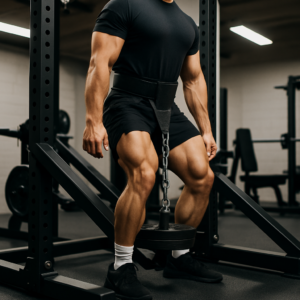
Your hamstring has a Grade 1 strain? You can still squat (usually completely pain-free), still train upper body, still do lower body cardio. You just skip deadlifts and leg curls for a few days. The gentle tension from squatting increases blood flow to the injured tissue without creating additional damage.
After 3-5 days, start reintroducing the direct movement with very light loads—50% of your normal weight. If that feels fine, progress to 75% the next session. By day 7-10, you’re back to normal.
Grade 2: Modify Training
Timeline: 1-2 weeks before gradual reintroduction
This is a legitimate injury that requires structure. You’re not training through it; you’re training around it while it heals.
For the first 1-2 weeks:
- Completely avoid the injured muscle’s primary movement pattern
- Train all unaffected body parts normally
- Perform light, pain-free movement of the injured area (mobility, very light activation work)
- If no improvement after 2 weeks, see a physical therapist
After 1-2 weeks, begin very gradual reintroduction. Start with 30-40% of your normal weight. The rule: if it causes pain beyond mild discomfort, you’re going too heavy. Progress 10-15% each session if pain-free.
Grade 3: Stop. See a Doctor.
Timeline: Medical evaluation required
Get imaging done (ultrasound or MRI). Complete training suspension of that muscle until medically cleared. This typically means 4-12 weeks depending on the tear severity and whether surgery is needed. Train everything else, but don’t touch the injured area until your doctor says it’s safe.
How to Train Around Specific Muscle Strains
Here’s what I tell the people I train with when common strains happen:
Hamstring Pull (Grade 1-2)
Keep squatting—quadriceps-dominant movements are usually pain-free. Skip deadlifts, RDLs, and leg curls. Upper body training is unaffected. Light walking and mobility work on the hamstring is beneficial. After 1-2 weeks (depending on grade), reintroduce RDLs with light weight before deadlifting.
Pec Strain (Grade 1-2)
Lower body training continues normally. Back work continues normally. Skip all pressing movements—bench press, overhead press, dips. When you return, start with machine work or dumbbells (which allow a more natural range of motion) before returning to barbells. Eventually modify grip width if the injury was specific to a particular pressing angle.
Lower Back Strain (Grade 1-2)
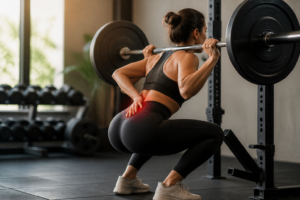
Upper body training continues. Switch to spine-neutral movements: leg press, leg curl, and leg extension instead of squats and deadlifts. Walk daily—this is one of the best things you can do for lower back recovery. Avoid loaded spinal flexion or extension. After 1-2 weeks, reintroduce squats with light weight before deadlifting.
Bicep Strain (Grade 1-2)
All pressing movements continue normally. Skip curls and heavy pulling (strict pullups, heavy rows) temporarily. Light chin-ups or assisted pullups (which involve the bicep less) are usually fine. After 1-2 weeks, reintroduce curls with light weight. Heavy pulling comes last.
PEACE & LOVE: The Modern Recovery Framework
For decades, trainers prescribed RICE (Rest, Ice, Compression, Elevation). We now know this is outdated science.
In 2020, Dubois and Esculier published research showing that ice actually delays healing by suppressing inflammation—which is a necessary part of the repair process. Complete rest beyond the acute phase (48-72 hours) leads to deconditioning and slower recovery.
The modern framework is PEACE & LOVE:
Acute Phase (First 48-72 hours): PEACE
- Protection: Avoid movements that increase pain
- Elevation: Reduce swelling
- Avoid anti-inflammatories: Let inflammation do its job (unless pain is severe)
- Compression: Manage swelling
- Education: Understand what you injured
Recovery Phase (After 72 hours): LOVE
- Load: Progressive, pain-free loading accelerates recovery
- Optimism: Psychological state matters—people who expect to recover fully do recover faster
- Vascularization: Light activity and movement increase blood flow to the injury
- Exercise: Structured, progressive training is part of the cure, not the enemy
This is why my Grade 1 and Grade 2 protocols include movement and light training. You’re not resting your way back to strength. You’re loading your way back.
Return to Full Training: The Progression Protocol
Don’t test your recovery with heavy weight. This is how people re-injure themselves. Instead, follow this simple progression:
Stage 1: Pain-Free Through Full Range of Motion
Can you move the injured muscle through its complete range of motion without pain? This is the starting point. No weight, no resistance. Just movement.
Stage 2: Light Load, Full Range of Motion
Can you perform your movement with very light weight (30-50% of your normal weight) with zero pain? If yes, progress.
Stage 3: Moderate Load, Full Range of Motion
Can you handle 70-80% of your normal weight with zero pain? If yes, you’re nearly there.
Stage 4: Full Training
Return to your normal weight and volume, but progress conservatively for the first 2-3 weeks. Don’t immediately jump back to your previous PR attempts.
This entire progression typically takes 2-4 weeks for Grade 1 strains and 4-8 weeks for Grade 2 strains.
The Psychological Side: Why Mindset Matters
Here’s what most trainers won’t tell you: a muscle strain feels catastrophic in the moment, but it almost never is. A Grade 1 or Grade 2 strain will heal completely with proper training. You will return to full strength.
The biggest mistake people make isn’t pushing too hard—it’s the opposite. Complete inactivity and deconditioning cause far more problems than the original injury. I’ve seen athletes take two weeks completely off and come back weaker, stiffer, and actually taking longer to recover than if they’d trained around the injury from day one.
The research backs this up: expectancy of recovery significantly improves actual recovery. When you believe you’ll be back to full capacity, you typically are.
Final Checklist: What to Do This Week
1. Grade your strain honestly using the definitions above
2. Follow the corresponding protocol (Train Around for Grade 1, Modify for Grade 2, Doctor for Grade 3)
3. Apply PEACE in the acute phase, then LOVE during recovery
4. Continue training unaffected body parts at normal intensity
5. Progress your injured muscle gradually—don’t test it with heavy weight
6. If you’re not improving after 2 weeks, see a physical therapist
Most muscle strains are not career-ending. They’re not even season-ending. They’re training problems that require training solutions, not rest solutions.
Use this framework, stay patient with the progression, and you’ll be back to full strength faster than if you’d done nothing at all.
—Jordan Ellis is a home-gym builder who has spent eight years testing equipment and training in his own garage. He specializes in injury prevention and return-to-sport protocols.
The Tool I Use Between Loading Sessions
During the active recovery phases of this protocol—especially when you’re reintroducing controlled movement to a Grade 1 or early Grade 2 strain—managing inflammation between sessions matters. I have the people I train with rotate between cold compression for the first 48 hours post-injury and heat during the loading phase to support blood flow to the healing tissue, and having a reusable pack that does both eliminates the excuse to skip this step.
Yes. Skip direct work on that muscle for 3-5 days, but train everything else normally. Gentle movement of the injured area speeds healing by increasing blood flow without creating additional damage. After 3-5 days, reintroduce the movement with 50% of your normal weight, then progress to 75% the next session. You’re usually back to normal by day 7-10. For the first 1-2 weeks, completely avoid the injured muscle’s primary movement pattern while training all unaffected body parts normally. Perform light, pain-free movement of the injured area. After 1-2 weeks, begin gradual reintroduction starting at 30-40% of your normal weight, progressing 10-15% each session if pain-free. If no improvement after 2 weeks, see a physical therapist. PEACE applies in the first 48-72 hours: Protection, Elevation, Avoid anti-inflammatories, Compression, and Education. LOVE applies after 72 hours: Load progressively, maintain Optimism, increase Vascularization through light activity, and do structured Exercise. Research shows complete rest beyond 48-72 hours actually delays healing and causes deconditioning. Yes, immediately. Grade 3 strains involve extreme pain, significant swelling and bruising, and complete loss of function. Get imaging done with ultrasound or MRI. Suspend all training of that muscle until medically cleared, which typically takes 4-12 weeks depending on severity and whether surgery is needed.Frequently Asked Questions
Can I train with a Grade 1 muscle strain?
How long should I rest a Grade 2 muscle strain?
What does the PEACE and LOVE framework mean?
Should I see a doctor for a Grade 3 muscle strain?
About This Article

Written by Jordan Ellis. Jordan Ellis isn't a certified personal trainer — just someone who's been genuinely obsessed with training for over eight years and turned it into building smarter home gyms. He focuses on home fitness: effective training spaces, equipment that earns its price, and programs that work in a spare room or basement, not just a commercial gym. More about this site.
Scope and limits. Jordan is not a certified personal trainer, and nothing here is medical advice. Check with a physician before starting a new program, and prioritize form over load on every lift described.
Verify this against a primary source
Specifics change, and your situation may differ from the one described here. These are the authorities worth checking directly:
- Physical Activity Guidelines for Americans (HHS) — the federal physical activity guidelines
- American College of Sports Medicine — exercise prescription and position stands
- NSCA — strength and conditioning research