
Most people assume that training harder every single session is the path to muscle growth — but the opposite is often true. Grinding through every workout without strategic recovery leaves you depleted, stalled, and vulnerable to injury. The push pull workout split solves this by organizing your training around movement patterns, not body parts, so each muscle group receives both substantial stimulus and genuine time to recover between sessions. It’s an approach grounded in exercise science that athletes and strength professionals use to build muscle and strength without running into the wall.
What Is a Push-Pull Split and Why Does It Work?
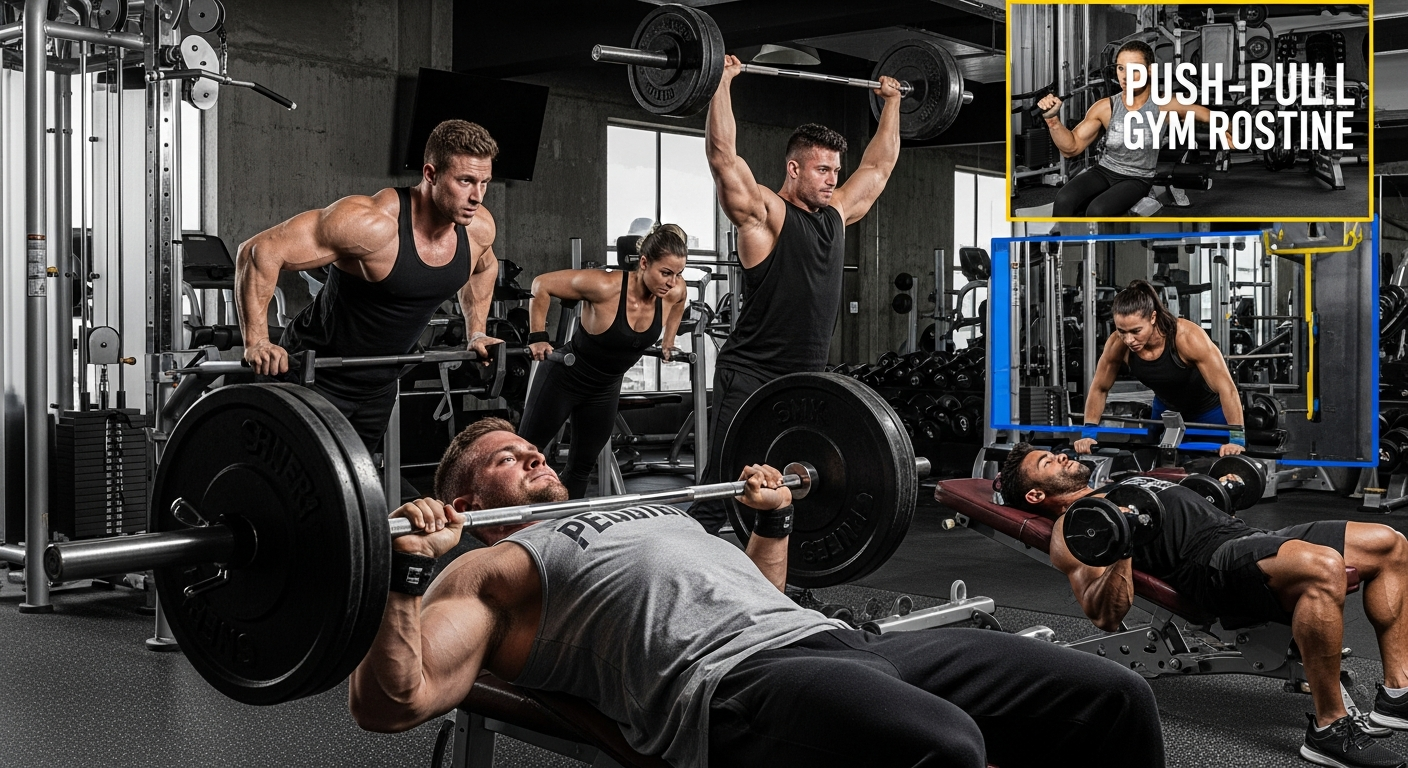
The push-pull split structures your week by categorizing exercises into two opposing movement types. During push sessions, you target chest, shoulders, and triceps — any lift where force moves away from your body. During pull sessions, you work back, biceps, and rear delts — movements that draw the weight inward. The method itself isn’t random; it reflects fundamental patterns in how muscle tissue responds to load and recovers.
The advantage backed by research is clear and practical: concentrating all pressing movements into a single session lets you accumulate substantial work on those patterns while your pulling muscles simultaneously rest and repair. The following session reverses this demand. Researchers refer to this as optimal recovery partitioning — your central nervous system and soft tissues experience focused stimulus without the accumulated wear of taxing opposing muscle groups within the same training day.
This framework also eliminates the muscular imbalances I struggled with during my early overtraining phase. Fatigue clouds judgment, and you end up skipping the exercises you find challenging. A structured push-pull split mandates equal attention to both pushing and pulling movement patterns, developing a more robust and durable physique that resists injury.
The Science Behind Push Pull Workouts
The mechanics of push pull workouts distill into three core principles. First, dividing your sessions by movement category prevents overlapping systemic fatigue: pressing muscles recover passively while pulling work happens, so no muscle group is asked to perform while still depleted from the prior session. Second, this structure naturally creates the training frequency — hitting each movement pattern twice weekly — that peer-reviewed analyses consistently link to superior muscle growth compared to once-per-week body-part routines. Third, balancing push and pull volume equally protects shoulder joint health and counteracts the anterior-chain dominance that press-focused programs create.
You don’t need complex periodization schemes. The split itself encodes the science — consistency and progressive effort on your lifts is all that’s required.
Push Days: Building Pressing Strength and Volume
Push sessions typically begin with a pressing variation — barbell bench press, incline dumbbell press, or overhead press — executed for 3–5 sets in the 5–8 rep range. This is your primary strength block, performed when your nervous system is most prepared and capable of moving substantial weight. The objective is steady progression: increasing load or repetitions with each passing week.
Once your main pressing work is complete, transition into hypertrophy-focused movements: dumbbell presses, machine chest work, or cable flyes using moderate loads for 8–12 reps. These build muscle size through mechanical tension. Cap the session with isolation or higher-repetition accessories — shoulder raises, dip variations, or rope pushdowns — targeting 12–15 reps to generate metabolic stress, a crucial hypertrophy stimulus.
The recurring pattern I observe: lifters attempt to lift maximally on every single exercise. That’s the trap I fell into. Reserve your maximum effort for the primary pressing movement. Subsequent exercises should feel deliberate and maintainable.
Pull Days: Maximizing Vertical and Horizontal Pulling
Pull sessions mirror the push-day structure: a primary pulling movement — vertical or horizontal (weighted pull-ups, barbell rows, or lat pulldowns) for strength development, followed by hypertrophy-range work (assisted pull-ups, dumbbell rows, machine rows), and concluding with high-rep accessory movements (cable rows, face pulls, or bicep curls).
The vertical pulling movement — pull-ups, chin-ups, or lat pulldowns — deserves particular attention because most home environments don’t offer the same heavy-load pulling options that pressing work provides. This is precisely where a reliable piece of equipment becomes indispensable.
The Pull Up Bar That Finally Made Home Training Viable
Push-pull training demands substantial vertical pulling volume, yet many home environments lack cable stations or lat pulldown machines. A doorway pull up bar bridges this gap efficiently, occupying minimal space while eliminating the excuse not to train pulling on your designated pull days — no power rack required, no permanent home modifications necessary.
What works
- Installs in seconds with zero permanent alterations, making it portable between doorways and suitable if you rent your living space.
- Remains rock-solid under load once properly positioned, a non-negotiable feature when handling heavy pull-up sets across multiple rounds of 5–8 reps.
- Compact design stays out of the way throughout your day, so the equipment actually gets used rather than becoming an obstacle you navigate around.
What doesn’t
- Height is locked to your specific doorframe, which creates problems for taller individuals or for movements like hanging leg raises if your door opening is insufficient.
- Finish on wall trim and paint deteriorates with repeated use, particularly if you rotate the bar across different doors or your door frames lack rigidity.
I was skeptical the first week — thought the bar would slip or shift mid-set — but it stayed locked solid through weighted pull ups and high-rep sets. If you’re serious about a push-pull split at home, grab a doorway pull up bar.
Frequency and Programming: How Often Should You Push and Pull?
Most athletes structure a push-pull split between 2–4 weekly sessions. The standard approach involves two push sessions paired with two pull sessions, plus a dedicated day for lower body or complete rest. If you prefer to allocate a separate training day to leg development, the push pull legs routine applies this same partitioning concept across three divisions. Some trainees incorporate a fourth session — either an additional push or pull day — if upper body emphasis is the goal. Overall frequency matters less than sustained adherence and proper spacing — stimulating each movement pattern sufficiently to trigger adaptation, paired with adequate rest intervals (typically 48 hours minimum) between sessions to allow muscular recovery and growth.
Begin with a modest approach. If structured programming is new to you, two push and two pull sessions per week is sufficient. You can increase demands later once the routine feels established.
Recovery and Nutrition: The Often-Forgotten Half
An intelligently designed training split demands serious recovery practices to deliver results. Target 7–9 hours of sleep each night, consume adequate protein (aiming for roughly 0.7–1 gram per pound of bodyweight daily), and maintain sufficient caloric intake to fuel muscle tissue development. Water intake becomes particularly important during intense pull sessions when you’re accumulating high-rep volume.
This element eluded me during high school — the training stimulus was there, but nutrition remained at maintenance levels, leaving my muscles with insufficient resources to rebuild and grow. A push-pull split provides the recovery window your muscles require; delivering proper nutrition is your responsibility.
The Bottom Line
The push-pull split endures because it aligns with how your body actually builds muscle and strength. Sufficient stimulus paired with genuine recovery creates the conditions for adaptation. It lacks flashiness and won’t deliver overnight transformation, but sustained effort over weeks and months produces substantial gains in muscle and strength. It represents the more intelligent approach I should have discovered at sixteen — and it’s within reach today.
Perform 3–5 sets in the 5–8 rep range for your primary pressing variation like barbell bench press or overhead press. This is your strength block when your nervous system is most prepared, and you should focus on steady progression by increasing load or repetitions each week. Use 8–12 reps for hypertrophy-focused movements like dumbbell presses and machine chest work with moderate loads. Cap your session with isolation accessories targeting 12–15 reps to generate metabolic stress, a crucial hypertrophy stimulus. Space at least 48 hours minimum between sessions to allow muscular recovery and growth. Overall frequency matters less than sustained adherence and proper spacing between stimulating each movement pattern and allowing adequate recovery. Aim for roughly 0.7–1 gram per pound of bodyweight daily. Also target 7–9 hours of sleep each night and maintain sufficient caloric intake to fuel muscle tissue development alongside your push-pull training.Frequently Asked Questions
How many sets and reps for push day primary pressing movements?
What rep range should I use for push day hypertrophy work?
How much rest should I take between push pull sessions?
How much protein should I eat daily for muscle growth?
About This Article

Written by Jordan Ellis. Jordan Ellis isn't a certified personal trainer — just someone who's been genuinely obsessed with training for over eight years and turned it into building smarter home gyms. He focuses on home fitness: effective training spaces, equipment that earns its price, and programs that work in a spare room or basement, not just a commercial gym. More about this site.
Scope and limits. Jordan is not a certified personal trainer, and nothing here is medical advice. Check with a physician before starting a new program, and prioritize form over load on every lift described.
Verify this against a primary source
Specifics change, and your situation may differ from the one described here. These are the authorities worth checking directly:
- Physical Activity Guidelines for Americans (HHS) — the federal physical activity guidelines
- American College of Sports Medicine — exercise prescription and position stands
- NSCA — strength and conditioning research