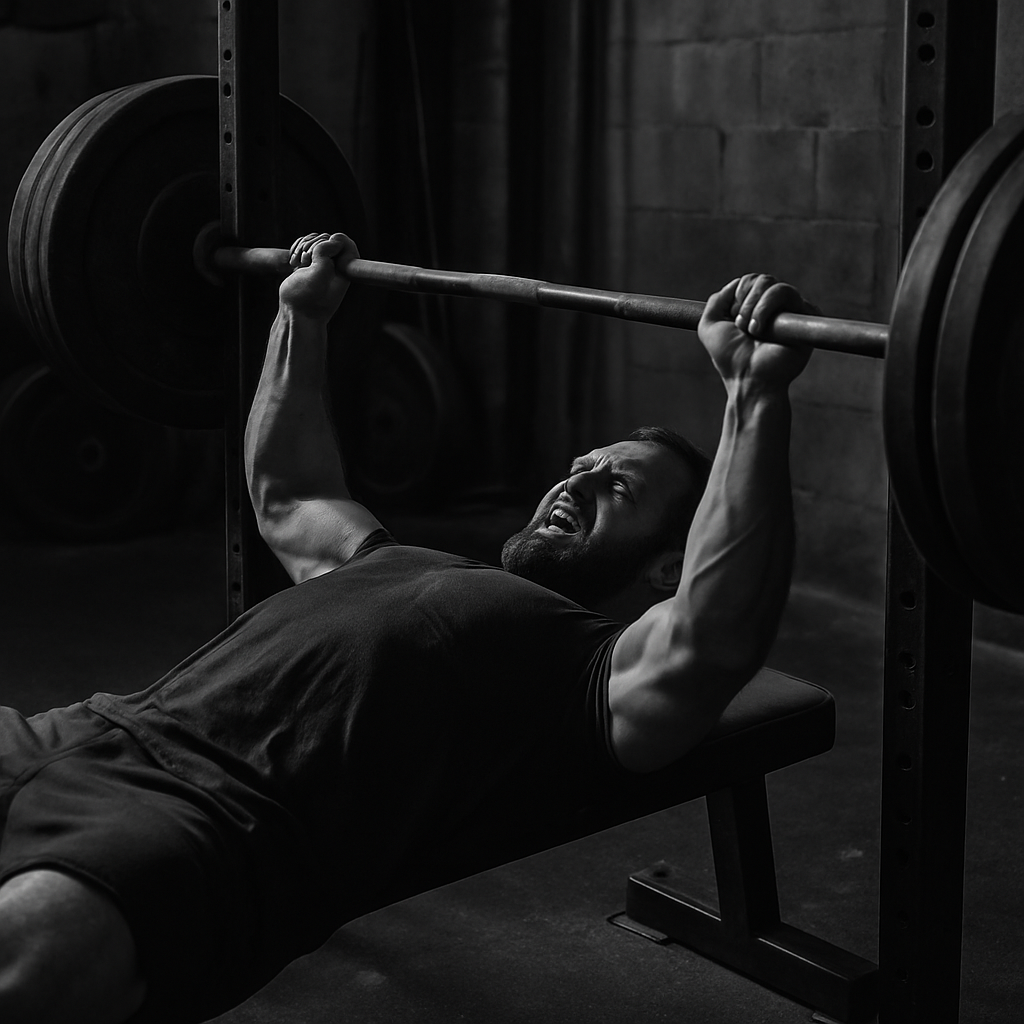
A stalled bench press is one of the most common complaints I hear, and almost nobody diagnoses it correctly before trying to fix it. “My bench is stuck” is not one problem — it is at least three different problems depending on WHERE in the rep the bar stalls, and each one has a completely different weak link and a completely different fix. Throwing more bench press at a bench press stuck sticking point, without knowing your specific sticking point, is why so many lifters spend a year chasing the same number.
I’ve watched this play out hundreds of times. A lifter hits a plateau at 225, 315, or 405 pounds. They panic. They add more volume. They grind out more reps. They bench four times a week. And nothing changes because they’re training the wrong thing.
Here’s what I want you to understand: the bar doesn’t stall in the same place for every lifter, and it doesn’t stall for the same reason. Your sticking point is a diagnostic tool. Once you know where it lives, the fix becomes obvious.
The Three Sticking Points (And How to Find Yours)
I divide bench press stalling into three zones: the bottom (off the chest), the middle (mid-range), and the lockout (top third). Some lifters stick in more than one place, but usually there’s a primary culprit.
To identify your sticking point, load the bar to about 85–90% of your current max and perform 3–5 singles with full focus on where the bar slows or stops. Don’t grind. Don’t ego-lift. Just feel where the weight becomes heavy. That’s your diagnosis.
- Bottom-position stall: Bar struggles to leave the chest; moves quickly once it clears.
- Mid-range stall: Lockout power is fine, but the bar slows between mid-chest and mid-range.
- Lockout stall: Bar moves well until the final 6–12 inches, then grinds or stops.
Most lifters I work with have never actually tested this. They just assume they’re weak everywhere and add more benching. Big mistake.

Sticking at the Bottom: Your Chest Isn’t Generating Force
When the bar stalls hard on your chest, the problem is almost never your triceps or shoulders. It’s your ability to generate force from the stretched position.
In my gym, I see this constantly with lifters who either touch too low (losing stretch tension in the pec), use a grip that’s too wide, or have poor arch stability. The weight sits on your chest and nothing happens because your pecs can’t initiate the drive.
The fix requires two components:
1. Paused Bench Press (4–5 second pause)
Do 3–4 sets of 3–5 reps with 60–70% of your max, pausing for 4–5 seconds on the chest. This teaches your CNS to generate force from a dead stop, which is exactly what you need. The pause eliminates the stretch reflex, forcing your muscles to do the actual work.
Run this protocol twice per week for 4 weeks, then test. You will see immediate improvement if bottom strength was your limit.
2. Check Your Arch and Touch Point
You should be touching the bar to the lower chest, not the mid-chest. If you’re touching too high, you’re starting from a mechanically weaker position. Film yourself or have a coach watch. Many lifters are one inch of positioning away from a 10–15 pound jump.
Your arch should allow shoulder blades to stay packed and retracted without hyperextending your lumbar spine. A small, controlled arch beats a maxed-out arch every time when it comes to consistency and force production.

Sticking in the Middle: Your Chest and Shoulders Aren’t Coordinating
Mid-range stalls are sneaky. The bar leaves your chest okay, but somewhere between mid-chest and lockout, the momentum dies. This usually means your chest isn’t transferring force to your front delts and triceps effectively.
When I watch someone with a mid-range stall, I notice they often have a weak upper chest, poor scapular positioning during the press, or they’re not recruiting their shoulders enough during the drive.
The fix is targeted incline work and board presses:
Incline Bench Press (30–45 degree angle)
Perform 4 sets of 6–8 reps of incline bench at about 75–80% of your flat bench max. Incline shifts the emphasis to your upper chest and front delts — the exact musculature needed to push through mid-range. The angle forces you to use your shoulders more aggressively, which carryover is huge.
Program this once per week, separate from your main bench day.
Board Press (2–3 board)
Place a 2–3 board (wooden blocks) on your chest and bench off the board for 3–5 reps at 80–85% of your max. This reduces range of motion and lets you train the mid-range and lockout with heavier weight. You’re teaching your nervous system what heavier weight feels like in the exact range where you’re weak.
Use this as a secondary movement once per week. Three sets of 4 reps is plenty.
Sticking at the Lockout: Your Triceps and Front Delts Are Insufficient
Lockout stalls are the most straightforward to diagnose and the easiest to fix. The bar moves fine until the final 6–12 inches, where it slows or stops. Your triceps don’t have enough mass or strength to complete the press.
This is the one case where more specific arm and shoulder work is the direct answer. You need to build tricep and front delt volume in ranges that reinforce the lockout.
Close-Grip Bench Press
Shift your grip to about shoulder-width or slightly narrower. Perform 4 sets of 5–6 reps at about 80–85% of your flat bench max. The narrow grip shifts emphasis from chest to triceps. You’re still benching, so the movement pattern is identical to your competition lift, but you’re loading the lockout harder.
Dumbbell Floor Press or Machine Shoulder Press
Add 3 sets of 8–10 reps of either movement on a separate day. Floor press (dumbbells on the floor) limits range of motion and emphasizes the bottom-to-mid range, which carries over to lockout strength. Machine shoulder press hits the front delts more directly and allows for higher volume without joint stress.
Run this for 4–6 weeks and retest. Lockout stalls typically respond fastest because you’re addressing the exact weak muscle group.
Programming Your Fix: The Protocol
Don’t try to fix all three sticking points at once. You’ll dilute your effort and confuse your training.
Here’s how I structure it:
- Week 1–2: Test and identify your primary sticking point.
- Week 3–6: Run the specific protocol for that sticking point as your primary vertical press movement.
- Week 7: Test your max. You will move it.
- Week 8+: If you still have a secondary stalling point, address that.
Volume and frequency matter. If you’re doing flat bench 3+ times per week, cut it to 2 times per week and devote one session to your sticking point-specific work. This prevents overuse and ensures you’re fresh enough to drive quality reps.

The Real Problem: Guessing Instead of Testing
Most lifters get stuck because they’ve never actually identified where they get stuck. They bench. They hit a plateau. They add more benching. And because they’re addressing the wrong weakness, nothing changes.
Your bench press stuck sticking point is specific. It has a cause. And once you know the cause, the solution is simple and measurable.
Take 20 minutes this week. Load 85% of your max. Do singles. Pay attention to where the bar slows. Then run the protocol that matches your diagnosis for 4 weeks without deviation. Retest. You will move the needle.
That’s how you fix a stuck bench press. Not with more volume and guessing. With precision and strategy.
Frequently Asked Questions
How do I find out where my bench press sticks?
Load the bar to about 85–90% of your current max and perform 3–5 singles with full focus on where the bar slows or stops. Feel where the weight becomes heavy without grinding or ego-lifting. That’s your diagnosis—bottom (off the chest), middle (mid-range), or lockout (top third).
What exercises fix a bottom position bench stall?
Do paused bench press for 3–4 sets of 3–5 reps with 60–70% of your max, pausing for 4–5 seconds on the chest twice per week for 4 weeks. Also check your arch and touch point; you should touch the lower chest, not mid-chest, for better force production.
How do I fix mid-range bench press stalling?
Perform incline bench press at 30–45 degrees for 4 sets of 6–8 reps at about 75–80% of your flat bench max once per week. Also add board press with a 2–3 board for 3 sets of 4 reps at 80–85% of your max once per week to train the weak range with heavier weight.
What’s the fastest way to fix lockout bench problems?
Do close-grip bench press for 4 sets of 5–6 reps at about 80–85% of your max, plus 3 sets of 8–10 reps of dumbbell floor press or machine shoulder press on a separate day. Run this for 4–6 weeks; lockout stalls respond fastest because you’re addressing the exact weak muscle group.
About This Article

Written by Jordan Ellis. Jordan Ellis isn't a certified personal trainer — just someone who's been genuinely obsessed with training for over eight years and turned it into building smarter home gyms. He focuses on home fitness: effective training spaces, equipment that earns its price, and programs that work in a spare room or basement, not just a commercial gym. More about this site.
Scope and limits. Jordan is not a certified personal trainer, and nothing here is medical advice. Check with a physician before starting a new program, and prioritize form over load on every lift described.
Verify this against a primary source
Specifics change, and your situation may differ from the one described here. These are the authorities worth checking directly:
- Physical Activity Guidelines for Americans (HHS) — the federal physical activity guidelines
- American College of Sports Medicine — exercise prescription and position stands
- NSCA — strength and conditioning research