Tag: workout routine

  • Gym Workout Plan for Beginners: Your First 12 Weeks

    Gym Workout Plan for Beginners: Your First 12 Weeks

    This post contains affiliate links. As an Amazon Associate, I earn from qualifying purchases at no extra cost to you.

    Walking into a gym for the first time can feel like showing up to a party where everyone else knows the dress code and you definitely don’t. The machines look complicated, the free weight area feels like it belongs to someone else, and you’re not quite sure where to start. Here’s the truth: every single person in that building had their first day. Every one of them stood exactly where you’re standing right now. The difference between people who stick with it and people who don’t usually comes down to one thing — having a plan. A solid gym workout plan for beginners removes the guesswork, gives you purpose the moment you walk through the door, and makes the whole experience about ten times less intimidating. That’s exactly what this guide is designed to give you.

    Before You Start: What Beginners Actually Need to Know

    Before we get into the workouts themselves, let’s clear up a few things that stop a lot of people from ever getting started in the first place.

    You do not need supplements, a perfect wardrobe, or some baseline level of fitness before you show up. The gym is not a reward for already being fit — it’s the tool you use to get there. A decent pair of trainers and whatever comfortable clothes you already own are genuinely all you need on day one. Nobody is checking your pre-workout brand or your leggings label.

    More importantly, your only job in the early weeks is to learn movements — not to lift heavy. Every exercise in this guide has a learning curve, and the smartest thing you can do is respect that curve. Lighter weight with good form will build more strength, prevent injury, and produce better long-term results than loading up a bar before your body knows what it’s doing. Progress in this context means moving better, not moving more weight. That shift in mindset is genuinely everything.

    And finally — nobody is watching you. I know it feels that way. But the reality of any gym is that the other members are focused almost entirely on themselves. They’re checking their own form in the mirror, thinking about their next set, or zoning out to their playlist. You have far more freedom to learn, make mistakes, and figure things out than you probably realize.

    One practical thing that genuinely helps in those early sessions: protecting your hands. When you’re learning to grip barbells, dumbbells, and cables, the skin on your palms hasn’t toughened up yet, and blisters are a real nuisance that can interrupt your training. Most of my clients start out using the HOZMOZ Ventilated Weight Lifting Gloves with Full Palm Protection & Grip & Shock Absorption. What I like about these specifically is the thick palm padding combined with the ventilated design — your hands stay comfortable and protected without overheating mid-set. They’re suitable for both men and women, and they make a real difference when you’re building up grip tolerance in those first few weeks of pulling and pressing movements.

    The 12-Week Beginner Gym Workout Plan

    This beginner workout plan is structured in three four-week phases, each one building logically on the last. You’ll start with full-body training three days a week, and by week nine you’ll be ready for a more structured upper/lower split. Rest at least one day between each training day — your body gets stronger during recovery, not during the workout itself.

    Weeks 1–4: Learn the Movements (Full Body, 3x/Week)

    Your entire focus in month one is technique. Choose weights that feel almost too easy. You should be able to complete every rep with full control and finish every set feeling like you had two or three more in you. This is deliberate — it protects you from injury and builds the neuromuscular patterns that make heavier lifting possible later.

    • Goblet Squat — 3 sets of 10 reps
    • Romanian Deadlift (dumbbells) — 3 sets of 10 reps
    • Dumbbell Bench Press — 3 sets of 10 reps
    • Cable or Dumbbell Row — 3 sets of 10 reps
    • Dumbbell Overhead Press — 3 sets of 10 reps
    • Plank — 3 sets of 20–30 seconds

    Rest 60–90 seconds between sets. Three sessions per week with a rest day in between is the ideal structure — Monday, Wednesday, Friday works well for most people.

    Weeks 5–8: Build on the Foundation (Full Body, 3x/Week)

    By now the movements should feel familiar. It’s time to add a little weight and introduce one or two new exercises. Aim to increase the load slightly every session or every other session — even small jumps matter. This phase is where you’ll start to notice real changes in how you feel and how the exercises feel.

    • Barbell or Goblet Squat — 3 sets of 8 reps
    • Romanian Deadlift (barbell or dumbbells) — 3 sets of 8 reps
    • Dumbbell or Barbell Bench Press — 3 sets of 8 reps
    • Cable Row — 3 sets of 8 reps
    • Overhead Press — 3 sets of 8 reps
    • Lat Pulldown — 3 sets of 10 reps
    • Dumbbell Lateral Raise — 3 sets of 12 reps
    • Plank or Dead Bug — 3 sets of 30 seconds

    Weeks 9–12: Upper/Lower Split (4x/Week)

    This phase adds a fourth training day and separates your sessions into upper body and lower body focus days. More volume, more frequency for each muscle group, and a structure that serious lifters use at every level. You’re ready for it by this point.

    Upper Body Day (2x/week — e.g., Monday & Thursday):

    • Barbell Bench Press — 4 sets of 6–8 reps
    • Cable Row — 4 sets of 8 reps
    • Overhead Press — 3 sets of 8 reps
    • Lat Pulldown — 3 sets of 10 reps
    • Dumbbell Lateral Raise — 3 sets of 12 reps
    • Tricep Pushdown — 3 sets of 12 reps
    • Dumbbell Curl — 3 sets of 12 reps

    Lower Body Day (2x/week — e.g., Tuesday & Friday):

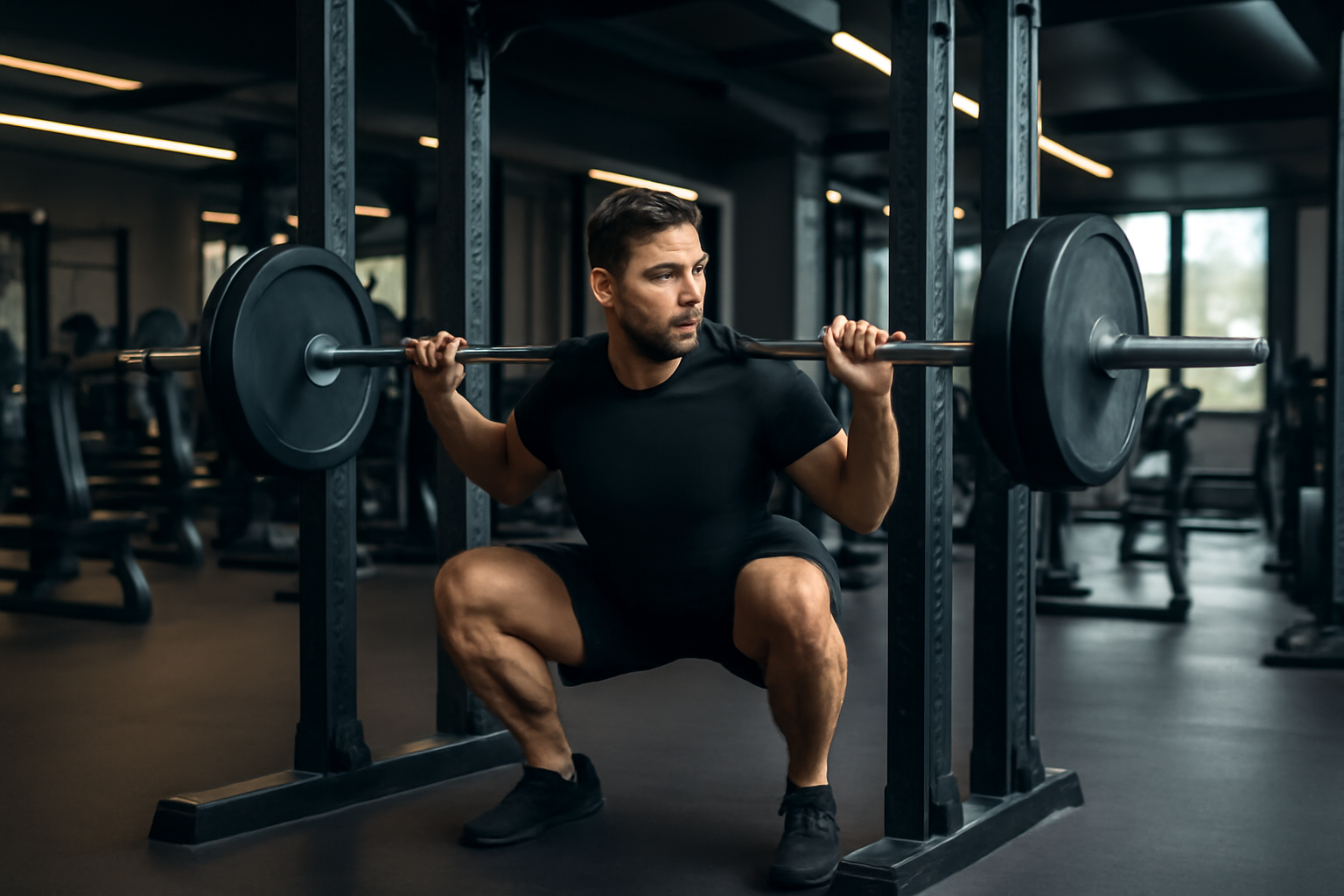
    • Barbell Squat — 4 sets of 6–8 reps
    • Romanian Deadlift — 4 sets of 8 reps
    • Leg Press — 3 sets of 10 reps
    • Leg Curl — 3 sets of 12 reps
    • Calf Raise — 3 sets of 15 reps
    • Ab Wheel or Plank Variation — 3 sets

    Tracking your workouts through all three phases is one of the most underrated habits a beginner can build. Writing down your sets, reps, and weights means you always know whether you’re progressing, and it keeps you accountable to the plan. I recommend the Fitness Workout Journal for Women & Men — A5 Workout Log Book Planner for Tracking, Progress, and Achieving Your Wellness Goals. It’s compact enough to throw in a gym bag and specifically laid out for logging training sessions rather than being a generic notebook. Having a dedicated space to record your progress makes the habit stick in a way that a phone note or random scrap of paper just doesn’t.

    The 5 Exercises Every Beginner Should Master First

    These are the foundation of this entire gym workout plan for beginners — and honestly, of most effective strength programs at any level. Master these and you have a toolkit that will serve you for years.

    1. Squat

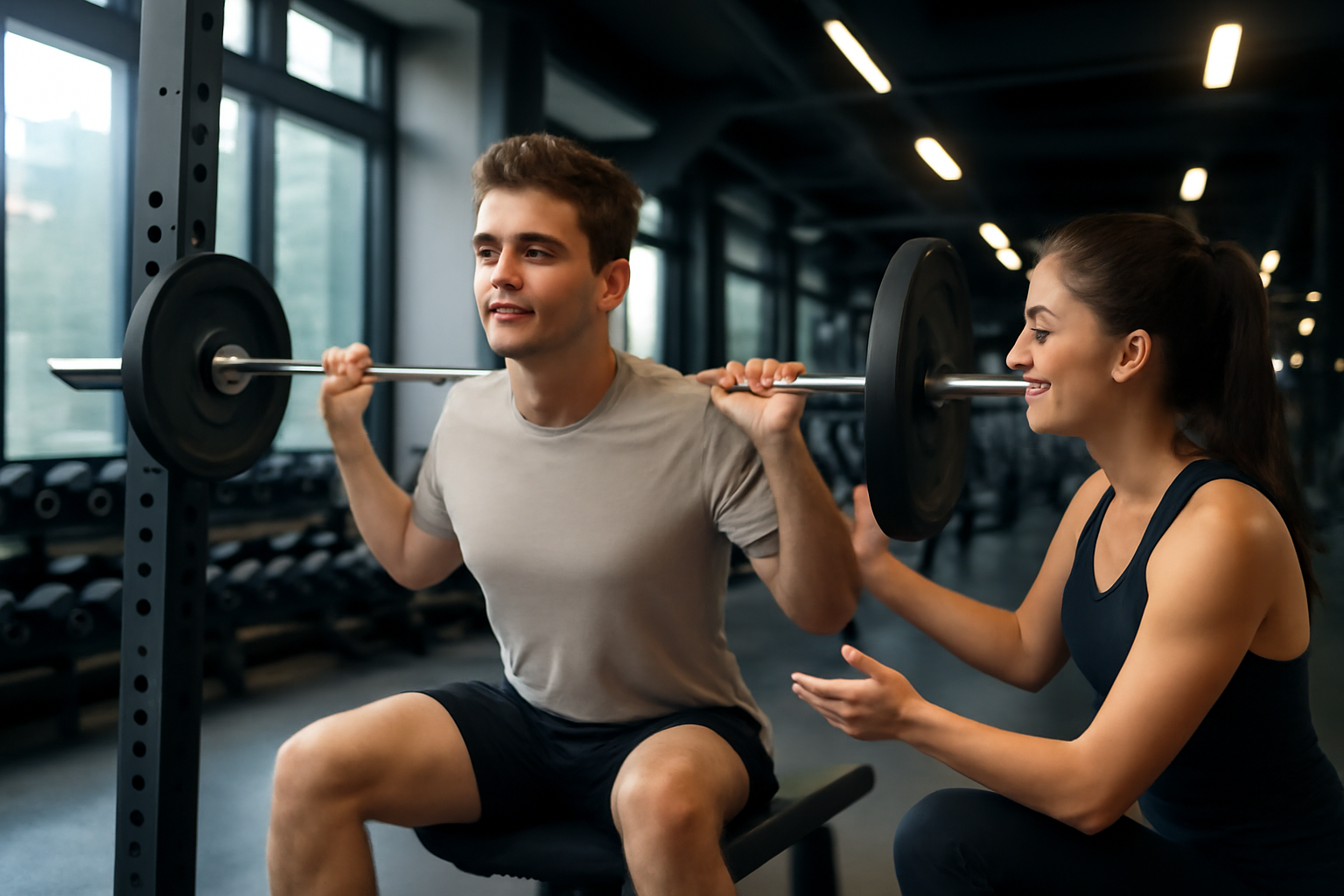
    Start with the goblet squat — hold a dumbbell or kettlebell at your chest and focus on sitting your hips back and down while keeping your chest tall. Once this feels natural, transition to a barbell back squat. The goblet variation teaches you the movement pattern with far less risk, and it’s genuinely where I start every new client regardless of their age or background.

    2. Deadlift

    Begin with the Romanian deadlift rather than a conventional deadlift. You’ll hinge at the hips, keep a slight bend in the knees, and feel a strong stretch in your hamstrings as the weight lowers. It’s a safer starting point that builds the hip hinge pattern you need before loading up a conventional pull from the floor.

    3. Bench Press

    Dumbbell pressing is an excellent starting point because it requires each side of your body to work independently, which corrects imbalances early. Once you’re comfortable, move to the barbell bench press. Focus on keeping your shoulder blades retracted and your feet flat on the floor throughout the movement.

    As you progress to heavier pressing movements in weeks five through twelve, grip comfort becomes increasingly important. This is where a well-made glove earns its place. The HOZMOZ Ventilated Weight Lifting Gloves with Full Palm Protection, Grip & Shock Absorption are what I keep in my own gym bag for heavier pressing and pulling sessions. The shock absorption padding is particularly noticeable on barbell work — it takes the edge off the pressure on your palms without reducing your sense of grip control, which matters a lot when the weights start to climb.

    4. Row

    Rows train the muscles of your back and are the essential counterpart to pressing exercises. The cable row and dumbbell single-arm row are both great beginner options. Focus on pulling your elbow back and squeezing your shoulder blade at the end of each rep rather than just yanking the weight with your arm.

    5. Overhead Press

    Pressing a weight directly overhead trains your shoulders, upper traps, and triceps while also demanding core stability. Start with dumbbells seated or standing, and ensure you’re pressing the weight in a straight vertical path. Keep your core braced and avoid flaring your ribs upward as you press.

    Alongside your gloves, keeping a structured log of your progress on these five movements is one of the most motivating things you can do. The Nextnoid Hardcover Fitness Journal Workout Planner for Men & Women — A5 Sturdy Workout Log Book to Track Gym & Home Workouts is a great option if you want something built to last. The hardcover construction means it holds up in a gym bag over months of use, which a standard notebook simply doesn’t. Being able to flip back to week one and see how far your lifts have come is genuinely one of the most satisfying experiences in training — and this journal is built for exactly that purpose.

    Common Beginner Mistakes to Avoid

    Even with the best beginner workout plan, a few common habits can quietly undermine your progress. Here’s what to watch for.

    Program Hopping

    This is the single most common thing I see derail beginners. You try a plan for two weeks, see someone else’s routine on social media, and switch. Then you switch again. Twelve weeks later you’ve done fragments of six different programs and made progress in none of them. Commit to one gym workout for beginners and follow it for the full twelve weeks. Results take time and consistency — not novelty.

    Too Much Volume Too Soon

    Soreness is not a reliable measure of a good workout. Doing twice as many sets as prescribed won’t get you results twice as fast — it’ll just leave you too sore to train the next session. The volume in this plan is calibrated to be productive without being excessive. Trust the structure.

    Skipping Warm-Ups

    Five to ten minutes of light cardio followed by a couple of warm-up sets at a lower weight before your working sets is non-negotiable. Cold muscles and joints are significantly more vulnerable to injury, and injury is the fastest way to lose months of progress. Warm-ups also improve performance — you’ll lift better with prepared muscles than without.

    Comparing Yourself to Others

    The person squatting twice your weight has been training for years. The person with the impressive physique didn’t build it in twelve weeks. Your only relevant comparison is the version of yourself from last month. This gym workout for beginners is designed to make you better than you were — and that’s the only benchmark that matters.

    Consistency Beats Perfection Every Time

    You’re not going to nail every session. Some days the weights will feel heavier than they should. Some weeks life will get in the way. That’s completely normal and it doesn’t mean the plan isn’t working. What matters is that you keep showing up. Three imperfect sessions a week, week after week, will produce dramatically better results than occasionally perfect sessions with long gaps in between. Follow this gym workout plan for beginners, track your progress, protect your hands, and give yourself the full twelve weeks. You will be genuinely surprised by what you’re capable of — and so will everyone who said the gym wasn’t for them.

  • Full Body Workout Routine: The Most Efficient Way to Build Muscle

    Full Body Workout Routine: The Most Efficient Way to Build Muscle

    This post contains affiliate links. As an Amazon Associate, I earn from qualifying purchases at no extra cost to you.

    If you’re still running a chest-on-Monday, back-on-Tuesday, legs-on-Friday bro split, I want you to stop and ask yourself one question: how’s that actually working for you? For most people — busy professionals, parents, anyone juggling a real life outside the gym — the answer is “not as well as I’d like.” A well-structured full body workout performed three days per week is, for the vast majority of lifters, a more effective and more efficient path to building muscle and strength. I’ve trained hundreds of clients, and the shift to full body training is one of the highest-leverage changes I recommend. This guide covers the science, gives you a complete full body workout routine, and shows you how to progress so you’re actually getting stronger month after month.

    Why Full Body Workouts Build More Muscle

    The core argument against bro splits is rooted in training frequency. When you train chest once per week on a traditional split, you stimulate muscle protein synthesis once — and that elevated synthesis window largely closes within 48–72 hours. The rest of the week, that muscle group is sitting idle. A full body workout approach changes that equation completely by hitting each muscle group three times per week.

    A 2016 meta-analysis published in the Journal of Strength and Conditioning Research by Schoenfeld, Ogborn, and Krieger found that training a muscle group twice or three times per week produced significantly greater hypertrophy compared to once per week, even when total volume was equated. In other words, frequency itself is a driver of muscle growth, not just how much total work you do. Spreading your sets across three sessions rather than cramming them into one creates more frequent protein synthesis spikes, and more spikes mean more cumulative growth over time.

    There’s also a practical efficiency argument. If you’re working out three days per week and hitting every muscle group each session, you never have a “wasted” workout. Miss your leg day on a traditional split? You’ve gone two weeks without training legs. Miss a Wednesday on a full body plan? You’re back at it Friday. The redundancy built into a full body workout schedule acts as a buffer against real-life disruption.

    The Full Body Workout Routine (3 Days Per Week)

    This full body workout routine uses an A/B alternating template across Monday, Wednesday, and Friday. Week one looks like A/B/A, week two looks like B/A/B, and so on. This gives you slightly more frequency on alternating lifts without overloading any single movement pattern. Both days train the full body — they just use different exercises to provide variety, manage fatigue, and develop more complete musculature.

    Day A

    • Barbell Back Squat — 4 sets x 6 reps
    • Barbell Bench Press — 3 sets x 8 reps
    • Barbell Row — 3 sets x 8 reps
    • Overhead Press — 3 sets x 10 reps
    • Bicep Curls — 2 sets x 12 reps

    Day B

    • Deadlift — 3 sets x 5 reps
    • Incline Dumbbell Press — 3 sets x 10 reps
    • Pull-ups — 3 sets x AMRAP (as many reps as possible)
    • Leg Press — 3 sets x 12 reps
    • Tricep Pushdowns — 2 sets x 12 reps

    To execute this full body workout plan properly at home, you need a rack that can handle heavy squats, bench press, overhead press, and pull-ups without compromise. The ULTRA FUEGO Power Cage Multi-Functional Power Rack with J-Hooks, Dip Handles, Landmine Attachment and Optional Cable Pulley System covers every exercise in this program and then some. What I appreciate most about this rack is the landmine attachment — it opens up rotational pressing and rowing variations that a basic squat stand simply can’t offer. The dip handles mean your tricep work doesn’t require a separate station, and the optional cable pulley system brings the pushdowns and cable rows from Day B into your home gym without needing a commercial cable machine. If you’re serious about running this program long-term, this is the rack I’d put in my own garage.

    For lifters who want more cable variety — particularly for the pull-down and crossover movements that complement a full body workout — the GOIMU DP01 Power Cage 2000LBS Squat Rack with Cable Crossover and Dual Independent Pulley System is a serious upgrade worth considering. The dual independent pulley system is the standout feature here — it lets you perform cable crossovers, independent cable rows, and unilateral cable work that a single-stack system simply can’t replicate. A 2000 lb weight capacity means you’ll never outgrow it no matter how strong you get. Most of my more advanced clients who train at home end up in a rack like this eventually, and the GOIMU DP01 punches well above its price point for what it delivers.

    Of course, neither rack does much without quality plates and a solid barbell. For beginners and intermediate lifters building their home gym around this program, the CAP Barbell 160 lb Economy Olympic Weight Set with 7ft Chrome Barbell and Black Bumper Plates with Color Logo is an excellent starting point. The bumper plates are the key detail here — they protect your floors on deadlifts and allow you to drop the bar safely if you miss a lift, which matters when you’re training alone at home. A 160 lb total capacity is plenty of iron to run Day A and Day B as a beginner, covering squats, presses, rows, and deadlifts through the early months of linear progression.

    How to Progress on a Full Body Program

    The program above is only as good as the progression model driving it. Exercises don’t build muscle — progressive overload does. Here’s how I structure progression depending on training age.

    Beginners: Linear Progression

    If you’ve been lifting consistently for less than a year, you’re in the most privileged position in all of strength training: you can add weight to the bar every single session. Add 5 lbs per session on upper body lifts and 10 lbs per session on lower body lifts. It sounds aggressive, but your nervous system adapts faster than your muscles at this stage, and failing to push load progression is the single biggest mistake beginners make. Track every session in a notebook or app, and do not skip planned weight increases unless you genuinely failed to complete your reps.

    Intermediates: Double Progression

    Once linear progression stalls — you can’t add weight every session anymore — shift to double progression. This means you work within a rep range rather than a fixed rep target. Take bench press at 3×8 as an example: start at the bottom of the range (say, 3×6) and work up over multiple sessions until you hit 3×8 with clean form. Only then do you add 5 lbs and drop back to 3×6. This slower ramp allows you to accumulate more volume before jumping weight, which is appropriate once you’re no longer a rapid responder to every new stimulus.

    Deloads Every 4–6 Weeks

    Every 4–6 weeks, take a deload week. Drop your working weights by 40–50% and reduce volume by half. This isn’t optional softness — it’s a deliberate tool for managing accumulated fatigue and allowing connective tissue to recover. Research consistently shows that supercompensation — the performance rebound after a period of reduced training — produces strength and size gains that wouldn’t occur without the recovery phase. Come back after your deload and you’ll almost always hit new personal records.

    As your strength grows and you’re regularly deadlifting and squatting at heavier loads, your starting weight set may no longer be sufficient. The CAP Barbell 260 LB Economy Olympic Bumper Plate Set with Color Logo in Black gives you the iron to train at intermediate and advanced loads without compromising on plate quality. The bumper construction remains intact for deadlift drops, and 260 lbs of total capacity means you’re equipped for heavy squats, deadlifts, and loaded presses well into your intermediate training career. This is the set I’d recommend upgrading to once you’ve outgrown a starter kit — it’s straightforward, durable, and gives you room to grow.

    Full Body Workout at Home

    No barbell? No problem. A full body workout at home is completely viable with bodyweight and a pair of adjustable dumbbells. Here’s how to adapt the same structure:

    Home Day A

    • Goblet Squat or Bulgarian Split Squat — 4 sets x 8–10 reps
    • Dumbbell Floor Press or Push-ups (weighted vest) — 3 sets x 10–12 reps
    • Dumbbell Row — 3 sets x 10 reps each side
    • Dumbbell Overhead Press — 3 sets x 10–12 reps
    • Dumbbell Curl — 2 sets x 12–15 reps

    Home Day B

    • Romanian Deadlift (dumbbells) — 3 sets x 10–12 reps
    • Incline Push-ups or Dumbbell Incline Press — 3 sets x 10–12 reps
    • Pull-ups or Inverted Rows — 3 sets x AMRAP
    • Dumbbell Reverse Lunge — 3 sets x 10 reps each leg
    • Overhead Tricep Extension (dumbbell) — 2 sets x 12–15 reps

    The same progression principles apply here. Add reps until you hit the top of your rep range, then increase dumbbell weight. The home version is genuinely effective — I’ve seen clients build significant muscle training exclusively this way for months before transitioning to a barbell setup.

    Final Thoughts

    A well-programmed full body workout three days per week is not a compromise — it’s a smart, evidence-based training strategy that outperforms low-frequency splits for the majority of natural lifters. You’re hitting every muscle group more often, stimulating protein synthesis more frequently, and building in structural redundancy that keeps progress moving even when life gets in the way. Whether you’re training in a commercial gym, building a home setup around one of the power racks above, or working with nothing but dumbbells and your bodyweight, the framework in this guide will get you stronger. Run this full body workout routine, track your progress, add weight consistently, and deload when scheduled. That’s the whole system — and it works.