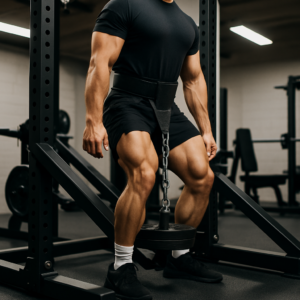
You’ve probably heard the advice: “Lift heavy weight for low reps.” It’s correct. But it’s also useless without a program you can actually follow.
Here’s the reality: strength and muscle size are related but not the same. You can add meaningful weight to your lifts over a training block while changing very little about how you look—and for many people, that’s exactly what they want. You won’t decouple the two completely; some growth comes with the territory. But you can heavily bias the ratio in favor of strength, and this post shows you how.
Whether you’re a woman who doesn’t want to bulk, an athlete trying to stay in a weight class, or someone who simply wants to get stronger without the commitment of a hypertrophy program, this post gives you three complete, proven programs you can start this week.
The Science: Why You Can Get Stronger Without Getting Bigger
Your muscles get stronger through two completely different mechanisms:
- Neural Adaptation: Your nervous system learns to recruit more muscle fibers, fire them faster, and coordinate them better across muscles. This is the dominant driver of strength gains early on. The classic study here—Moritani and deVries (American Journal of Physical Medicine, 1979)—tracked an 8-week training program and found neural factors accounted for the larger share of the initial strength increase, with hypertrophy taking over as the dominant contributor after roughly the first 3 to 5 weeks. Measurable protein accretion didn’t show up until around week 6.
- Muscular Adaptation: Your muscle fibers actually grow (hypertrophy). This happens over time and requires specific conditions—mainly high volume and moderate loads.
Think of your muscles like a car engine. Neural adaptation is like learning to use all the gears and optimize your shifting. Muscular adaptation is like upgrading to a bigger engine. You can drive faster by shifting better without changing the engine at all.
But here’s the part most articles get wrong, so let me be precise: neural adaptation isn’t a window that stays open for months. It dominates the first few weeks and then hypertrophy starts pulling its weight. If the only mechanism keeping you small were “I’m still in my neural phase,” this whole approach would expire after a month and a half.
The mechanism that actually lasts is a different one: strength and size respond to different variables. Hypertrophy is driven primarily by total volume—how many hard sets you accumulate per muscle per week. Strength is driven primarily by load and specificity—how heavy you go and how much you practice the specific lift. Those two levers are separable, and that’s the whole trick.
So you pull the load lever hard and leave the volume lever alone. You lift heavy, you practice the movement constantly, and you keep weekly set counts low enough that you never accumulate the volume that would drive significant growth.
For Strength (Neural Adaptation): Heavy loads (85-95% of 1RM), low reps (1-5), high sets (4-6), long rest periods (3-5 minutes), LOW total volume.
For Size (Muscular Adaptation): Moderate loads (65-85% of 1RM), moderate-to-high reps (6-12), moderate sets (3-4), shorter rest (60-90 seconds), HIGH total volume.
The beauty of training for strength without size is this: you’re deliberately minimizing the stimulus for growth. By keeping volume low, you avoid the conditions that trigger hypertrophy.
Understanding the Variables
- Load (85-95% 1RM): Heavy enough to recruit all available muscle fibers. Lighter weights only recruit a fraction of your fibers; heavier weights force recruitment of everything.
- Reps (1-5): Low enough that you’re not accumulating significant metabolic stress, which drives growth. You’re simply moving heavy weight.
- Sets (4-6): Enough volume to practice the movement pattern and allow your nervous system to adapt, but not so much that you create a strong growth signal.
- Rest (3-5 minutes): Long enough to recover ATP/CP energy systems. You need full recovery between sets to maintain force production and recruiting power.
- Staying Far From Failure: If you perform sets of 3 reps at 85% 1RM, you’re probably only 2-3 reps away from failure. But you stop there. No grinding out a final rep. No pushing to the edge. This keeps the stimulus neural, not metabolic.
Busting the “Bulky” Myth
- Caloric surplus (you must eat more than you burn)
- High training volume (multiple sets and reps per muscle group per week)
- Consistent effort over 1-3+ years
- Often, genetics work in your favor
You will not accidentally gain 20 pounds of muscle. It doesn’t happen. If you’re following a strength-focused program with low volume and moderate food intake, you might gain 2-3 pounds of muscle over 12 weeks. You might not gain any. You’ll get noticeably stronger, but you probably won’t “look” much different.
That’s the whole point.
Program 1: The Minimalist (3 Days Per Week)
Best for: Busy people, beginners, anyone who wants a simple, fast program with proven results.
This is the most straightforward strength program ever written. Three exercises. Three days. Forty-five minutes per session. Add weight every week.
Session Structure:
| Exercise | Sets x Reps | Load | Rest |
|---|---|---|---|
| Main Lift (Squat/Bench/Deadlift) | 5 x 3 | 85% 1RM | 4-5 min |
The Rotation:
- Day 1 (Monday): Back Squat 5×3
- Day 2 (Wednesday): Bench Press 5×3
- Day 3 (Friday): Deadlift 5×3
Progression:
Add 2.5 lbs to squat and bench each week. Add 5 lbs to deadlift each week. When you miss a rep, keep the weight the same for the next session. If you miss again, deload 10% and rebuild.
Why This Works:
- Minimal volume means minimal growth stimulus
- Heavy load means maximal nervous system adaptation
- Three days per week is sustainable forever
- Total time commitment is only 2.25 hours per week
What to Expect: After 12 weeks, expect to add 15-25 lbs to your main lifts. Virtually no visible size change. Noticeable strength increase in everyday life (stairs, picking things up, feeling physically capable).
Program 2: Grease the Groove (Daily Practice)
Best for: Bodyweight exercises, skill development, people who want to train daily without traditional “workout” sessions.
Based on Pavel Tsatsouline’s GTG (Greasing the Groove) method, this program is genius for building strength in pull-ups, push-ups, pistol squats, and other bodyweight movements. The secret is frequent, easy exposure.
How It Works:
Pick one exercise (or two maximum). Throughout the day, do multiple sets of 50% of your max reps. Never approach failure. Never feel fatigued. Rest fully between sets.
Example 1: Pull-Up Progression
- Your max: 8 consecutive pull-ups
- Target: 4 reps per set (50% of 8)
- Daily schedule:
- 8:00 AM: 4 pull-ups
- 10:30 AM: 4 pull-ups
- 1:00 PM: 4 pull-ups
- 4:00 PM: 4 pull-ups
- 7:00 PM: 4 pull-ups
- Total: 20 reps in ~5 minutes of actual work, spread across the day
- Rest 2-3 minutes between sets, at least 2 hours between sessions
- Never perform to failure—stop at 4 even if you could do 5
Example 2: Push-Up Progression
- Your max: 20 consecutive push-ups
- Target: 10 reps per set (50%)
- Daily schedule: 5-6 sets of 10 spread throughout the day
- Total: 50-60 reps per day with no fatigue
Progression Scheme:
- After 2 weeks, test your max again
- Let’s say pull-ups went from 8 to 10 max
- New target: 5 reps per set (50% of new max)
- Keep the same number of sets per day—so daily volume rises from 20 reps to 25 as your max climbs. The difficulty per set stays constant at 50% of max, which is the point; the absolute work goes up on its own as you get stronger
- If the 5-rep sets start feeling like work rather than practice, cut back to 4 sets per day rather than lowering the reps
- Continue for 4-8 weeks
Why This Works for Strength Without Size:
- Low intensity per set (50% max) keeps each session easy
- High frequency allows nervous system to practice the movement constantly
- No fatigue accumulation means no hypertrophy signal
- The movement is done perfectly every rep—no grinding sets—so you train motor patterns optimally
What to Expect: After 8 weeks, expect to add 2-4 reps to your max (if you started at 8 pull-ups, you might hit 10-12). Zero size gain. Incredibly strong feeling in that specific movement. Zero soreness, zero fatigue.
Program 3: The Powerbuilder Lite (4 Days Per Week)
Best for: People who want strength focus but enjoy a bit of variety, those comfortable with four training days, athletes wanting compound movement strength plus some accessory work.
This is an upper/lower split with a twist: heavy compound lifts for strength, and a small amount of light accessory work purely for movement quality and joint health—not for growth. The accessory work is deliberately kept below the volume threshold that would drive meaningful hypertrophy.
Day 1 — Lower (Squat Focus)
| Exercise | Sets x Reps | Load | Rest |
|---|---|---|---|
| Back Squat | 5 x 3 | 85% 1RM | 4 min |
| Romanian Deadlift | 3 x 5 | 70% 1RM | 3 min |
| Walking Lunge | 2 x 8/leg | Light | 90 sec |
| Plank | 3 x 45 sec | Bodyweight | 60 sec |
Day 2 — Upper (Bench Focus)
| Exercise | Sets x Reps | Load | Rest |
|---|---|---|---|
| Bench Press | 5 x 3 | 85% 1RM | 4 min |
| Weighted Pull-Up | 4 x 4 | Heavy | 3 min |
| Face Pull | 2 x 15 | Light | 60 sec |
| Band Pull-Apart | 2 x 20 | Light | 45 sec |
Day 3 — Lower (Deadlift Focus)
| Exercise | Sets x Reps | Load | Rest |
|---|---|---|---|
| Deadlift | 4 x 3 | 85% 1RM | 5 min |
| Front Squat | 3 x 5 | 70% 1RM | 3 min |
| Hip Thrust | 2 x 10 | Moderate | 90 sec |
| Suitcase Carry | 3 x 30 yd | Heavy | 90 sec |
Day 4 — Upper (Press Focus)
| Exercise | Sets x Reps | Load | Rest |
|---|---|---|---|
| Overhead Press | 5 x 3 | 85% 1RM | 4 min |
| Barbell Row | 4 x 5 | 75% 1RM | 3 min |
| Dumbbell Curl | 2 x 10 | Light | 60 sec |
| Tricep Pushdown | 2 x 12 | Light | 60 sec |
Progression:
Add 2.5 lbs per week to bench and overhead press. Add 5 lbs per week to squat and deadlift. Leave the accessory weights alone—they’re not the point. When you miss a rep on a main lift, repeat the weight next week. Miss twice, deload that lift 10% and build back.
Why This Works:
- Each main lift gets its own dedicated day, so you’re fresh for the heavy work
- The 5×3 at 85% keeps the strength stimulus high and the volume low
- Accessory work is capped at 2 sets per exercise—enough for joint health and movement quality, well below the volume needed to drive real growth
- Twice-weekly frequency on each movement pattern accelerates skill acquisition
What to Expect: After 12 weeks, expect meaningful additions to all four main lifts—typically more on squat and deadlift than on the presses, which move more slowly for almost everyone. Expect 0-4 lbs of scale weight if you’re eating at maintenance. Clothes should fit essentially the same.
Which Program Should You Actually Pick?
Three programs is two more than you need. Pick one and run it for at least 12 weeks. Here’s the decision:
- Choose The Minimalist if you have limited time, you’re newer to lifting, or you’ve historically failed to stick with programs. Three sessions, three lifts, 45 minutes. The best program is the one you actually do.
- Choose Grease the Groove if your goal is a specific bodyweight skill—pull-ups, dips, pistol squats, push-ups—or if you don’t have reliable gym access. It is the single best method for adding reps to a bodyweight movement, and it’s nearly impossible to overtrain on.
- Choose Powerbuilder Lite if you have four solid days, you’re past the beginner stage, and you want your overhead press and rows progressing alongside the big three.
You can also run them in sequence: Minimalist for 12 weeks to build the base, then Powerbuilder Lite for 12 weeks, with GTG running in the background for a pull-up goal the entire time. GTG stacks with anything because it generates almost no fatigue.
The Variable That Matters More Than Your Program
I’ve given you three programs, but if you take one thing from this post, take this: your food intake controls your size far more than your set-and-rep scheme does.
You can run the lowest-volume, heaviest program ever designed, and if you eat in a 700-calorie daily surplus for six months, you will get bigger. You can run a fairly high-volume bodybuilding program and, eating at maintenance, gain very little size.
Muscle tissue has to be built out of something. If the raw material isn’t there in surplus, growth is slow regardless of how you train.
- Eat at maintenance calories. Not a surplus, not an aggressive deficit. Your weight on the scale should be roughly flat month to month.
- Keep protein adequate—roughly 0.7-1.0 g per pound of bodyweight. Protein supports recovery and strength adaptation; it does not force growth on its own without surplus calories.
- Don’t under-eat either. A deep deficit will blunt your strength progress and your recovery. Maintenance is the target, not restriction.
Get this right and the programs above will do exactly what they promise. Get it wrong in either direction and you’ll either gain size you didn’t want or stall out entirely.
An Honest Note on Expectations
I want to be straight with you about something, because a lot of content in this space isn’t.
You cannot fully separate strength from size, and anyone promising you zero growth is overselling. Heavy training does produce hypertrophy—particularly myofibrillar growth in the contractile proteins themselves. What you’re doing with these programs is heavily biasing the ratio, not eliminating one side of it.
Realistically, over 12 weeks on any of these programs at maintenance calories, expect a couple of pounds of lean mass at most, distributed across your whole body. That is not a visible change to anyone but you. Your lifts, meanwhile, will move substantially—and that’s the trade you signed up for.
The flip side is worth saying too: if you’re a woman worried about “bulking up,” the concern is almost entirely unfounded regardless of which program you pick. Building substantial visible muscle requires years of high-volume training in a caloric surplus, and it’s a goal people chase deliberately and often fail at. It does not happen by accident to someone squatting three times a week.
Start This Week
Here’s your first session, concretely:
- Establish your working weights. If you don’t know your 1RM, don’t test it—take a weight you can do for a clean set of 8 and use that as roughly 75% of your max. Multiply by 1.13 for a rough 85%.
- Pick one program above. Not two. One.
- Weigh yourself three mornings this week and average it. That’s your baseline. Re-check monthly—if it’s climbing, you’re in a surplus and you’ll gain size whether you want to or not.
- Log every session. Weight, sets, reps. The progression schemes above only work if you know what you did last week.
- Give it 12 weeks before you judge it. Strength programs are slow and boring by design. The boredom is the mechanism working.
Heavy weight, low reps, long rests, low volume, maintenance calories. That’s the entire formula. Everything above is just three different ways of arranging it around your schedule.
Frequently Asked Questions
How much muscle will I gain doing a strength program?
Over 12 weeks at maintenance calories, expect a couple of pounds of lean mass at most, distributed across your whole body. That is not a visible change to anyone but you. Your lifts will move substantially instead—that’s the trade-off.
What should I eat to get stronger without getting bigger?
Eat at maintenance calories—your weight on the scale should be roughly flat month to month. Keep protein adequate at roughly 0.7-1.0 g per pound of bodyweight. A deep deficit will blunt your strength progress and recovery, so don’t under-eat either.
Can I do grease the groove with weights?
Grease the Groove is designed for bodyweight exercises like pull-ups, dips, pistol squats, and push-ups. It works by doing multiple sets of 50% of your max reps throughout the day, never approaching failure, which keeps fatigue and growth signals low.
How much weight should I add each week?
For The Minimalist and Powerbuilder Lite: add 2.5 lbs to squat and bench each week, and 5 lbs to deadlift each week. If you miss a rep, keep the weight the same next session. Miss twice and deload that lift 10%.
About This Article
Written by Jordan Ellis. Jordan Ellis isn't a certified personal trainer — just someone who's been genuinely obsessed with training for over eight years and turned it into building smarter home gyms. He focuses on home fitness: effective training spaces, equipment that earns its price, and programs that work in a spare room or basement, not just a commercial gym. More about this site.
Scope and limits. Jordan is not a certified personal trainer, and nothing here is medical advice. Check with a physician before starting a new program, and prioritize form over load on every lift described.
Verify this against a primary source
Specifics change, and your situation may differ from the one described here. These are the authorities worth checking directly:
- Physical Activity Guidelines for Americans (HHS) — the federal physical activity guidelines
- American College of Sports Medicine — exercise prescription and position stands
- NSCA — strength and conditioning research