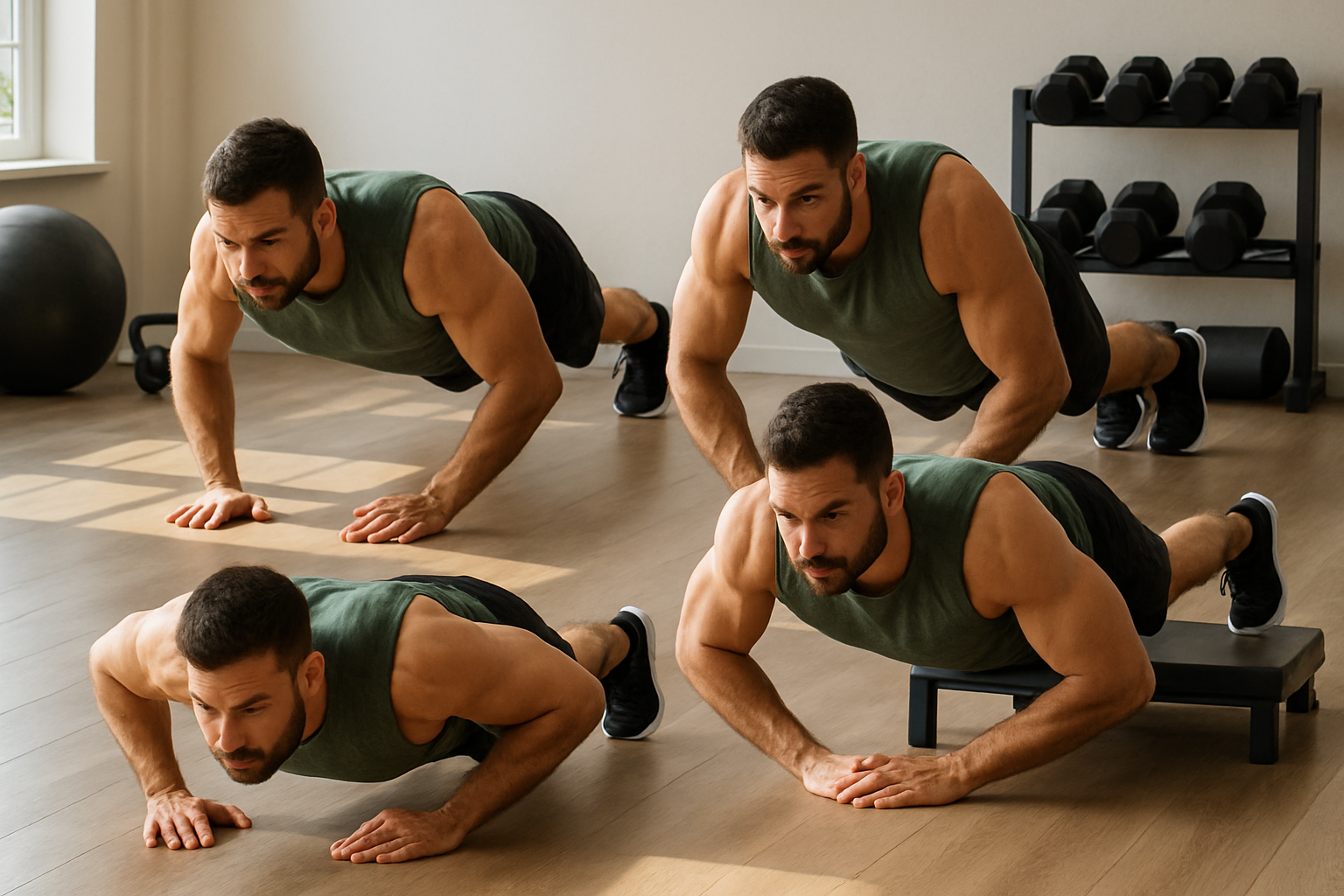

The moment my palms hit the floor for another standard push-up, I knew something had to change. Week after week, the same movement pattern, the same stalled results. Years earlier, Sunday pickup basketball had taught me that repetition without progression is just spinning your wheels—but I’d somehow fallen into that trap with chest work. Grinding through identical push-ups day after day while waiting for my chest to respond differently is what finally pushed me to map out a push-up variations difficulty ranking — a structured system that takes you from beginner foundations all the way to advanced strength, builds real chest and tricep power at home, and gives you genuine forward momentum instead of just going through the motions.
| Push-Up Variation | Hand Position | Primary Focus | Difficulty Level |
|---|---|---|---|
| Wall Push-Up | Hands on wall | Foundation building | Beginner |
| Incline Push-Up | Hands elevated on bench/chair/step | Bridge to floor work | Beginner |
| Knee Push-Up | Supported on knees, not toes | Full chest-to-floor depth practice | Beginner |
| Standard Push-Up | Shoulder width, full plank | Chest and triceps foundation | Intermediate |
| Wide-Grip Push-Up | Beyond shoulder-width | Outer pectoral region / chest width | Intermediate |
| Close-Grip (Diamond) Push-Up | Closer together, diamond formation | Triceps and inner chest | Intermediate |
| Decline Push-Up | Floor, feet elevated on bench/box | Upper chest and anterior deltoids | Intermediate |
| Archer Push-Up | One arm extended, one handles load | Serious single-arm work | Advanced |
| Pike Push-Up | Inverted V-shape, hips thrust up | Shoulder involvement, handstand prep | Advanced |
| Explosive/Clap Push-Up | Standard position, hands leave ground | Power and rapid force production | Advanced |
| One-Arm Push-Up | Single arm supports bodyweight | Core control and shoulder stability | Advanced |
| Pseudo Planche Push-Up | Hands rotated outward near hips, lean forward | Extreme chest and front shoulder tension | Elite |
| Handstand Push-Up | Feet planted high on wall | Shoulders and triceps bearing full load | Elite |
Why Push-Up Variations Actually Matter for Chest and Tricep Development
Understanding the anatomy before you start matters more than most people realize. Your chest is made up of two main muscle groups — the pectoralis major (the large fan-shaped muscle across your chest) and the pectoralis minor situated beneath it. Your triceps, which run along the back of your upper arm, are heavily involved in any pressing or arm extension movement. Body angle, hand spacing, and how deep you go all determine which sections of these muscles bear the most load. This is exactly why repeating the same push-up endlessly stops delivering results. You’re only working one segment of the muscle through a single movement pattern. Introducing variation forces your muscles to respond differently — and response means building stronger, bigger muscle.
Push-Up Variations Difficulty Ranking: From Easiest to Hardest
Below is my full ranking, laid out from beginner to elite-level difficulty. Think of this as your personal progression map. Don’t rush ahead — building solid strength at each tier prepares you to move forward safely and effectively.
Level 1 — Beginner: Build the Foundation
- Wall Push-Up: Standing upright and pressing into a wall surface is your starting point. Use this if standard push-ups feel out of reach right now. There’s nothing wrong with beginning here and building upward.
- Incline Push-Up: Hands positioned higher on a bench, chair, or elevated step. The higher the elevation, the less effort is required. This variation bridges the gap nicely between wall work and floor-based push-ups.
- Knee Push-Up: Supporting yourself on your knees rather than your toes. This lowers the total load and allows beginners to rehearse full chest-to-floor depth before progressing to a full plank position.
Level 2 — Intermediate: The Core Classics
- Standard Push-Up: The foundational version. Full plank position, hands positioned at shoulder width, bringing your chest all the way to floor level. If you’re not reaching full depth, work on it — shallow repetitions rob you of the stretch needed to stimulate real muscle development.
- Wide-Grip Push-Up: Positioning your hands beyond shoulder-width moves the focus toward the outer pectoral region. Excellent for developing chest width.
- Close-Grip (Diamond) Push-Up: Hands positioned closer together, thumbs and fingers arranged in a diamond beneath your chest. This puts significant demand on the triceps and activates the inner chest intensely. The feel is noticeably different from other variations.
- Decline Push-Up: Feet elevated on a bench or box while hands rest on the floor. This increases the load on the upper chest and anterior deltoids (front of the shoulders). It’s an underutilized variation worth adding to your toolkit.
Level 3 — Advanced: Serious Strength Work
- Archer Push-Up: One arm extends outward to the side while the opposite arm handles most of the pressing load. Think of it as a one-arm push-up with assistance — and it’s legitimately hard to execute.
- Pike Push-Up: Your hips thrust upward, forming an inverted V-shape with your body, then you lower your head toward the floor. This demands significant shoulder involvement and serves as a stepping stone toward handstand pressing.
- Explosive/Clap Push-Up: You generate enough upward force that your hands leave the ground between repetitions. This develops power—the capacity to produce force rapidly—which goes beyond pure strength and matters for athletic movement.
- One-Arm Push-Up: The ultimate push-up achievement. It demands substantial core control, shoulder stability, and total body tension. Work toward this variation — the payoff is real.
Level 4 — Elite: Gymnastic Territory
- Pseudo Planche Push-Up: Hands rotated outward, positioned down near your hips, leaning forward so your shoulders move in front of your hands. Your chest and front shoulders come under extreme tension.
- Handstand Push-Up: Feet planted high on the wall, pressing your entire bodyweight upward. This moves into completely different territory for upper body training — mostly shoulders and triceps bearing the full load.
Push-Up Handles: How to Train Harder Without Wrist Problems
Floor push-ups started limiting me around rep 15, especially once I moved into advanced progressions. The issue was wrist strain from that extended position. Push-up handles change everything—the grip sits neutral and elevated, letting you access deeper range without the wrist angle that was holding me back on volume.
What works
- The ability to rotate your grip through a full range of motion proves valuable when moving through standard, diamond, and rotational variations—no stopping to reposition your hands between sets.
- Neutral grip orientation removes wrist stress and directs all the tension where it belongs—into your chest and triceps, making progression feel immediate and accessible.
- A non-slip foundation allows you to push harder and move deeper into your range without handles shifting underneath you, which becomes critical during archer push-ups or single-limb work.
What doesn’t
- The handle width runs narrower than anticipated—larger hands will feel the squeeze during high-repetition work.
- Requires more floor space compared to traditional push-ups, so apartment-based training means thinking through your space setup in advance.
I had a moment midway through my first week where the handles felt awkward enough that I almost went back to floor push-ups, but that was just my stabilizers waking up — by week two, the activation was undeniable. READAEER 360° Rotatable Push Up Bars
Frequently Asked Questions
Should I do full depth on every push-up repetition?
Yes. Bringing your chest all the way to floor level is essential for the stretch needed to stimulate real muscle development. Shallow repetitions rob you of that stimulus, so prioritize reaching full depth on standard push-ups and other variations where possible.
What’s the difference between wide-grip and close-grip push-ups?
Wide-grip push-ups, with hands positioned beyond shoulder-width, focus the work toward the outer pectoral region for chest width. Close-grip (diamond) push-ups with hands positioned closer together put significant demand on the triceps and activate the inner chest intensely.
How do push-up handles help with progression?
Push-up handles eliminate wrist strain from the extended floor position, letting you access deeper range and progress to harder variations like archer push-ups without your hands slipping or wrists bending incorrectly. The neutral grip directs tension into your chest and triceps instead of your wrists.
What body parts does the decline push-up target most?
The decline push-up, with feet elevated on a bench or box, increases the load on the upper chest and anterior deltoids at the front of your shoulders. It’s an underutilized variation worth adding to your toolkit for upper chest development.
About This Article

Written by Jordan Ellis. Jordan Ellis isn't a certified personal trainer — just someone who's been genuinely obsessed with training for over eight years and turned it into building smarter home gyms. He focuses on home fitness: effective training spaces, equipment that earns its price, and programs that work in a spare room or basement, not just a commercial gym. More about this site.
Scope and limits. Jordan is not a certified personal trainer, and nothing here is medical advice. Check with a physician before starting a new program, and prioritize form over load on every lift described.
Verify this against a primary source
Specifics change, and your situation may differ from the one described here. These are the authorities worth checking directly:
- Physical Activity Guidelines for Americans (HHS) — the federal physical activity guidelines
- American College of Sports Medicine — exercise prescription and position stands
- NSCA — strength and conditioning research