How Much Protein Do You Really Need? The 30g-Per-Meal Myth Is Finally Dead
By Jordan Ellis | Workout Answers
I’ve said it in person consultations probably a thousand times: “Your body can only use about 30 grams of protein per meal. Anything more is just wasted.”
I was wrong. We all were.
For nearly two decades, this 30-gram rule has dominated fitness circles like gospel. Personal trainers cite it. Nutrition apps enforce it. Google’s AI summary still regurgitates it. But in 2024, Dutch researchers Trommelen and colleagues delivered the scientific sledgehammer we needed: the protein digestion cap doesn’t exist the way we’ve been teaching it.
Here’s what actually happened, what the new research shows, and what it means for your training and nutrition starting today.
Where the 30g Myth Actually Came From
The 30-gram limit wasn’t invented out of thin air. It came from real science—but real science that was fundamentally misinterpreted.
In the early 2000s, researchers began studying muscle protein synthesis (MPS), which is the process your body uses to actually build new muscle tissue. They’d give people different amounts of protein and measure how much MPS spiked in the hours afterward. A 30-gram dose would spike it. A 40-gram dose would spike it. A 50-gram dose… also seemed to spike it similarly.
The leap to “your body can only use 30g” came from a fundamental measurement problem: most of these studies only measured the muscle protein synthesis response for 4-6 hours after eating. That’s it. A short snapshot.
What they missed was what happened in the next 6-12 hours. The cumulative response. The actual sustained muscle-building process.
For years, this became the rule everyone quoted. I quoted it. Your gym bro quoted it. Your nutrition app enforced macros around it. The fitness industry built an entire edifice on a measurement window that was simply too short.
Until 2024 came along.
The Trommelen et al. 2024 Study That Changes Everything
Here’s what Trommelen and his team did differently: they measured the full picture.
They had subjects consume 100 grams of whey protein in a single meal—more than triple the “maximum usable” amount according to conventional wisdom. Then they didn’t just measure for 4-6 hours. They measured for 12 hours straight.
The results were unambiguous: even at 100 grams in one meal, muscle protein synthesis continued to rise. It didn’t plateau at 30g or 40g or even 60g. It kept climbing.
This wasn’t a one-off finding. The methodology was solid, the sample size was appropriate, and the implications are massive. Your body doesn’t have a hard protein ceiling per meal. The ceiling is either much higher than we thought, or it barely exists at all in practical terms.
What matters instead is something more nuanced—and honestly, more interesting from a science perspective.
The Real Limiting Factor: Leucine, Not Total Grams
If it’s not the total amount of protein per meal, what actually determines how much muscle synthesis you can trigger?
Leucine. A single amino acid.
Leucine is the trigger that flips on your muscle-building machinery. It activates mTOR, the pathway responsible for initiating protein synthesis. You need roughly 2.5 to 3 grams of leucine per meal to hit the threshold that maximizes muscle protein synthesis stimulation.
Here’s where this gets practical: different protein sources have different leucine content.
- Whey protein: About 10-11% leucine by weight (so 30g whey = ~3-3.3g leucine)
- Beef: About 7-8% leucine by weight (so 40g beef = ~2.8-3.2g leucine)
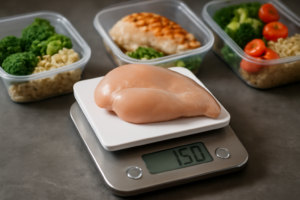
- Chicken breast: About 8% leucine by weight (so 40g chicken = ~3.2g leucine)
- Most plant proteins: About 6-7% leucine by weight (so you need ~45-50g to hit the 3g threshold)
This is why the “30g ceiling” seemed to work for decades: most people eating 30g of animal protein were hitting the leucine threshold. But it was never about the 30 grams themselves. It was about hitting that 2.5-3g leucine target.
And yes, you can absolutely exceed that threshold in a single meal. You can hit it multiple times over. The body doesn’t say “okay, leucine threshold achieved, shutting down muscle protein synthesis for the next 6 hours.” It doesn’t work that way.
How Much Protein Do You Actually Need Daily?
The 30g myth dying doesn’t mean you should suddenly eat 300g of protein in one sitting. You’re still constrained by daily totals and meal frequency.
The gold standard for protein intake in active people comes from Morton et al.’s 2018 meta-analysis in the British Journal of Sports Medicine, which synthesized 49 studies and 1,863 participants and found gains plateaued at about 1.62 g/kg/day, with the confidence interval running up to roughly 2.2 g/kg/day:
1.6 to 2.2 grams of protein per kilogram of body weight daily is optimal for muscle growth and strength development.
Let me break this down practically:
- 150-pound person (68kg): 109-150g protein daily
- 180-pound person (82kg): 131-180g protein daily
- 200-pound person (91kg): 146-200g protein daily
The higher end (2.2g/kg) is for people doing intense resistance training 4+ days per week. The lower end (1.6g/kg) still works for serious lifters; it’s just slightly less optimal in the studies.
Here’s the critical part: hitting your daily total matters far more than hitting a specific amount per meal.
If you eat 50g at breakfast, 40g at lunch, 60g at dinner, and 20g in a shake—that’s 170g total. That works. Your muscles don’t care that you “only” got 40g at lunch.
If you do intermittent fasting and eat 85g at lunch and 85g at dinner? That works too. The 85g meals trigger protein synthesis. Trommelen’s data shows us that.
Plant Protein vs. Animal Protein: The Honest Truth
I want to be straight with you because the fitness industry has gotten weirdly ideological about this.
Plant-based proteins are nutritionally complete (most of them). They can absolutely help you build muscle. But they require strategic eating.
The issue is twofold:
First: Leucine content. As I mentioned, plant proteins have lower leucine density than animal proteins. You need about 20% more volume. If you’re targeting that 2.5-3g leucine threshold, you’ll need roughly 45-50g of plant protein instead of 30-35g of animal protein.
Second: Bioavailability and the amino acid profile. Plant proteins tend to have lower bioavailability (your body doesn’t absorb/utilize every amino acid as efficiently) and are sometimes limiting in certain amino acids. Legumes are low in methionine. Grains are low in lysine. Getting a full complement of essential amino acids from plant sources requires more intentionality—combining complementary proteins, or eating a wider variety.
The research from 2020 (Nieman et al.) showed that plant-based athletes need to be more deliberate about their protein intake, but they can absolutely build muscle and strength at equivalent levels when they do.
So if you’re plant-based or mostly plant-based: aim for the higher end of that 1.6-2.2g/kg range (closer to 2.2), diversify your protein sources, and make sure you’re hitting that leucine threshold per meal, which might mean 45-50g of plant protein instead of 30g of chicken.
What 150g of Protein Actually Looks Like: Three Real Days
Knowing you need 150-180g of protein is one thing. Actually eating it is another. Let me show you what this looks like in the real world across three different budget/lifestyle scenarios.
Budget Day (Cost ~$8-10)
Breakfast:
- 3 whole eggs + 2 egg whites scrambled: 24g protein
- 1 slice whole wheat toast with peanut butter: 8g protein
Lunch:
- 1 can of tuna (in water): 25g protein
- 1/2 cup white rice: 2g protein
- Mixed vegetables: 2g protein
Dinner:
- 5 oz chicken breast: 42g protein
- 1 cup white rice: 4g protein
- Broccoli: 3g protein
Snack:
- Greek yogurt (1 cup, 2%): 20g protein
Total: 130g protein (Add a protein shake for 150g)
Normal Day (Cost ~$15-18)
Breakfast:
- Oatmeal with protein powder shake: 35g protein
- Banana and almond butter: 8g protein
Mid-Morning Snack:
- Greek yogurt with granola: 20g protein
Lunch:
- Grilled chicken breast (6 oz): 48g protein
- Sweet potato: 3g protein
- Quinoa (1/2 cup): 4g protein
Pre-Workout:
- Protein shake with fruit: 25g protein
Dinner:
- Salmon (5 oz): 35g protein
- Rice pilaf: 4g protein
- Asparagus: 3g protein
Total: 185g protein
High-Income Day (Cost ~$25-30)
Breakfast:
- 4 whole eggs scrambled: 24g protein
- 2 pieces of thick-cut smoked salmon: 12g protein
- Whole grain toast: 5g protein
Mid-Morning Snack:
- Grass-fed beef jerky (2 oz): 16g protein
- Mixed nuts: 6g protein
Lunch:
- Grilled steak (7 oz sirloin): 56g protein
- Sweet potato and broccoli: 6g protein
Pre-Workout:
- Whey protein shake: 30g protein
Dinner:
- Wild-caught halibut (6 oz): 42g protein
- Quinoa: 8g protein
- Roasted vegetables: 4g protein
Evening Snack:
- Casein protein shake: 30g protein
Total: 239g protein (This is intentionally higher for someone doing serious lifting)
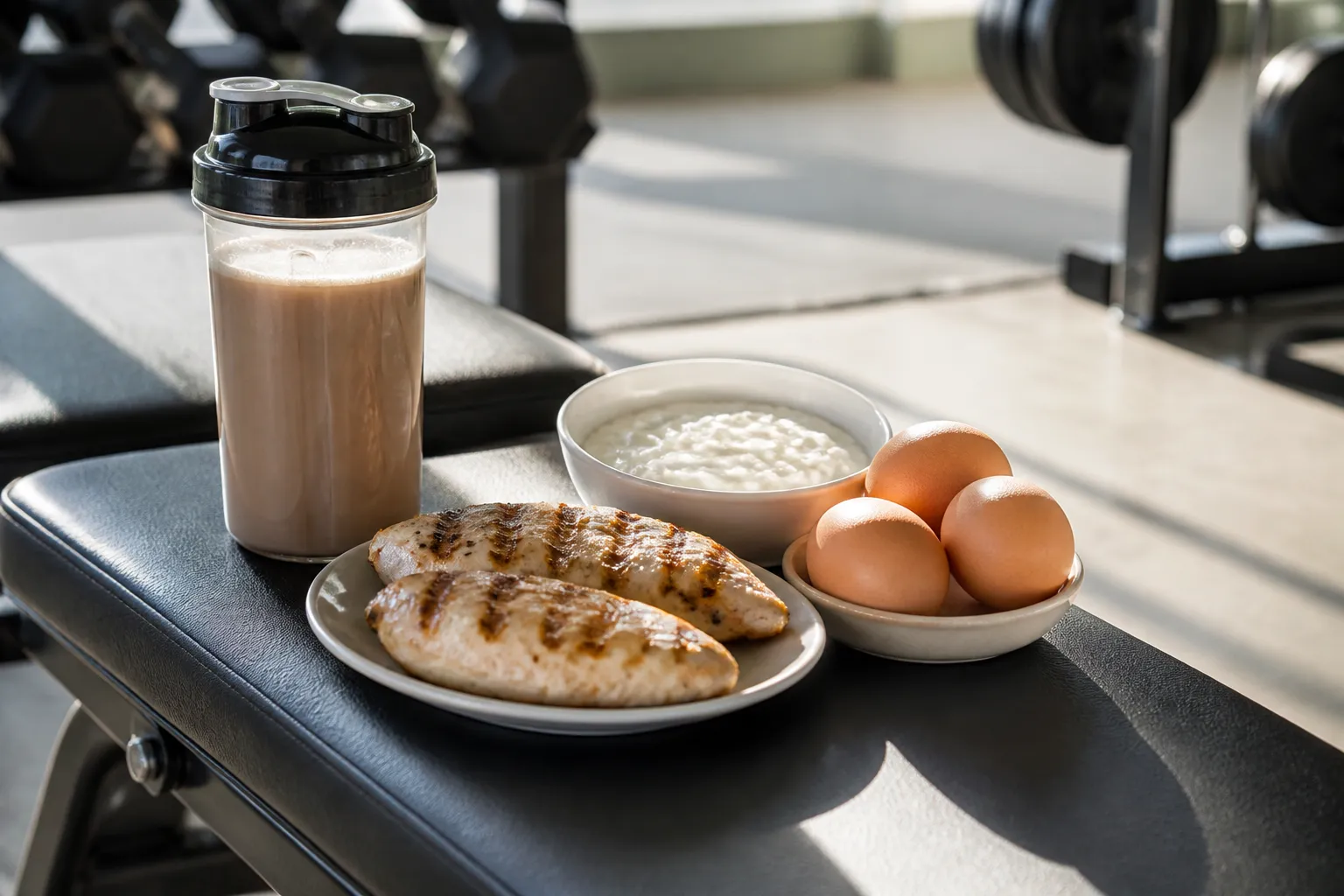
The point: hitting 150-180g doesn’t require exotic foods or ridiculous meal prep. It’s achievable across different budgets. You’re looking at 30-45g per meal across 3-4 meals, or larger meals if you’re eating fewer times per day.
Special Case: What About Intermittent Fasting?
One question I get constantly: “I do intermittent fasting with a 6-hour eating window. Can I still get enough protein?”
Absolutely. This is actually where Trommelen’s research directly applies.
If you’re eating only during an 8-hour window (say, noon to 8 PM), and you need 170g of protein, that’s an average of about 85g per eating occasion if you have two main meals. Or 57g per meal if you have three eating windows.
Both of those amounts trigger full muscle protein synthesis. Trommelen et al. in Cell Reports Medicine showed that 100 g of protein in a single meal produced a greater and longer-lasting (over 12 hours) anabolic response than 25 g. Your 85g meals? They’re completely fine.
What matters is your daily total. How you distribute it across your eating window is flexible. Some of the people I train with doing intermittent fasting actually build muscle faster than their non-fasting counterparts—because they’re more disciplined about hitting that daily protein total without the temptation of snacking.
If you’re doing 20/4 intermittent fasting (one meal per day), you’d need all 170g in one sitting. That’s heavier, and some people feel uncomfortable. But it’s not physiologically impossible. Digestively, your stomach can handle it. Metabolically, your body can process it and use it.
The Practical Takeaway
Here’s what changes for you, starting today:
Stop worrying about the 30g cap. It doesn’t exist. Eat 40g at breakfast, 80g at lunch, 60g at dinner. Your muscles don’t care.
Focus on hitting 1.6-2.2g/kg daily. This is the number that actually matters. Get your total, however you want to distribute it.
Make sure each meal hits the leucine threshold. That’s 2.5-3g, which usually means 30-35g of animal protein or 40-50g of plant protein. This ensures you’re maximizing the stimulus from each meal.
If you’re plant-based, eat a bit more and be intentional about variety. You’re not building muscle differently—you’re just absorbing amino acids slightly less efficiently, so you compensate with volume.
Your meal frequency is a tool, not a law. Three meals, four meals, two meals, one meal—the distribution doesn’t override the total. Pick what fits your life.
The 30g myth wasn’t evil—it was a useful heuristic for an era when we measured things poorly. But we’ve measured things better now. The science has evolved. And honestly? It’s more forgiving than we thought.
Your body is smarter than the fitness industry gave it credit for.
| Protein Source | Leucine Content | Amount for 2.5-3g Leucine |
|---|---|---|
| Whey protein | 10-11% by weight | 30-35g |
| Beef | 7-8% by weight | 40g |
| Chicken breast | 8% by weight | 40g |
| Most plant proteins | 6-7% by weight | 45-50g |
Frequently Asked Questions
Can your body use more than 30g protein in one meal?
Yes. The 2024 Trommelen et al. study measured subjects consuming 100 grams of whey protein in a single meal for 12 hours straight, and muscle protein synthesis continued to rise—it didn’t plateau at 30g or any other threshold. Your body doesn’t have a hard protein ceiling per meal.
How much leucine do I need per meal for muscle growth?
You need roughly 2.5 to 3 grams of leucine per meal to maximize muscle protein synthesis stimulation. This threshold can be hit with 30g of whey protein, 40g of beef or chicken, or 45-50g of most plant proteins, since plant sources have lower leucine density.
What’s the optimal daily protein intake for muscle building?
The gold standard from Morton et al.’s 2018 meta-analysis of 49 studies and 1,863 participants is 1.6 to 2.2 grams of protein per kilogram of body weight daily. The higher end applies to people doing intense resistance training 4+ days per week.
Can I build muscle on intermittent fasting with high protein meals?
Yes. Trommelen et al. showed that 100g of protein in a single meal produced greater and longer-lasting anabolic response over 12 hours. If you eat 85g across two meals in an 8-hour window, that triggers full muscle protein synthesis. Your daily total matters most.
About This Article

Written by Jordan Ellis. Jordan Ellis isn't a certified personal trainer — just someone who's been genuinely obsessed with training for over eight years and turned it into building smarter home gyms. He focuses on home fitness: effective training spaces, equipment that earns its price, and programs that work in a spare room or basement, not just a commercial gym. More about this site.
Scope and limits. Jordan is not a certified personal trainer, and nothing here is medical advice. Check with a physician before starting a new program, and prioritize form over load on every lift described.
Verify this against a primary source
Specifics change, and your situation may differ from the one described here. These are the authorities worth checking directly:
- Physical Activity Guidelines for Americans (HHS) — the federal physical activity guidelines
- American College of Sports Medicine — exercise prescription and position stands
- NSCA — strength and conditioning research