The first CrossFit class I walked into, I couldn’t do a single strict pull-up and I finished dead last in the workout — that was the most educational hour of my fitness life, because what it actually taught me wasn’t about strength or conditioning, it was about how completely wrecked my body already was from years of sitting at a desk. My hips couldn’t hinge properly, my thoracic spine was locked up solid, and my shoulders had basically forgotten what “overhead” meant — and I hadn’t even hit thirty yet. What followed that humbling hour was an obsession with undoing the damage that prolonged sitting does, and after working through it myself and with dozens of clients, I can tell you that you don’t need an hour in the gym or a complete program overhaul to start turning things around. A focused, 10-minute daily mobility routine is genuinely enough to begin reversing what your chair is doing to your body — and I’m going to show you exactly how to do it.
This post contains affiliate links. As an Amazon Associate, I earn from qualifying purchases. This means I may earn a small commission if you purchase through my links — at no extra cost to you. I only recommend gear I actually believe in.
Why Sitting Is Wrecking Your Body (And What Mobility Actually Does)
Here’s the hard truth: the human body was not designed to sit for 8 to 10 hours a day. When you’re parked in a chair, your hip flexors — the muscles that connect your hips to your spine — are in a constantly shortened position. Over time, they tighten up and start pulling on your lower back, which is a major reason so many desk workers deal with chronic lumbar pain. Meanwhile, your glutes essentially “forget” how to fire correctly (trainers call this gluteal amnesia, and yes, it’s a real thing), your thoracic spine — the middle part of your back — loses its ability to rotate, and your chest tightens while your upper back weakens.
Mobility work addresses all of this. Mobility isn’t the same as stretching, by the way. Stretching is passive — you hold a position and let the muscle lengthen. Mobility is active — you’re moving through a full range of motion while your muscles are engaged, which trains your nervous system to actually use that range. That’s what makes it so effective for counteracting sitting posture.
The 10-Minute Daily Mobility Routine for Sitting Damage
Do this sequence once a day — morning works great, but right after work is honestly ideal because you’re addressing the damage you just did. All you need is a mat and a few feet of floor space. Move slowly and with control. This isn’t a race.
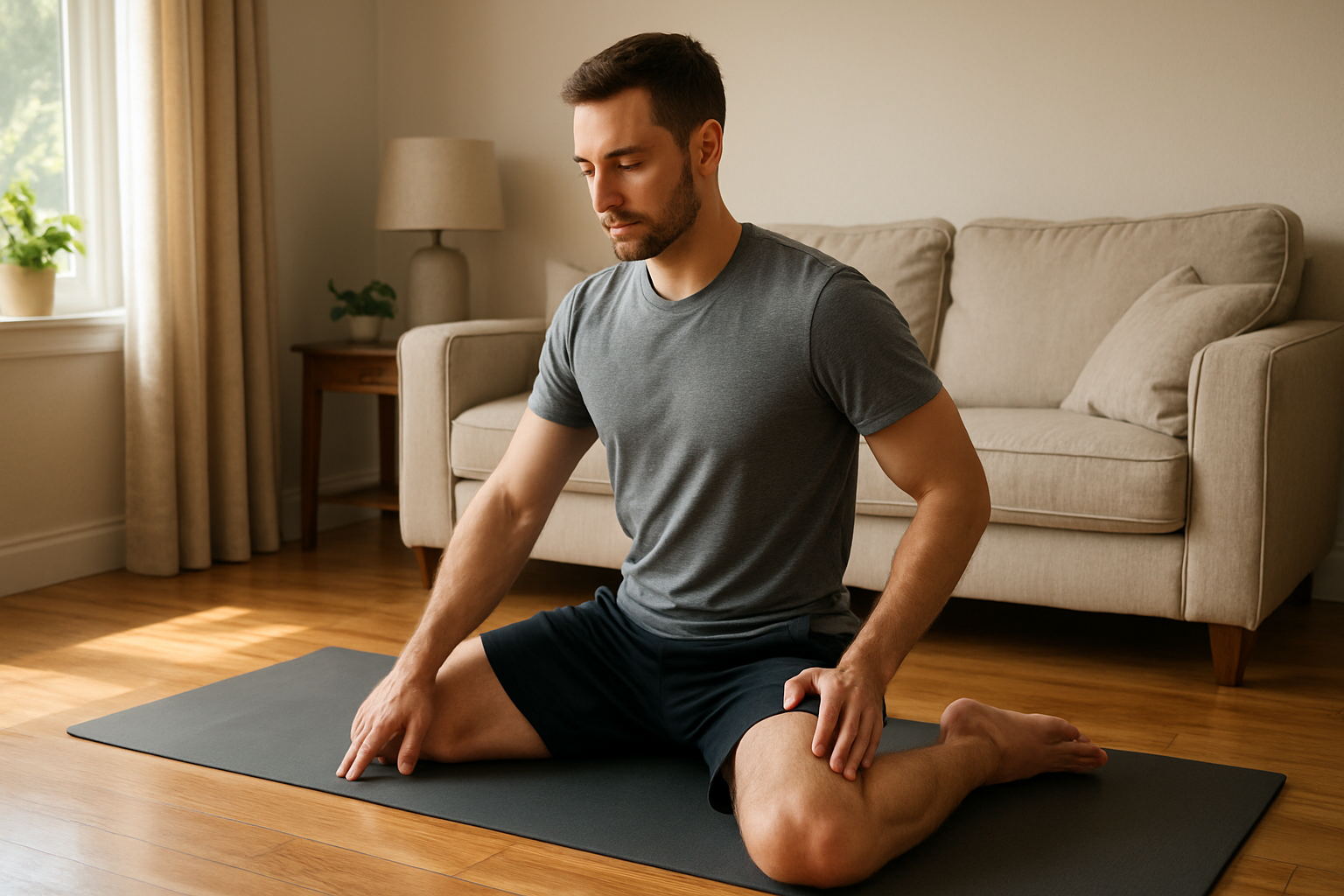
1. 90/90 Hip Stretch — 60 Seconds Per Side
Sit on the floor with both legs bent at 90-degree angles — one in front of you, one to the side. Keep your spine tall and gently hinge forward over your front leg. This is one of the best exercises on the planet for restoring hip rotation, which sitting absolutely destroys. Don’t collapse your back. Breathe into the stretch.
2. World’s Greatest Stretch — 5 Reps Per Side
Start in a lunge position with your right foot forward. Place your right hand on the ground inside your right foot, then rotate your left arm up toward the ceiling and open your chest. Return and repeat. This single movement hits your hip flexors, thoracic rotation, hamstrings, and groin all at once. It earned its name for a reason.
3. Cat-Cow — 10 Reps
Get on all fours. Inhale as you drop your belly toward the floor and lift your head (cow). Exhale as you round your spine toward the ceiling and tuck your chin (cat). Move slowly and breathe deliberately. This rehydrates your spinal discs and restores movement to a spine that’s been compressed in a chair all day.
4. Thoracic Spine Rotation — 10 Reps Per Side
Lie on your side with knees stacked at 90 degrees. Keep your hips still and rotate your top arm open toward the opposite side, letting your upper back follow. Hold briefly at end range. This directly targets the mid-back stiffness that causes that hunched-over desk posture and is crucial for shoulder and neck health.
5. Glute Bridge — 15 Reps
Lie on your back, feet flat on the floor, hip-width apart. Drive your heels into the ground and squeeze your glutes as you lift your hips toward the ceiling. Hold for two seconds at the top. This wakes up those sleeping glutes and counteracts the anterior pelvic tilt (forward tipping of the hips) that comes from chronic sitting.
6. Deep Squat Hold — 60 Seconds
Feet shoulder-width apart, toes slightly turned out. Lower into the deepest squat you can manage while keeping your heels on the floor. Hold onto a doorframe if needed. This position restores ankle mobility, opens the hips, and decompresses the lower spine. Most adults in Western cultures have completely lost this position. Get it back.
Gear I Recommend for This Routine
You don’t need much equipment, but having the right gear makes a real difference in consistency. If your setup is comfortable, you’ll actually do the work.
For Your Mat: The floor exercises in this routine are so much more comfortable with a quality mat under you. I like the Grey Blue/Black Eco Friendly Non Slip Yoga Mat (6mm) — it’s thick enough to cushion your spine during bridges and rotations without being so squishy that you lose stability. If you prefer a different color, the Matcha Green/Black version is the same quality mat with a fresh look. Both come with a carrying strap, which is a small thing that actually keeps you accountable. If you want something with a little more visual flair, the Gaiam Premium Print Sublime Sky Mat (6mm) is a fan favorite and holds up extremely well to daily use.
For Recovery and Tissue Work: After your mobility routine — or on rest days — doing some self-myofascial release (basically, using tools to massage your own soft tissue) can speed up how fast you feel results. The Foam Roller Set with Muscle Roller Stick, Massage Balls, and Stretching Strap gives you everything you need in one affordable kit — I especially like using the massage balls on the bottoms of the feet and glutes. If you want something with a bit more structure, the Krightlink 5-in-1 Foam Roller Set includes a resistance band and a carry bag, making it easy to keep everything organized and even take it with you when you travel.
How Long Before You Feel a Difference?
Most people notice a reduction in lower back tightness and hip tension within the first week. Seriously —

Written by Lucy Bamboo
Lucy Bamboo is a NASM-certified personal trainer (CPT) and corrective exercise specialist (CES) with over 12 years of experience coaching clients through injury recovery, strength building, and sustainable fitness. She holds a B.S. in Kinesiology and has worked in both clinical rehabilitation and private training settings. Lucy writes at Push Pull Ya'll to make evidence-based exercise guidance accessible to everyone — whether you're rehabbing a shoulder injury at home or building your first real training program.