
Strength plateaus are real, and they’re frustrating — but they’re not permanent. During an intense period of manual labor combined with early-morning training sessions, I learned that your body won’t keep changing unless you keep changing what you’re asking it to do. Around the six-week mark, I stopped seeing progress on any lift, no matter how hard I pushed. What took years to fully grasp is that muscle and strength development aren’t random outcomes — they’re direct results of applying one core, unavoidable principle. If you’ve been consistent in the gym for an extended period yet the barbell hasn’t budged in months, the problem typically comes down to one thing: you’re no longer introducing progressive overload into your training. This isn’t an advanced concept for competitive lifters — it’s the single most critical factor underlying every strength improvement you’ve ever made, and I’ll walk you through exactly how to use it.
What Is Progressive Overload and Why Does It Drive Every Strength Gain?
At its core, progressive overload means increasing the stress placed on your muscles in measurable increments over time. Your muscles are intelligent and efficient — they do only what’s required. Once your body adapts to a particular challenge, adaptation stops. Without a rising demand, there’s no reason for growth or strength gains to continue. Moving forward requires constantly upping that challenge — sometimes quite literally adding pounds to the bar.
This principle has solid historical backing. In the 1940s, Thomas DeLorme, a physician, created progressive resistance training protocols for rehabilitating soldiers after combat injuries. He observed that steadily ramping up resistance produced superior and more reliable strength development compared to keeping resistance constant. Today’s research in exercise science has validated this finding repeatedly — if strength gains are your goal, progressive overload isn’t negotiable. It’s the actual mechanism that produces results.
Here’s what trips most people up: progressive overload doesn’t automatically mean piling more weight on the bar every single time you train. That’s one valid method, and a powerful one at that, but it’s far from your only option.
Six Practical Methods for Implementing Progressive Overload
Below are concrete, actionable techniques you can begin using immediately in your training.
1. Increase Load Incrementally
The simplest method available. If you completed 3 sets of 5 with 185 lbs last session, work toward 190 lbs this session. Steady, modest increases trump erratic, aggressive ones. This is exactly where fractional plates shine, particularly on movements where even a 5 lb bump feels premature. See the equipment breakdown further down for details.
2. Increase Repetitions Per Set
Take last week’s 3 sets of 8 reps and push for 3 sets of 9 or 10 this week, keeping the load constant. Once you’re consistently hitting the upper limit of your target rep range, that’s the signal to bump up your weight.
3. Increase Total Work Volume
Building cumulative training volume — the sum total of all weight moved — drives meaningful adaptation. Adding an extra set to your primary movements (moving from 3 to 4 sets) can yield substantial progress over weeks and months.
4. Shorten Recovery Intervals
Completing identical work within a compressed timeframe boosts training density, creating overload through a different mechanism. Progressively cutting rest periods from 3 minutes down to 2 creates genuine physiological demand.
5. Expand Your Movement Depth
Descending lower into a squat or achieving a deeper stretch on a Romanian deadlift amplifies muscular challenge independent of load changes. Extended range of motion triggers more muscle fibers to activate — that’s legitimate overload.
6. Extend Time Under Tension
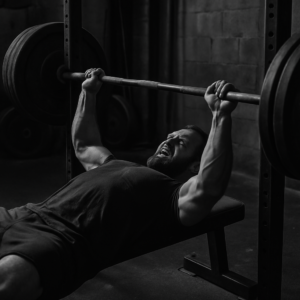
The lowering portion of any lift (for example, descending with the barbell during a bench press) is called the eccentric phase. Drawing this out deliberately (referred to as “tempo training”) magnifies time under tension, delivering a serious overload effect without requiring additional load.
Home Gym Equipment for Effective Progressive Overload
Training from your garage or home space becomes significantly more manageable when you have tools designed specifically for progression. Here’s what I recommend for your setup.
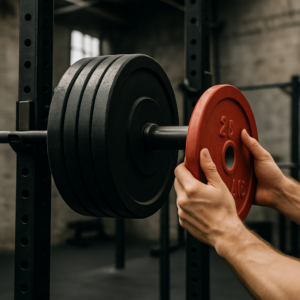
Fractional Plates: Breaking Through When Standard Weight Jumps Don’t Fit
That stall I experienced during the warehouse summer? Some of it stemmed from excessive volume, but another piece was hitting a ceiling with standard plate increments. Once your lifts become advanced enough, a straight 5 or 10 lb increase can overwhelm your central nervous system, even though your muscles have adapted. Fractional plates fill exactly that gap.
The advantages
- Smaller jumps (1.25 lb per plate) allow you to add 2.5 or 5 lbs per session rather than the full 10 — your muscles build without overloading your nervous system.
- You track incremental wins on stalled movements; I added a 2.5 lb plate once and hit three extra reps the following week—small additions create major long-term changes.
- They’re compact enough for quick loading and won’t slip or create noise on a standard Olympic bar, keeping your focus entirely on the lift.
The limitations
- They consume additional space on your barbell, making the loading process more complicated if you’re working with a tight setup or shorter barbells.
- Cost runs $30–40 per pair, positioning them as a specialized investment — not a replacement for your primary weight plates, just an addition for breakthrough moments.
I was skeptical the first time I loaded 2.5 lbs and felt like I was cheating the progressive overload principle—then I hit a rep PR on my third week. Pick up the EVERYMATE Fractional Weight Plates Set of 8 and stop treating plateaus like dead ends.
Frequently Asked Questions
What is progressive overload in strength training?
Progressive overload means increasing the stress placed on your muscles in measurable increments over time. Your muscles adapt to challenges, so without rising demand, growth stops. It’s the mechanism that produces strength gains and isn’t limited to adding weight—you can increase reps, sets, volume, training density, range of motion, or time under tension.
Can I add weight every single workout session?
Adding weight every session isn’t necessary or always optimal. Steady, modest increases trump erratic, aggressive ones. Fractional plates let you add 2.5 or 5 lbs per session rather than full 10 lb jumps, which prevents overwhelming your nervous system while your muscles adapt.
How do I know when to increase my lifting weight?
Once you’re consistently hitting the upper limit of your target rep range—for example, hitting 3 sets of 10 when your goal was 3 sets of 8—that’s the signal to bump up your weight. You can also add volume by moving from 3 to 4 sets on primary movements.
Does progressive overload only mean adding more weight?
No. Progressive overload has six practical methods: increasing load, increasing reps per set, building total work volume, shortening rest periods from 3 minutes to 2, expanding movement depth, and extending time under tension through tempo training. Weight is one powerful option among many.
About This Article

Written by Jordan Ellis. Jordan Ellis isn't a certified personal trainer — just someone who's been genuinely obsessed with training for over eight years and turned it into building smarter home gyms. He focuses on home fitness: effective training spaces, equipment that earns its price, and programs that work in a spare room or basement, not just a commercial gym. More about this site.
Scope and limits. Jordan is not a certified personal trainer, and nothing here is medical advice. Check with a physician before starting a new program, and prioritize form over load on every lift described.
Verify this against a primary source
Specifics change, and your situation may differ from the one described here. These are the authorities worth checking directly:
- Physical Activity Guidelines for Americans (HHS) — the federal physical activity guidelines
- American College of Sports Medicine — exercise prescription and position stands
- NSCA — strength and conditioning research