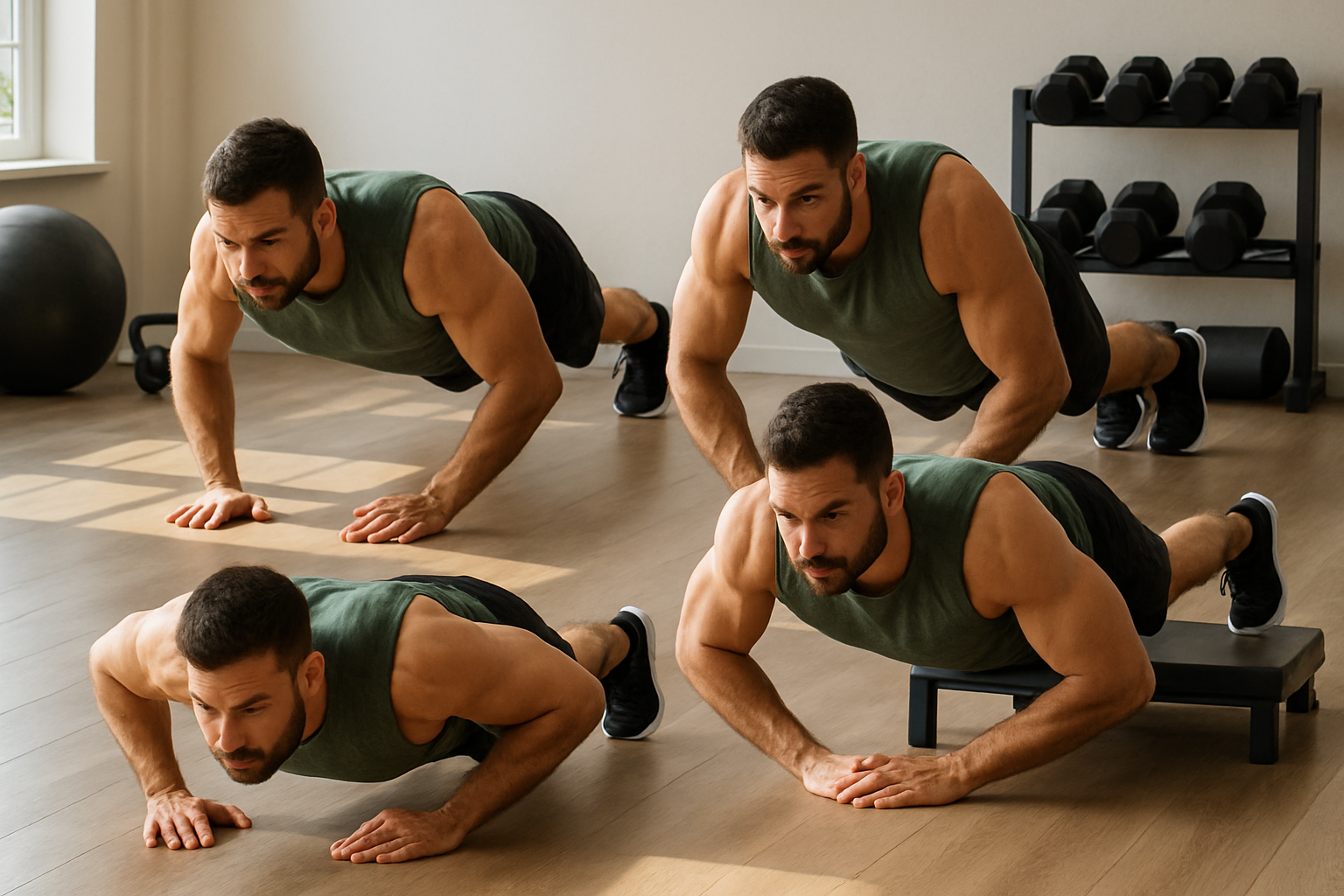
For about three years in my early twenties, pickup basketball on Sunday afternoons was my main form of exercise — and trying to keep up with guys ten years younger forced me to actually learn how training works. I quickly realized that doing the same thing over and over wasn’t building anything; it was just maintaining, and barely at that. The same principle hit me later when I caught myself grinding through the same flat push-up week after week, wondering why my chest had completely stopped responding. That frustration is exactly what pushed me to build out a push-up variations difficulty ranking — a simple progression system that takes you from beginner to advanced, builds real chest and tricep strength at home, and gives you a clear path forward so you’re never just going through the motions again.
This post contains affiliate links. As an Amazon Associate, I earn from qualifying purchases. This helps keep the content on WorkoutAnswers.com free — and I only recommend gear I’d actually use myself.
Why Push-Up Variations Actually Matter for Chest and Tricep Development
Before we get into the rankings, let’s talk about why variation isn’t just about keeping things interesting. Your chest is made up of two main muscle groups — the pectoralis major (the big fan-shaped muscle) and the pectoralis minor underneath it. Your triceps, located on the back of your upper arm, are heavily recruited any time you press or extend your arms. The angle of your body, your hand placement, and the range of motion you use all change which part of these muscles gets hammered the hardest. That’s the science behind why doing the same push-up every day eventually stops working. You’re only hitting part of the muscle through one movement pattern. Variety forces your muscles to adapt — and adaptation means growth and strength.
Push-Up Variations Difficulty Ranking: From Easiest to Hardest
Here’s my complete ranking, organized from beginner-friendly to seriously advanced. Use this as your personal roadmap. Don’t skip ahead — mastering each level sets you up for injury-free progress on the next one.
Level 1 — Beginner: Build the Foundation
- Wall Push-Up: Standing and pressing against a wall, this is the gentlest entry point. Perfect if standard push-ups feel impossible right now. No shame — start here and build up.
- Incline Push-Up: Hands elevated on a bench, chair, or step. The higher your hands, the easier it is. This is the best move to bridge the gap between wall push-ups and the floor.
- Knee Push-Up: On your knees instead of your toes. This reduces the load significantly and helps beginners practice proper chest-to-floor depth before going full plank position.
Level 2 — Intermediate: The Core Classics
- Standard Push-Up: The gold standard. Full plank, hands shoulder-width apart, chest touches the floor. If you can’t get your chest all the way down, work on it — partial reps cheat you out of the full muscle stretch that triggers growth.
- Wide-Grip Push-Up: Hands wider than shoulder-width shifts more emphasis to the outer chest. Great for building width.
- Close-Grip (Diamond) Push-Up: Hands close together under your chest, forming a diamond shape with your fingers. This crushes the triceps and works the inner chest hard. Expect to feel this one differently right away.
- Decline Push-Up: Feet elevated on a bench or box, hands on the floor. This shifts the emphasis to the upper chest and anterior deltoids (front shoulders). A great move that most people skip entirely.
Level 3 — Advanced: Serious Strength Work
- Archer Push-Up: You extend one arm out wide while the other arm does the pressing work. This is essentially a one-arm push-up with training wheels — and it’s genuinely difficult.
- Pike Push-Up: Hips high in the air in a V-shape, pressing your head toward the floor. This targets the shoulders heavily and serves as a progression toward handstand push-ups.
- Explosive/Clap Push-Up: You push hard enough to get your hands off the floor. This builds power (the ability to generate force quickly), not just strength — important for athletes.
- One-Arm Push-Up: The benchmark of push-up mastery. Requires tremendous core stability, shoulder strength, and overall body tension. Work toward this one — it’s worth it.
Level 4 — Elite: Gymnastic Territory
- Pseudo Planche Push-Up: Hands rotated outward, positioned near your hips, leaning forward so your shoulders go past your hands. The chest and anterior deltoids scream on this one.
- Handstand Push-Up: Feet up on the wall, pressing your full bodyweight overhead. This is an upper body exercise in a completely different league — almost entirely shoulders and triceps under maximum load.
Gear I Recommend to Get More Out of Every Push-Up
Your wrists take a beating doing push-ups on flat palms, especially as volume and difficulty increase. Push-up bars fix this by letting you grip a handle in a neutral position, which reduces wrist strain and actually increases your range of motion — meaning more chest stretch at the bottom of each rep. Here are the options I’d point you toward depending on your goals and budget.
If you want versatility and smooth rotation during your reps, the READAEER 360° Rotatable Push Up Bars are a standout pick. The bearing-assisted rotating handles allow your wrists and arms to move naturally through the press — which is better for your joints and engages more muscle through a wider range of motion. The non-slip rubber pads keep them locked to the floor even during explosive reps.
The Perfect Fitness Perfect Pushup Rotating Handles are a classic for a reason. These have been around for years and the rotating mechanism genuinely helps engage more of the chest and shoulder muscles through a more natural arm path. They’re compact, durable, and easy to toss in a bag.
For a stable, budget-friendly option with excellent grip, check out the JLoibao Push Up Bars. The wide 7.48-inch base gives you a rock-solid platform even on tile or hardwood floors, and the ergonomic grips make high-rep sets feel comfortable on your hands.

Written by Lucy Bamboo
Lucy Bamboo is a NASM-certified personal trainer (CPT) and corrective exercise specialist (CES) with over 12 years of experience coaching clients through injury recovery, strength building, and sustainable fitness. She holds a B.S. in Kinesiology and has worked in both clinical rehabilitation and private training settings. Lucy writes at Push Pull Ya'll to make evidence-based exercise guidance accessible to everyone — whether you're rehabbing a shoulder injury at home or building your first real training program.