This post contains affiliate links. As an Amazon Associate, I earn from qualifying purchases at no extra cost to you.
I’ve been coaching clients for over 15 years. In that time, I’ve heard every excuse for stalled progress imaginable. But one pattern kept showing up again and again: people were wildly off on their protein intake. Kitchen scale protein tracking fixed that problem faster than any macro app, meal plan, or motivational speech I ever gave. The results were honestly embarrassing — for me and my clients both.
My client Marcus is a good example. He was a 34-year-old guy training four days a week. He ran a solid push/pull/legs split, hitting bench press, rows, and squats consistently. His lifts were decent — 185 lbs on bench, 225 on squat. But muscle gain had stalled for three straight months. He swore he was hitting 180 grams of protein daily.
He wasn’t. Not even close. When we actually weighed his food for one week, he was averaging 112 grams. That 68-gram daily gap explained everything. So I decided to run a 30-day experiment myself — tracking every gram of protein I ate using a kitchen scale. What I found changed how I coach nutrition permanently.
Why I Chose the Etekcity Food Kitchen Scale
I didn’t just grab the first option on Amazon. I spent about a week researching before committing. Several coaches in my gym network had mentioned the Etekcity Food Kitchen Scale, Digital Grams and Ounces for Weight Loss, Baking, Cooking, Keto and Meal Prep, LCD Display, Medium, 304 Stainless Steel specifically. That wasn’t random. They cited its accuracy at low weights as the deciding factor.
For protein tracking, accuracy at small measurements matters enormously. Weighing 30 grams of Greek yogurt or 25 grams of whey powder requires precision. Cheaper scales can drift by 3–5 grams at those small readings. That adds up to real tracking errors over a full day.
I also looked at a few other options. The Amazon Basics Digital Kitchen Scale crossed my radar early. Honestly, it’s a reasonable scale. However, the stainless steel platform on the Etekcity felt more durable for daily heavy use. The price difference was minimal, so I went with the better-built option. No regrets there.
First Impressions Out of the Box
The Etekcity Food Kitchen Scale arrived well-packaged. Setup took under two minutes — batteries were included, which I appreciated. No hunting through kitchen drawers at 6 AM before a training session.
Build quality impressed me immediately. The 304 stainless steel platform feels solid. It doesn’t flex or rattle when you press on it. The surface wipes clean in seconds, which matters when you’re handling raw chicken at 5:30 AM every day. That LCD display is bright and easy to read. No squinting required under kitchen lighting.
The unit switching button cycles cleanly between grams, ounces, pounds, and milliliters. In my experience, cheaper scales have mushy buttons that feel unreliable over time. These buttons have a satisfying, firm click. The tare function resets instantly — you press it, and the display zeros out without any lag. That responsiveness matters when you’re building a meal in layers inside a single bowl.
One thing I noticed right away: the scale sits flat and stable on my countertop. No wobbling. That sounds minor, but it affects reading accuracy. A wobbly platform can throw off readings by 2–4 grams on lighter items.
My 30-Day Kitchen Scale Protein Tracking Protocol
I ran this experiment alongside my own training block. My program was a 4-day upper/lower split: upper strength days focused on bench press (working sets at 80% of 1RM), weighted pull-ups, and overhead press. Lower days included back squats, Romanian deadlifts, and Bulgarian split squats.
My body weight was 192 lbs at the start. My protein target was 190 grams daily — roughly one gram per pound of body weight. Before this experiment, I was estimating intake using visual portion judgment and app logging without measuring. I thought I was hitting my target most days.
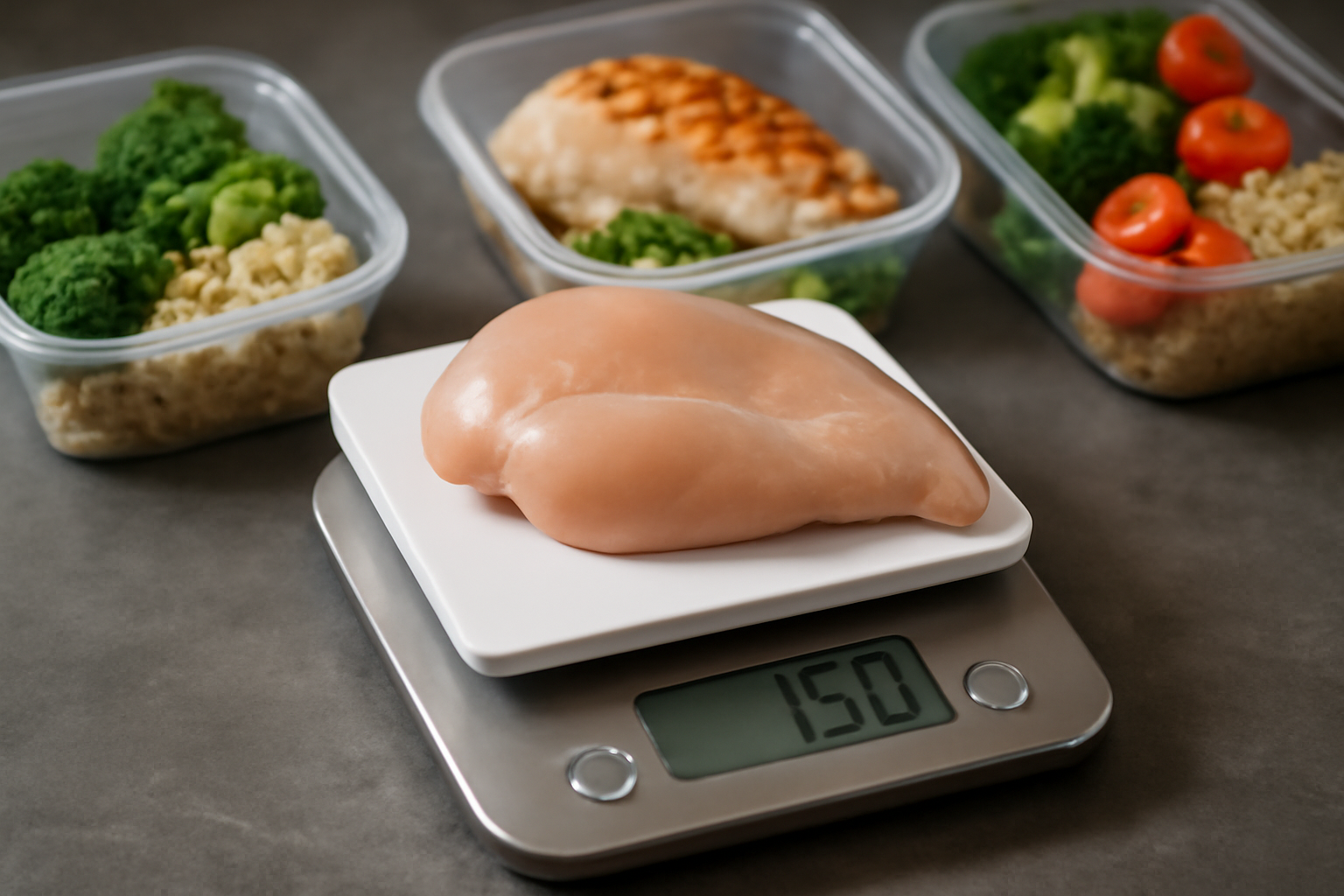
The protocol was simple: weigh every single protein source before eating it for 30 consecutive days. No eyeballing, no estimating. Every chicken breast, every scoop of whey, every egg, every cup of cottage cheese — weighed on the Etekcity Food Kitchen Scale, Digital Grams and Ounces for Weight Loss, Baking, Cooking, Keto and Meal Prep, LCD Display, Medium, 304 Stainless Steel before it hit my plate.
I logged everything in MyFitnessPal using the gram weights directly. No volume measurements, no “one medium chicken breast” guesses. Raw weights only, before cooking.
What I Tracked Daily
- Pre-workout meal: eggs, oats, Greek yogurt
- Post-workout shake: whey protein, banana, almond milk
- Lunch: chicken breast or ground turkey with rice
- Afternoon snack: cottage cheese or hard-boiled eggs
- Dinner: salmon or lean beef with vegetables
What Actually Changed After 30 Days
Week one was humbling. I discovered I was averaging only 154 grams of protein daily. That’s 36 grams short of my target — every single day. Over a week, that’s 252 grams of missing protein. Over a month, it’s over 1,000 grams. No wonder my strength progress felt sluggish during my last training block.
The biggest eye-opener was chicken breast. I was consistently underestimating portion size by 30–40 grams raw weight. That translates to roughly 7–9 grams of missed protein per meal. Multiply that across two meals daily, and the deficit compounds fast.
By week two, I had adjusted my portions and was consistently hitting 185–195 grams daily. The change in training performance was noticeable by week three. My bench press working sets felt more recoverable. I was hitting 5×5 at 195 lbs without the fatigue bleed-over I’d been experiencing into my next upper day. Pull-up volume increased — I went from 4 sets of 8 to 4 sets of 10 with bodyweight.
Recovery between sessions felt different too. Soreness after heavy squat days dropped noticeably. I’m not claiming the scale caused that directly — adequate protein supports muscle protein synthesis, and I was finally hitting adequate protein consistently. That’s the mechanism.
By the Numbers at Day 30
- Starting average protein intake (estimated): ~154g/day
- Ending average protein intake (measured): ~191g/day
- Bench press working weight: +10 lbs over the 30-day block
- Pull-up reps per set: increased from 8 to 10
- Body weight: 192 lbs to 194 lbs (lean mass, not fat gain)
The Downsides You Should Know About
I want to be straight with you here. The Etekcity Food Kitchen Scale, Digital Grams and Ounces for Weight Loss, Baking, Cooking, Keto and Meal Prep, LCD Display, Medium, 304 Stainless Steel is not perfect. There are real limitations worth knowing before you buy.
The platform size is medium. It handles a dinner plate fine. However, if you cook in large mixing bowls or try to weigh a full pot of ingredients, you may find the surface slightly cramped. This never bothered me during my 30-day experiment, but it’s worth noting for people who do batch cooking in large volumes.
The auto-shutoff feature activates after about 2 minutes of inactivity. That sounds fine in theory. In practice, if you’re building a layered meal and step away to grab something from the fridge, you’ll come back to a blank display. You’ll need to re-tare and re-zero. It happened to me several times in the first week. After that, I just learned to move faster in the kitchen.
There’s also no backlight option for the LCD beyond its standard brightness. In a dim kitchen early in the morning, the display is still readable. That said, it’s not the brightest screen I’ve used. This is a minor complaint — not a dealbreaker by any stretch.
Who This Scale Is NOT For
Skip this if you cook exclusively in enormous batches and need a large commercial-style platform. Skip it if you want a scale with Bluetooth app integration — this doesn’t have that. On the other hand, if you don’t want another app to deal with, that’s actually a feature, not a flaw.
Final Verdict: Is Kitchen Scale Protein Tracking Worth It?
Absolutely yes — and the Etekcity is the tool I’d recommend to start. Kitchen scale protein tracking revealed a 36-gram daily deficit I had no idea existed. Closing that gap produced measurable strength gains within three weeks. That’s not coincidence. That’s the direct result of finally fueling my training correctly.
This scale earns its spot on my counter permanently. The stainless steel build holds up to daily abuse. Accuracy at small gram measurements is reliable. The tare function is fast and responsive. For the price point, nothing I tested came close in durability and precision combined.
Buy this if: You’re serious about hitting a protein target for muscle gain, fat loss, or body recomposition. You train consistently but your results don’t match your effort. You want a no-fuss, durable kitchen tool that does exactly one thing perfectly.
Skip this if: You want Bluetooth connectivity and automatic app syncing. You need a jumbo platform for large batch cooking. You’re not ready to commit to weighing food consistently — because an unused scale helps no one.
For most people reading this, the Etekcity is the right call. Grab it, use it for two weeks, and I guarantee you’ll be surprised by what you find.
Runner-Up Option Worth Considering
If the Etekcity is unavailable or you want a backup option, the Amazon Basics Digital Kitchen Scale with LCD Display, Tare Function, Multiple Units, Weighs up to 11 Pounds, Batteries Included, Black and Stainless Steel is a solid choice. It handles the core job well — weighing food accurately with a tare function and multi-unit display. The build feels slightly less premium than the Etekcity, and the platform has a bit less surface area. However, for someone on a tighter budget just getting started with food weighing, it gets the job done without complaint.