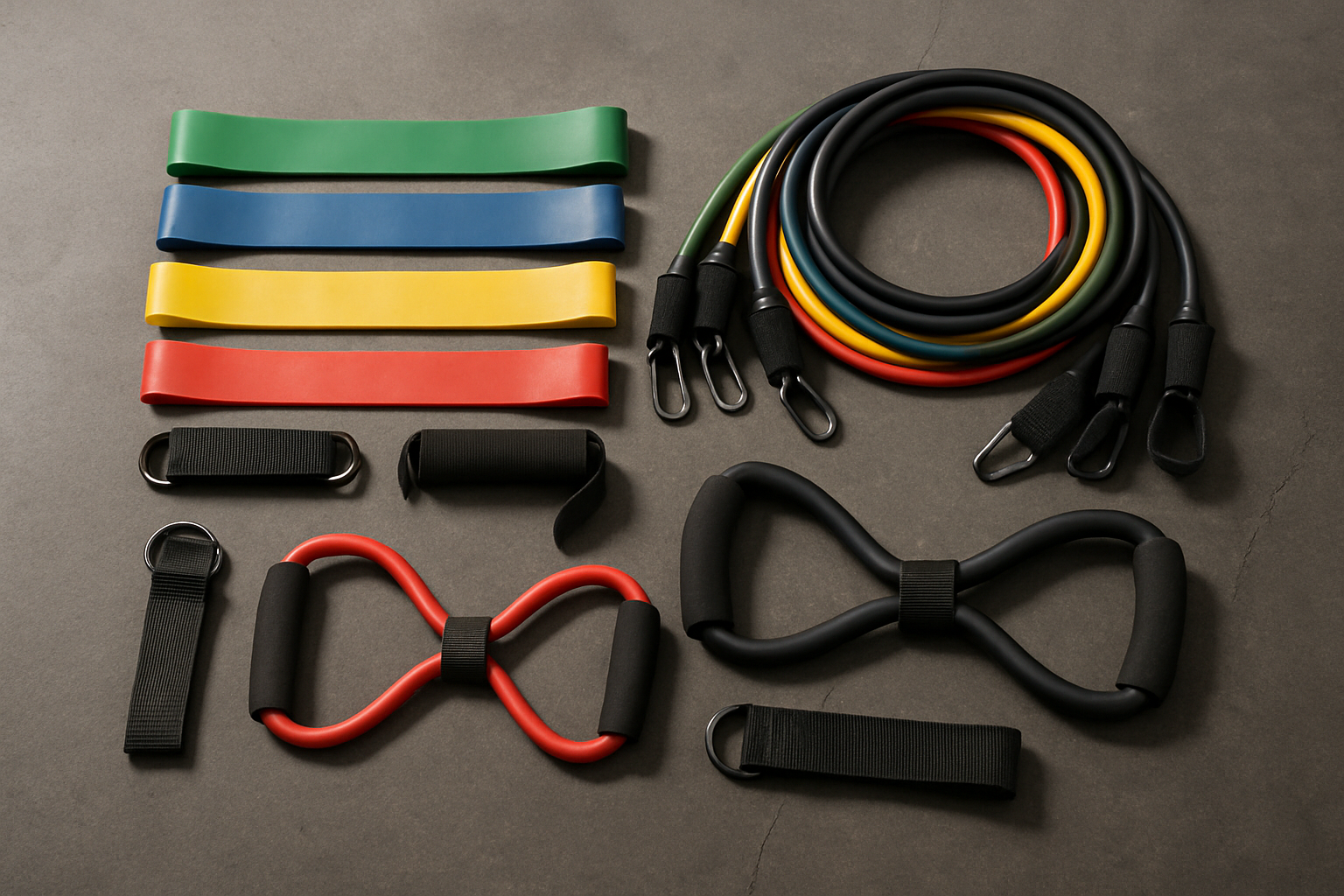
The summer before my sophomore year of college, I worked a warehouse job and trained every morning before my shift — and that combination taught me more about recovery than any article I ever read. My joints were constantly beat up, my budget was nearly zero, and a cheap set of resistance bands I’d bought online ended up being the only thing keeping my training going. Back then I had no idea what I was doing with them, and honestly, if someone had handed me a complete guide to resistance bands — types, tensions, and the best exercises — I would have saved myself weeks of frustration and a few embarrassing snapped-band moments. Whether you’re training at home, rehabbing an injury, or just looking to add variety to your sessions, this guide will take you from staring at a tangled mess of colorful bands to actually knowing how to use them.
This post contains affiliate links. As an Amazon Associate, I earn from qualifying purchases. This means I may earn a small commission if you purchase through my links — at no extra cost to you. I only recommend products I’d genuinely use or suggest to my own clients.
The Resistance Bands Guide to Types and Tensions You Actually Need
Not all resistance bands are created equal — and that’s not marketing fluff, it’s the truth. Using the wrong type for the wrong exercise is one of the most common mistakes I see, and it can limit your results or even lead to injury. Let me break down the main types so you know exactly what you’re working with.
Tube Bands with Handles
These are the bands most people picture when they hear “resistance bands.” They’re cylindrical, usually made of rubber or latex, and come with plastic or foam handles at each end. They’re fantastic for upper body work — think bicep curls, chest presses, shoulder raises, and rows. Most sets come in multiple resistance levels, typically ranging from about 10 lbs all the way up to 50+ lbs per band, and many let you stack them together for even more challenge. Door anchors (usually included) let you mimic cable machine exercises without the cable machine.
Loop Bands (Flat Loop Resistance Bands)
These are thick, flat continuous loops made from layered latex. You’ve seen powerlifters use them to add accommodating resistance to barbell squats and deadlifts, but they’re equally useful for assisted pull-ups, glute work, and mobility training. They come in color-coded tensions — light bands are great for stretching and mobility, while heavier ones (like the green or black bands) provide serious resistance for big compound movements.
Mini Bands (Hip Circles)
These are smaller, thinner loops that sit around your thighs or ankles. They’re the go-to for glute activation, lateral walks, clamshells, and hip abduction work. Physical therapists love them. So do athletes doing warm-up protocols. If your glutes aren’t firing during squats, a mini band can fix that fast.
Figure-8 and Therapy Bands
Figure-8 bands have a crossover design that keeps your wrists or ankles locked in during exercises. Therapy or flat bands (like TheraBand-style) are used heavily in physical therapy and rehab settings. They’re super light and great for joint stabilization and recovery work.
Understanding Resistance Band Tensions
This is where most people get tripped up, so let me keep it simple. Resistance bands work on progressive tension — meaning the more you stretch the band, the harder it pulls back. That’s actually a major advantage over free weights, because you get maximum resistance at the point where your muscles are strongest (the end range of motion). This is called accommodating resistance, and it’s one reason serious strength coaches use bands alongside barbells.
When buying bands, look for sets that clearly label resistance levels. Most tube band sets use color coding like this:
- Yellow/Light: 10–15 lbs — great for beginners, rehab, and shoulder exercises
- Red/Medium: 20–30 lbs — good for most upper body pushing and pulling movements
- Green/Heavy: 30–40 lbs — ideal for rows, chest presses, and assisted pull-ups
- Blue/Extra Heavy: 40–60 lbs — lower body work, stacking with other bands
- Black/Max: 50–80+ lbs — advanced full-body training, powerlifting augmentation
For loop bands used in powerlifting or pull-up assistance, tension ratings can go well above 100 lbs. Always start lighter than you think you need — bands have a way of humbling you when your form breaks down under tension.
Best Resistance Band Exercises (By Muscle Group)
Upper Body
- Bicep Curl: Stand on the band, handles in hand, curl up to shoulder height. Keep elbows pinned to your sides.
- Chest Press: Anchor the band behind you at chest height, press forward like a bench press standing up.
- Lat Pulldown: Anchor overhead, pull down to your chest with a slight lean back. Best for back width.
- Seated Row: Loop the band around a post or foot, pull toward your belly button, squeeze shoulder blades together.
Lower Body
- Banded Squat: Stand on the band, loop handles over shoulders, squat down. Keeps you honest about depth.
- Glute Kickback: Anchor the band low, loop around ankle, kick back and squeeze your glute at the top.
- Lateral Band Walk: Mini band around thighs, slightly bent knees, step side-to-side. Brutal on the hips in the best way.
- Romanian Deadlift: Stand on the band, hinge at the hips, feel the hamstring stretch — control the way down.
Core
- Pallof Press: Anchor the band at chest height to your side, press straight out and hold. Outstanding for anti-rotation core strength.
- Woodchop: Anchor high, pull diagonally across your body toward the opposite hip. Great for obliques.
Gear I Recommend
Here are the bands I’d actually hand to a client or put in my own gym bag. All are solid options depending on your training goals and budget.