This post contains affiliate links. As an Amazon Associate, I earn from qualifying purchases at no extra cost to you.
Here’s the truth most people ignore when they walk into the gym and head straight for the dumbbell rack: your triceps make up roughly two-thirds of your upper arm mass. Your biceps account for the other third. Yet I watch people hammer curl after curl while barely touching a tricep exercise. If you want bigger, more defined arms, you need to flip that script and train both muscle groups with intention. This arm workout guide gives you exactly that — a science-backed, structured approach to building the arms you’re actually after.
The Best Bicep Exercises
The biceps brachii has two heads — the long head and the short head — and they respond differently depending on the angle and grip you use. The long head sits on the outer side of your arm and contributes most to that peak you see when you flex. It’s best targeted with a supinated grip and your elbow slightly behind your torso, like in an incline curl. The short head runs along the inner arm and responds better when your elbows are in front of your body, like on a preacher bench. If you’re only doing one type of curl, you’re leaving half your bicep development on the table. These are the four bicep exercises I program for most of my clients.
Barbell Curls
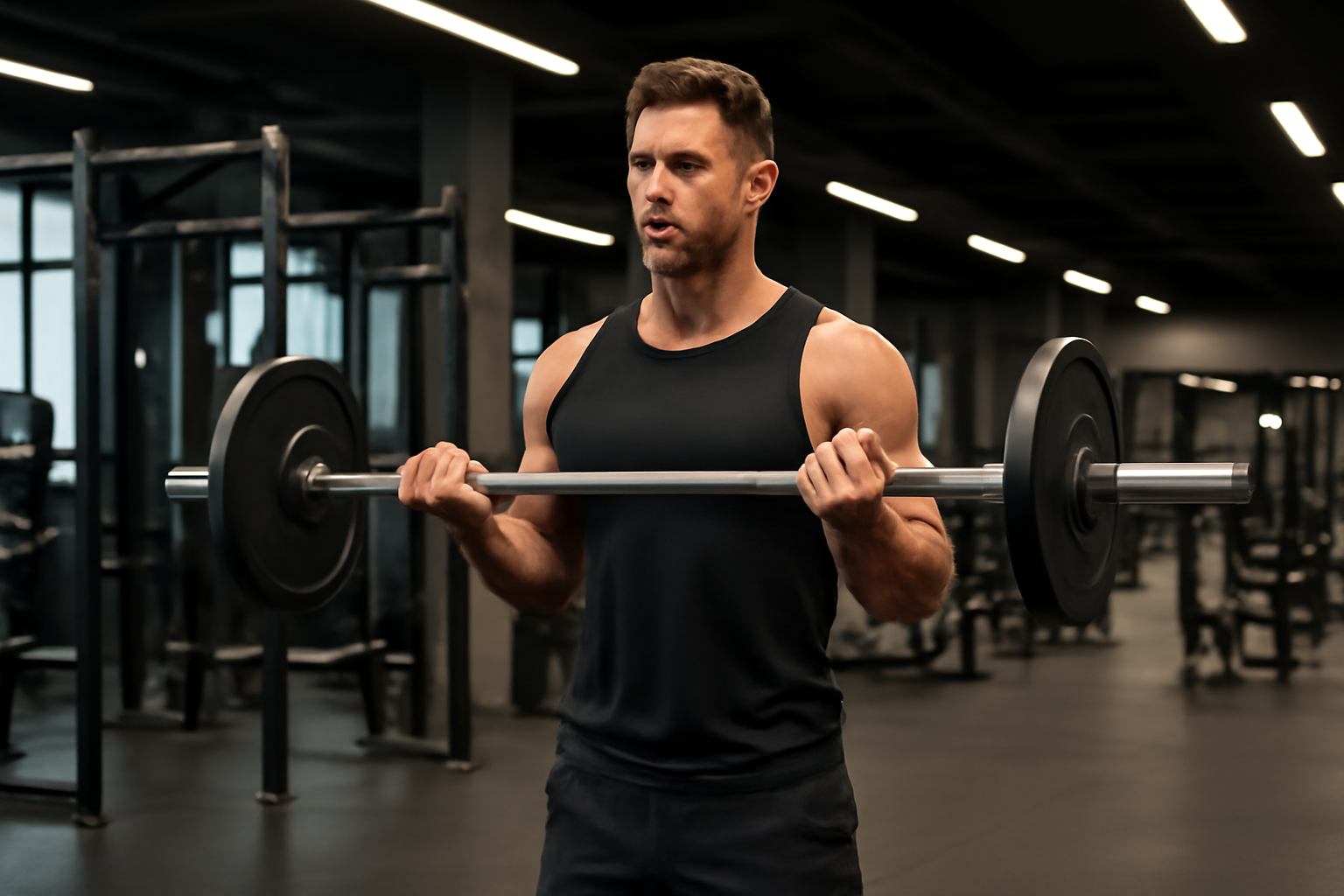
The barbell curl is the king of mass-building bicep exercises. The fixed bar path lets you overload with more weight than dumbbells, and the bilateral movement drives serious strength adaptations. The catch is that a straight bar puts your wrists in a compromised position for many lifters, which is exactly why I recommend an EZ curl bar for most people. The angled grip reduces ulnar deviation and wrist strain without sacrificing tension on the biceps.
For loaded barbell curls, I keep this Olympic EZ Curl Barbell Bar 47″ in my home gym and it’s held up to serious use. The chrome finish is durable, it fits standard 2-inch Olympic plates, and the 500 lb weight capacity means you’ll never outgrow it. The included spring collars are a small but genuinely useful detail — plates don’t shift mid-set. Most of my clients who train at home use this bar as their primary bicep and arm training tool, and it doubles perfectly for hip thrusts and squats too.
Incline Dumbbell Curls
Set your bench to a 45–60 degree incline, let your arms hang freely behind your torso, and curl. This position puts the long head of the bicep in a stretched position at the bottom of the movement, which research shows increases muscle damage and hypertrophy stimulus. It’s one of the most underrated bicep exercises in existence. Control the eccentric, don’t swing, and feel the stretch at the bottom of every rep.
Hammer Curls
Hammer curls use a neutral grip, which shifts emphasis to the brachialis — a muscle that sits underneath the bicep and literally pushes it up when developed. A thick brachialis makes your arms look fuller from every angle. Hammer curls also hit the brachioradialis hard, contributing to forearm development. Keep your elbows pinned to your sides and avoid the temptation to use momentum.
Preacher Curls
Preacher curls isolate the short head of the bicep by placing your elbows on a pad in front of your body. This position eliminates cheating and maximizes tension through the full range of motion. Go lighter than you think you need to here — this is a precision movement, not a strength test. The EZ curl bar version is particularly effective because it reduces forearm fatigue and keeps the tension where it belongs.
If you want a second EZ bar option with a different aesthetic and finish, the TEEMOO Olympic EZ Curl Barbell Bar is worth a look. It features a matte black E-coat finish that resists rust and looks sharp in any home gym setup. Same 47-inch length, same 2-inch Olympic sleeve compatibility, same 500 lb capacity — but the black finish holds up especially well over time compared to chrome in humid environments. I’ve recommended this one specifically to clients who train in garages where moisture is a concern.
The Best Tricep Exercises
If bigger arms are your goal, your tricep exercises need to be the centerpiece of your arm workout — not an afterthought. The triceps have three heads: the lateral head, the medial head, and the long head. The long head is the largest and most impactful for overall arm size, and it only gets fully recruited during overhead movements where the arm is raised above the head. Most people do pushdowns exclusively and wonder why their arms aren’t growing. Here’s what to do instead.
Close-Grip Bench Press
The close-grip bench press is the best compound tricep exercise you can do. It allows you to move serious weight, drives upper body strength, and hits all three heads of the tricep with the lateral and medial heads working hardest. Use a grip about shoulder-width apart — going narrower than that increases wrist stress without adding benefit. This movement belongs at the start of your tricep training when you’re freshest and strongest.
Overhead Tricep Extensions
This is the single most important tricep exercise for arm size, and most people skip it entirely. Because your arm is raised overhead, the long head of the tricep is stretched and fully loaded — the only position where it can be maximally recruited. Research consistently shows that training muscles in a lengthened position drives greater hypertrophy. Do overhead extensions with a rope attachment, EZ bar, dumbbell, or cable — the modality matters less than the mechanics.
Cable Pushdowns
Cable pushdowns are the workhorse of tricep training. The cable keeps constant tension throughout the entire range of motion, unlike free weights where tension drops at the bottom. They’re excellent for getting a strong muscle contraction at full extension and accumulating volume safely. The key is keeping your elbows pinned at your sides and not letting your shoulders creep forward. A rope attachment lets you spread the ends apart at the bottom for a stronger contraction.
For cable pushdowns, I use this Tricep Rope 27″ Cable Attachment and it’s one of the best value pieces of gym equipment you can buy. The heavy-duty coated nylon handles the load of real working sets without fraying, and the solid rubber ends give you something to actually grip and push against. It fits any standard cable machine carabiner. This is what I keep in my gym bag — at under $20, there’s no reason not to own one.
If you want to level up your cable work, I’d also point you toward the MANUEKLEAR 3 Grip Lengths in 1 Tricep Rope Cable Attachment. What makes this one stand out is the ergonomic handles that allow three different grip positions in a single attachment, which is useful for both pushdowns and overhead extensions without switching equipment. The greater range of motion it allows is a genuine advantage — I’ve had clients switch to this from standard ropes and notice the difference in the stretch position immediately.
Dips
Bodyweight and weighted dips are brutally effective tricep exercises. Keep your torso upright, elbows close to your body, and lower until your upper arms are parallel to the floor. Leaning forward shifts the load to your chest, so stay tall if triceps are the target. Add weight via a dip belt once bodyweight becomes easy for 3 sets of 10.
The Complete Arm Workout
This is a superset-based arm workout designed for efficiency and maximum stimulus. By pairing bicep and tricep exercises together, you cut rest time without compromising performance — your biceps rest while your triceps work, and vice versa. Research on weekly training volume suggests 12–16 sets per muscle group per week is the sweet spot for hypertrophy. This routine hits that range cleanly when performed twice per week.
- Superset 1: Close-Grip Bench Press 4 x 6–8 / Barbell EZ Curl 4 x 8–10 — Rest 90 seconds between supersets
- Superset 2: Overhead Tricep Extension (rope) 3 x 10–12 / Incline Dumbbell Curl 3 x 10–12 — Rest 75 seconds between supersets
- Superset 3: Cable Pushdown (rope) 3 x 12–15 / Preacher Curl 3 x 10–12 — Rest 60 seconds between supersets
- Superset 4: Dips 3 x 10–12 / Hammer Curl 3 x 12–15 — Rest 60 seconds between supersets
Total working sets: 13 per muscle group per week at this frequency. Adjust volume based on recovery — if your arms are still sore heading into your second session of the week, reduce sets on the first workout by one per superset.
How to Make Your Arms Actually Grow
A well-designed arm workout is only as good as the principles driving it. Here’s what the evidence actually supports for arm growth — and where most people go wrong.
- Progressive overload beats exercise variety. Adding five pounds to your curl over eight weeks will do more for your arms than rotating through twelve different curl variations. Track your lifts, aim to add weight or reps every one to two weeks, and stay consistent with your exercise selection long enough to actually see progress.
- Train arms twice per week. Research on training frequency consistently shows that spreading volume across two sessions per week produces faster hypertrophy than cramming it all into one. Your muscles synthesize protein for roughly 24–48 hours post-training — two sessions doubles that stimulus.
- Full range of motion beats heavy weight. Partial reps with heavier weight are one of the most common mistakes I see. A 2019 study published in the Journal of Strength and Conditioning Research found that full ROM training produced significantly greater hypertrophy than partial ROM even at lower loads. Go lighter, go full range, feel the muscle.
- Train your forearms. Forearms are the visual bridge between your arms and your hands. Wrist curls, reverse curls, and farmer carries add size and grip strength that carries over to every other arm exercise you do. Three sets twice a week is all you need.
Arm Workout at Home With Dumbbells
No barbell or cable machine? No problem. This complete home arm workout uses only dumbbells and delivers the same training principles — progressive overload, full range of motion, balanced bicep and tricep volume. Run this as supersets exactly like the gym version above.
- Superset 1: Dumbbell Close-Grip Floor Press 3 x 8–10 / Dumbbell Curl 3 x 10–12
- Superset 2: Overhead Dumbbell Tricep Extension 3 x 10–12 / Incline Dumbbell Curl 3 x 10–12
- Superset 3: Dumbbell Kickbacks 3 x 12–15 / Hammer Curl 3 x 12–15
- Superset 4: Diamond Push-Ups 3 x max reps / Concentration Curl 3 x 12 per arm
The overhead dumbbell tricep extension is your most important movement here — it’s the home equivalent of the overhead rope extension and targets that long head directly. Hold one dumbbell with both hands, raise it overhead, and lower it slowly behind your head until your elbows are fully bent. The arm exercises in this routine cover every angle without requiring a single cable machine or barbell. Progressive overload still applies — keep a log and increase weight when you can complete the top end of each rep range with clean form.
Final Thoughts
Building bigger arms comes down to a few non-negotiables: respect the anatomy, train both the biceps and triceps with equal intention, and apply progressive overload consistently over months — not weeks. Whether you’re running the full gym arm workout or the dumbbell-only version at home, the principles are identical. Stop guessing, start tracking, and trust the process. Arms respond well to smart, consistent training — give them the stimulus they need and they will grow.